Header

Modul
Showing posts with label Archaeology. Show all posts

Wednesday, April 19, 2017


The Cleveland Museum of Art and The Ministry of Cultural Heritage and Activities and Tourism of the Republic of Italy (Ministry) today announced that they have reached an agreement for the transfer of an early 1st century AD marble portrait head of Drusus Minor (Drusus Julius Caesar, 13 BC-AD 23) to the Republic of Italy.

Cleveland Museum of Art to transfer Roman sculpture of Drusus Minor to Italy
Head of Drusus Minor (13 BC-AD 23), probably after AD 23 and likely before AD 37. Roman, 1st cent. 
Marble; overall: h. 35 cm (13 3/4 in) [Credit: The Cleveland Museum of Art]
The sculpture, previously sold at a public auction in Paris in 2004, was acquired by CMA in 2012, after extensive research to confirm its ownership history. When the museum acquired the work, it was believed that the sculpture originally came from North Africa. When, more recently, CMA became aware of the fact that the sculpture may have been illicitly removed from a site near Naples towards the end of World War II, the museum promptly contacted the Ministry. Acting in cooperation with officials of the Ministry, and with the assistance of the Carabinieri for the Protection of Cultural Heritage, CMA was able to confirm the World War II events. As a result, CMA determined to transfer the sculpture to Italy

In 2008, the Cleveland Museum of Art entered into a cultural cooperation agreement with the Ministry that formed the basis for a new relationship between CMA and the Republic of Italy. That agreement also provided a framework for the museum to approach the Ministry and obtain the information necessary to allow the museum to decide to transfer the sculpture.

“We have had an excellent relationship with the Ministry for many years,” said William Griswold, CMA director. “When we became aware of facts that were inconsistent with our understanding of the provenance of the sculpture, contacting the Ministry directly was an easy decision in light of our many years of working with our Italian colleagues. We worked collaboratively with the Ministry first to determine the circumstances of the work’s removal and then to finalize the decision to transfer the work.”

"This return is the result of an important and fruitful cultural agreement and the full cooperation of CMA with the Italian authorities,” said the Minister of Cultural Heritage and Activities and of Tourism, Dario Franceschini. “Now we await the return of the work, which, once in Italy will be returned as soon as possible to Naples and its communities, from where it was removed."

Source: The Cleveland Museum of Art [April 19, 2017]

Cleveland Museum of Art to transfer Roman sculpture of Drusus Minor to Italy

The Cleveland Museum of Art and The Ministry of Cultural Heritage and Activities and Tourism of the Republic of Italy (Ministry) today annou...

Gunmen attacked security forces near St. Catherine's Monastery in Egypt's south Sinai on Tuesday, killing at least one police officer and injuring four others, the Health Ministry said, just a week after two deadly church bombings killed 45.

ISIS targets St. Catherine's Monastery in Sinai, Egypt
The Monastery of St. Catherine, near Mount Sinai in Egypt, where a policeman was killed and four others 
were wounded on Monday [Credit Pedro Costa Gomes/AFP/Getty Images]
Islamic State claimed responsibility for the attack on a police checkpoint about 800 meters from the entrance to the monastery, one of the world's most important Christian sites.

The attack comes just 10 days before Pope Francis is scheduled to visit Egypt and just over a week after two deadly suicide bombings on Christian churches, also claimed by Islamic State, plunged the country into mourning and marked one of the bloodiest days for the country's Christian minority in decades.

St . Catherine's, founded in the 6th century and located at the foot of Mount Sinai, is one of the oldest Christian monasteries in the world and a UNESCO world heritage site. It is part of the Eastern Orthodox church.

Egypt's Christian minority, which makes up about 10% of the country's 92 million people, has increasingly been targeted by Islamist militants, with three deadly church attacks in the span of four months.

In February, scores of Christian families and students fled North Sinai province after a spate of targeted killings.

A successful assault on St. Catherine's would be the latest challenge to President Abdel Fattah al-Sisi, who has pledged to protect the religious minority as part of his campaign against extremism.

Egypt has for years been battling an Islamist insurgency in the rugged and thinly populated northern Sinai, which gained pace after the military overthrew President Mohamed Mursi of the Muslim Brotherhood in 2013 following mass protests against his rule.

Attacks in Egypt's southern Sinai, a popular destination for tourists dotted with Red Sea resorts, are by contrast rare.

Security sources told Reuters that security had been put on high alert at tourist facilities across southern Sinai after the attack .

The attack in southern Sinai comes as Russia is expected to make a long-awaited decision on whether to restore flights to the Sharm el-Sheikh resort after a Russian airliner was downed in 2015, dealing a serious blow to the area's tourism industry, which relies heavily on Russian visitors.

Egypt's tourism industry, a crucial source of hard currency, has suffered in the years of turmoil that followed the overthrow of President Hosni Mubarak in 2011, as well as from the suspected bombing of the Russian plane, which killed all 224 on board.

Israel took the unusual step earlier this month of barring its citizens from crossing into the Sinai peninsula, saying the threat of attack s in the area inspired by Islamic State and other jihadi groups was high.

Author: Ali Abdelaty | Source: Reuters [April 19, 2017]

ISIS targets St. Catherine's Monastery in Sinai, Egypt

Gunmen attacked security forces near St. Catherine's Monastery in Egypt's south Sinai on Tuesday, killing at least one police office...

A prehistoric human skeleton, thought to be at least 5,000 years old, was uncovered during construction of a gallery for the Guar Kepah Neolithic site near Kepala Batas, on mainland Penang, on Monday.

5,000-year-old skeleton discovered in Malaysia
The prehistoric human skeleton was found at Guar Kepah Neolithic site on mainland Penang, near Kepala Batas 
[Credit: USM]
Universiti Sains Malaysia (USM) Global Archaeological Research Centre director Professor Datuk Dr Mokhtar Saidin said a skull, a femur bone and a rib cage were found beneath the floor of a house which had been recently flattened to make way for the gallery.

He said the bones were found 70cm underground as Public Works Department (PWD) backhoes were digging on Monday.

"This is an important discovery not only for us, but the state, and the nation as a whole. Digging works were immediately stopped following the discovery, and we took over to conduct the excavation.

"We have yet to conduct scientific studies, but we estimate it to be around 5,000 years old. More details, such as how the prehistoric people lived, what they ate and their burial patterns, will be released once we complete the studies," Dr Mokhtar told newsmen at Chief Minister Lim Guan Eng's office here, yesterday.

Mokhtar believes they could possibly find three skeletons at the site, but it would take them at least two weeks to excavate even the current findings.

USM's Global Archaeological Research Centre had been conducting excavation works and research at the site back in 2010, where prehistoric shells, pottery remnants, tool remnants and food remnants from the Neolithic period were found, documented and dated.

“With this latest discovery, our research is complete. We have the shells, the food, the hunting tools and now we have the skeleton. So, the gallery will be complete with all these on display,” Dr Mokhtar added.

Guar Kepah, the country's final remaining Stone Age site, features shell middens or mounds that date back more than five millennia.

According to a book by F. David Bulbeck, titled “The Perak Man and Prehistoric Skeletons of Malaysia”, a total of 37 skeletons were excavated from the site after British colonial officer G.W Earl first discovered the shell middens in 1860; dating placed the skeletons at between 4,000 and 5,000 years old.

Back in 2013, Mokhtar had said that the Neolithic period site at Guar Kepah, which is older than the ancient civilisation site of neighbouring Lembah Bujang, had the potential to be a major tourism draw.

The Neolithic era is considered to be the last period of the Stone Age, before the discovery of metal tools led humans into the Bronze Age.

He had said that the site was the only prehistoric evidence of marine adaptation by prehistoric humans living near the sea in Malaysia.

No new human remains were found beyond the 37 skeletons previously unearthed, and taken to the National Natuurhistorisch Museum in Leiden, Holland.

Meanwhile, Lim announced a RM20,000 allocation for further excavation works.

The Chief Minister also said that the state government is in talks to have the skeletons repatriated from Holland, to be placed in the new Guar Kepah gallery.

Author: Audrey Dermawan | Source: New Strait Times [April 19, 2017]

5,000 year old skeleton discovered in Malaysia

A prehistoric human skeleton, thought to be at least 5,000 years old, was uncovered during construction of a gallery for the Guar Kepah Neol...

Tuesday, April 18, 2017


Archaeologists have discovered a Roman emperor's summer residence in Kibyratis, located in the Turkish mountains, according to Haaretz.

Roman emperor's summer palace discovered in southern Turkey
Lydian tomb in the Kabalis with relief of a lion, Archaic period [Credit: University of Vienna]
The rural estate belonged to the family of Emperor Marcus Aurelius, who ruled from 161-180 AD, according to researchers from the Austrian Archaeological Institute.

The area of Kibyratis has had few archaeological digs, although large rural estates from the Roman period were known to exist there.

Comprehensive surveys only started in 2008, which revealed extensive sites belonging to imperial families.

The remains have been badly damaged but historians have managed to piece together mosaics, clay water pipes and marbled wall decorations.

The Roman Empire had lucrative contracts exporting wine and pottery goods from its Eastern provinces and there is evidence of wine making from the finds of marble press weights used in viticulture.

Roman emperor's summer palace discovered in southern Turkey
Survey on Asar Tepe: At least part of this belonged to the Calpurnii estate. Here the remains 
of pottery production were found [Credit: Oliver Hulden]
A votive altar unearthed is inscribed with a poem about a hunting party, which was one of the most popular pastimes of Roman nobles. The inscription was dedicated by Marcus Calpurnius Longus, of the Calpurnii family.

It describes Longus killing an ibex during a hunting expedition and sacrificing the animal to the gods to gain their protection over his lands and wealth.

Other finds include a relief carved in rock to the mother goddess Cybele, an ancient Phrygian deity, worshipped with orgiastic rites. A second carving shows a shepherd being attacked by a wolf.

Archaeologists believe that the man gave praise to the goddess Cybele for saving him from the attack, and dedicated the stone carving in gratitude.

Another important discovery found in 2011 was a rock-cut tomb in the northern research area. The tomb, decorated with the relief of a lion, can now be dated to the archaic period, hundreds of years before the find of around 180 AD.

For reasons unknown, the Calpurnii family lost the Kibyratis estate and it came into the hands of the royal family towards the end of the 2nd century AD. One of the new owners was Annia Cornifica Faustina, sister of Marcus Aurelius.

Author: Fiona Keating | Source: International Business Times [April 18, 2017]

Roman emperor's summer palace discovered in southern Turkey

Archaeologists have discovered a Roman emperor's summer residence in Kibyratis, located in the Turkish mountains, according to Haaretz ....

From July to December in 2016, 14 large Zinc mining and metallurgy sites in Guiyang district were surveyed by Hunan Institute of Cultural Relics and Archaeology cooperates with Peking University School of Archaeology and Museology and other organizations. Intentional excavation of Tongmuling site was hence carried out.

Ancient zinc mining and metallurgy site discovered in China's Hunan Province
Aerial photo of Tongmuling site [Credit: Chinese Archaeology]
The survey and excavation revealed a number of intact, large-scaled zinc and multi-metal smelting sites, unearthed a series of important smelting remains, encouraged our understanding of smelting technology during Ming and Qing dynasties, which therefore promoted the archaeological research on crafts production.

Excavation Results

Tongmuling site is situated in Renyi Town, Guiyang County. The total area of the site is around 110,000 square meters. There is a platform formed by slag in the center of the site. The surface of the platform is triangular, with a length of 100 meters from the east to the west and a width of 50 meters from the south to the north. According to the excavation, a burning unit and two smelting unites on the platform presented a “品” shape, show that the mines were burned first and then smelted.

The burning unit is located in front of the platform (south part) and distributed in an oval shape with a length of 55 meters from the east to the west, a width of 20 meters from the south to the north, and a total area of about 1100 square meters. There are 6 burning stations distributed according to the topography in the burning unit. Each burning station consists of 4 or 8 cylindrical burning furnaces. The burning furnaces have similar size, with a diameter of around 0.9 meters at the opening and a preserved height of 0.8 meters. The wall is relatively straight and the bottom is flat. There is a ventilation opening on a side of the furnace.

Ancient zinc mining and metallurgy site discovered in China's Hunan Province
The melting workshop [Credit: Chinese Archaeology]
The first smelting unit is located in the east part of the platform and distributed in a round-cornered rectangular shape with a length of 55 meters, a width of 25 meters, and a total area of about 1300 square meters. In this unit, No. 1 channel furnace smelting workshop is preserved more complete. The channel furnace is the main body of the workshop and surrounded by remains such as the storage pit, mixing pit, stirring pit, and raw material pile.

The second smelting unit is located in the southwest part of the platform. In this unit, there are 3 smelting workshops with the channel furnace as the main body. The workshops are all connected with the road surface; therefore, they are suggested as the remains from same time period. The structure, design, and size of each workshop are similar to No. 1 channel furnace smelting workshop in the first smelting unit. According to the investigation, the collapse of the southwest part of the third channel furnace was probably caused by coal mining in modern times.

Ancient zinc mining and metallurgy site discovered in China's Hunan Province
Illustration showing the smelting process [Credit: Chinese Archaeology]
A series of relatively intact smelting tools such as crucible, condensation pocket, condensation appliance, condensation lid, iron shovel, crooked chisel, and anvil were uncovered from the smelting working area. On the other hand, green graininess scattered slag and lumped corrugated slag were found. Also, furnace remains (K23 and K24) with a high content of copper, lead, and silver, as well as a suspected plank of circular bellow piston, were recovered at the correspondence positions to the slag. It is suggested that this is a multi-metal smelting site mainly used for zinc-smelting and combined with smelting of lead, copper, and silver.

Daily utensils and a small quantity of coins belong to Qianlong and Jiaqing periods of Qing dynasty were recovered from the housing and working areas. It is initially suggested that the site began to use in the late Ming and early Qing dynasties and abandoned in the late Qing dynasty.

Ancient zinc mining and metallurgy site discovered in China's Hunan Province
An ore wash trough on the river bed [Credit: Chinese Archaeology]
The archaeology team has investigated the surrounding areas of the Tongmuling site. Test excavations were also carried out to the sites with important signs and a double-lined furnace with a length of around 20 meters was recovered. This is the first time that this type of furnace found in China. On the other hand, remains related to zinc-smelting such as burning furnace, channel furnace, and housing remains were found.

Value and significance

The discovery and excavation of the entire platform in the center of the site indicates the function and structure of the smelting site. This is very important to the understanding of the function division, technological process, production capacity, and the daily life and productivity of the workers.

The discovery of lined round shaped furnaces has filled in the gap in the research of zinc-smelting technology in China. The channel furnaces recovered from the site are the most completed Qing dynasty zinc-smelting furnaces found in China. The remains of zinc-smelting and metallurgy uncovered with the furnaces dovetailed with the historical literature. It is very significant to the reconstruction of ancient zinc-smelting technology. The investigation and excavation result is a treasure to the research of Chinese metallurgical history, coin history, and political-social history.

Translator: Li Xuelei | Source: Chinese Archaeology [April 18, 2017]

Ancient zinc mining and metallurgy site discovered in China's Hunan Province

From July to December in 2016, 14 large Zinc mining and metallurgy sites in Guiyang district were surveyed by Hunan Institute of Cultural Re...

Egyptian archaeologists have unearthed several mummies, colourful wooden sarcophagi and more than 1,000 funerary statues in a 3,500-year-old tomb near the city of Luxor, hailing an "important discovery".

Mummies discovered in ancient tomb near Egypt's Luxor
Members of an Egyptian archaeological team work on a wooden coffin discovered in a 3,500-year-old tomb 
in the Draa Abul Nagaa necropolis, near the southern Egyptian city of Luxor [Credit: AFP/Stringer]
The 18th Dynasty tomb containing at least eight mummies was discovered in the Draa Abul Nagaa necropolis near the famed Valley of the Kings, the antiquities ministry said in a Tuesday statement.

It belonged to a nobleman named Userhat who worked as the city judge. It was opened to add more mummies during the 21st Dynasty, about 3,000 years ago, to protect them during a period when tomb-robbing was common, Mostafa Waziri, the head of the archaeological mission, said at the site.

"It was a surprise how much was being displayed inside," Antiquities Minister Khaled el-Enany told reporters outside the tomb.

"We found a large number of Ushabti (small carved figurines), more than 1,000 of them," Enany said.

"This is an important discovery."

Mummies discovered in ancient tomb near Egypt's Luxor
Members of an Egyptian archaeological team stand near artifacts, known as Ushabtis, discovered in a 3,500-year-old tomb 
in the Draa Abul Nagaa necropolis, near the southern city of Luxor [Credit: AFP/Stringer]
Ushabti figurines were often placed with the deceased in ancient Egyptian tombs to help with responsibilities in the afterlife.

Antiquities officials had initially said six mummies along with partial remains were discovered near the southern city, but said they had later identified two more mummies.

"There are 10 coffins and eight mummies. The excavation is ongoing," Waziri said.

Inside the tomb, archaeologists wearing white masks and latex gloves inspected the sarcophagi, which were covered with intricate drawings in red, blue, black, green, and yellow, and featured the carved faces of the dead.

The coffins were mainly well-preserved, though some had deteriorated and broken over the years.

Archaeologists were also examining a mummy wrapped in linen which was inside one of the coffins.

Mummies discovered in ancient tomb near Egypt's Luxor
A member of an Egyptian archaeological team shows artifacts discovered in a 3,500-year-old tomb
 in the Draa Abul Nagaa necropolis, near the southern city of Luxor [Credit: AFP/Stringer]
White, orange, green, and patterned pots were also found in the tombs.

The necropolis is located across the Nile from Luxor, on the west bank, where many of the famous ancient Egyptian pharaohs were buried, including Tutankhamun.

The age of the tomb was determined "through the drawings on the ceiling," said Waziri.

"It is a T-shaped tomb (which) consists of an open court leading into a rectangular hall, a corridor and an inner chamber," the ministry said in a statement.


A nine-metre shaft inside the tomb held the Ushabti figurines, as well as "wooden masks and a handle of a sarcophagus lid," the ministry said.

"The corridor of the tomb leads into an inner chamber where a cachette of sarcophagi is found," the ministry said.

Waziri said the mummies dated back to an age called "the era of the tomb robbers."

"It's evident that someone with a conscience, the priests or a high-profile government official... made an opening to the chambers, and they put the coffins there," he said.

Another room in the tomb was also discovered, though it has not yet been completely excavated, the ministry said.

Mummies discovered in ancient tomb near Egypt's Luxor
Photos courtesy of the Egyptian Ministry of Antiquities 

Archaeologists were able to enter the tomb "after removing almost 450 metres of debris out of the open court," it added.

The tombs and ancient temples of Thebes, the capital of ancient Egypt during its later periods and now the city of Luxor, have been a major tourist attraction.

Tourism here has dropped in the turmoil that followed the 2011 uprising that toppled longtime ruler Hosni Mubarak.

Enany said he hoped these new discoveries would help attract tourists again.

Nevine el-Aref, the spokeswoman for the antiquities ministry, said "there is evidence and traces that new mummies could be discovered in the future" at the site.

Author: Mohamed Abdel Aziz | Source: AFP [April 18, 2017]

Mummies discovered in ancient tomb near Egypt's Luxor

Egyptian archaeologists have unearthed several mummies, colourful wooden sarcophagi and more than 1,000 funerary statues in a 3,500-year-old...

The remains of five archbishops of Canterbury have been accidentally discovered by builders in a hidden tomb beneath a London church, site developers said Sunday.

Builders find remains of 'lost' archbishops of Canterbury in London crypt
Among the remains are those of Richard Bancroft, the "chief overseer" of the King James Bible 
[Credit: Craig Dick/Garden Museum]
Some 20 lead coffins were discovered in a crypt underneath St Mary's-at-Lambeth, which sits outside Lambeth Palace, the central London residence of the archbishop of Canterbury -- the highest cleric in England.

Two have been identified from name plates, while records show that five were buried in the crypt.

Of the two identified archbishops, one is Richard Bancroft, who was in office from 1604 to 1610 and who oversaw the production of the King James Bible, considered a definitive work of the English language.

Several hundred coffins were cleared out of the church for extensive renovation works in 1850s, during which the vaults were filled in with earth.

But builders accidentally discovered one crypt had been left untouched.

"This was the discovery of a recorded vault below the chancel for high status burials, including those of five archbishops of Canterbury," said the trust which runs the site.

Builders find remains of 'lost' archbishops of Canterbury in London crypt
The coffins were stacked on top of each other in a brick-lined vault 
[Credit: Heathcliff O'Malley/Garden Museum]
The deconsecrated church is now the Garden Museum. It closed in October 2015 for renovations.

The discovery of the hidden crypt was made by builders during the re-laying of ledger stones.

"We were lifting the slabs and we uncovered an entry to what looked like a tomb," said site manager Karl Patten.

"We got a camera on the end of a stick and discovered numerous coffins and one of them had a gold crown on top of it."

The crown was an archbishop's mitre.

Among the jumbled coffins found, four had name plates, including those of Bancroft and John Moore, who was the archbishop of Canterbury from 1783 to 1805.

Finding the coffin of Bancroft, the man who oversaw the English language's landmark Bible, is "the most incredible discovery", said historian Wesley Kerr.


Church records fished out since the discovery have revealed that three more archbishops were likely buried in the vault: Thomas Tenison (1695-1715), Matthew Hutton (1757-1758) and Frederick Cornwallis (1768-1783).

The archbishop of Canterbury is the leader of the world's Anglicans and the spiritual head of the Church of England.

Garden Museum director Christopher Woodward said: "We know there are five archbishops buried here.

"What we still don't know is who else is down there."

The museum is due to reopen next month. The coffins have been left undisturbed and a glass panel will allow visitors to see down into the vault.

Source: AFP [April 18, 2017]

Builders find remains of 'lost' archbishops of Canterbury in London crypt

The remains of five archbishops of Canterbury have been accidentally discovered by builders in a hidden tomb beneath a London church, site d...

Monday, April 17, 2017


The Papua Center for Archaeology has discovered a prehistoric cave dwelling in the Malaumkarta Village, Makbon Sub-district, Sorong City, West Papua Province.

Papua Center for Archaeology discovers prehistoric cave in Sorong City
Kalabus Cave [Credit: Papua Center for Archaeology]
"The local community named the cave as Kalabus Cave," Hari Suroto, an archaeologist of the Papua Center for Archaeology, stated during a telephonic conversation here on Sunday.

Suroto said the cave is located 200 meters west of the Kalabu River. When it was discovered, the caves floor was covered by the droppings of swallows, while the mouth and yard of the cave were in dry condition.

"Pottery and food remains, in the form of sea shells, were found on the floor of the caves mouth," he noted.

Based on the artifacts discovered in the cave, it could be assessed that Kalabus Cave had served as a prehistoric dwelling, as the men who once inhabited the cave largely depended on natural resources in the vicinity.

"The findings of food remains, in the form of sea shells, indicated that the men who once lived in the cave reached the coast in search of food," he revealed.

The finding of pottery artifacts also indicated that food processing activities were more varied, which included boiling.

"In addition, the pottery was used to store food or water," he noted.

Furthermore, Suroto, who was also an alumnus of the University of Udayana in Bali Province, said the observation results of the soil type around Kalabus Cave revealed that it could not have been used to make pottery. Hence, it could be assumed that the pottery came from outside the cave.

"Physically, Kalabus Cave is comfortable and safe, as it has spacious spaces, good lighting, dry and flat floor surface, good air circulation, and is located close to a water source," he stated.

"Kalabus Cave had the potential to be used as a place to live and move by humans," he added.

Source: Antara News [April 17, 2017]

Papua Center for Archaeology discovers prehistoric cave in Sorong City

The Papua Center for Archaeology has discovered a prehistoric cave dwelling in the Malaumkarta Village, Makbon Sub-district, Sorong City, We...

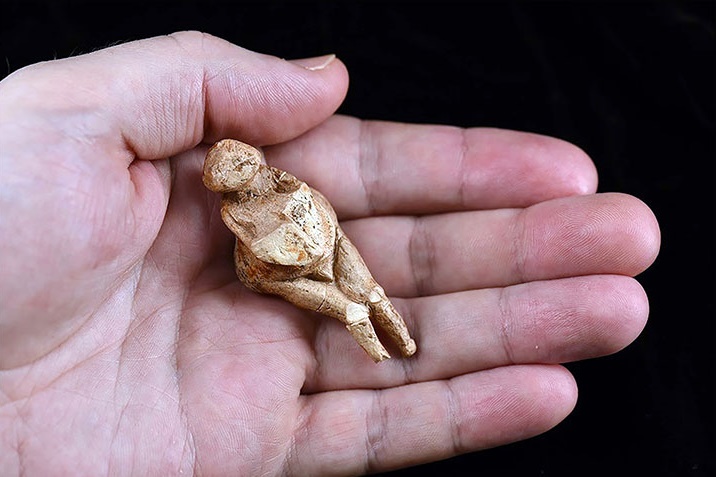
A stunning 23,000-year-old 'Venus' has been discovered in the Bryansk region of Russia, say scientists. The Palaeolithic beauty was carved from woolly mammoth tusk and shows a 'fantastically delicate' prehistoric woman.

'Palaeolithic Venus' discovered in Russia
The 23,000-year-old 'Venus' statue [Credit: Institute of Archaeology and Ethnography]
The rare find was made in the Bryansk region of Russia. Dr Konstantin Gavrilov, who led the expedition that discovered it.

"This statuette pictures a rather portly woman, but it looks fantastically delicate, probably due to the long and thin legs," enthused the scientist, from the Stone Age department of Moscow's Archaeology Institute.

'Palaeolithic Venus' discovered in Russia
The exceptionally rare Venus is made from 'a mammoth tusk [Credit: Institute of Archaeology and Ethnography]
It appeared to depict a "cult of fertility", said Dr Gavrilov, but then indicated this was impossible since it predated the existence of agriculture.

The 'Venus' is made from "mammoth tusk and it portrays a fat, maybe pregnant woman, with a big belly and bust," he said. "Part of the bust and belly has peeled off, along a natural crack in the tusk.
But the rear view remains intact from 23,000 years ago."

'Palaeolithic Venus' discovered in Russia
Front and rear views of the 23,000-year-old 'Venus' statue 
[Credit: Institute of Archaeology and Ethnography]
"The figurine was found near large limestone layers and parts of mammoth bones that were painted with a mineral sienna paint. Most likely, the statuette was put next to the bones on the ground rather than 'buried' like other 'Venuses'' found in Russia."

"Most experts believed such prehistoric statuettes are 'ceremonial' and 'ritual' objects", he said. "Other 'Venuses' have been found in Russia, notably near Lake Baikal in Siberia, but on closer inspection some of these were, in fact, clothed."

'Palaeolithic Venus' discovered in Russia
The site where the figurine was found [Credit: Institute of Archaeology and Ethnography]
The latest find was made among bones of mammoths, bison, and flint stones in a 23,000 year old layer at archaeological site Khotylyovo-2.

Author: Will Stewart | Source: Daily Mail [April 17, 2017]

'Palaeolithic Venus' discovered in Russia

A stunning 23,000-year-old 'Venus' has been discovered in the Bryansk region of Russia, say scientists. The Palaeolithic beauty was ...

The remains of a medieval priest who died 700 years ago have been uncovered in an elaborate grave. Archaeologists from the University of Sheffield uncovered the rare find at Thornton Abbey in Lincolnshire, which was founded as a monastery in 1139 and went onto become one of the richest religious houses in England.

Medieval priest discovered in elaborate grave 700 years after his death
The 700 year old grave was found in Thornton Abbey, Lincolnshire
[Credit: University of Sheffield]
The priest's gravestone was discovered close to the altar of a former hospital chapel. Unusually for the period, it displayed an inscription of the deceased's name, Richard de W'Peton -- abbreviated from 'Wispeton', a medieval incarnation of modern Wispington in Lincolnshire -- and his date of death, 17 April 1317.

The slab also contained an extract from the Bible, specifically Philippians 2:10, which reads; "that at the name of Jesus every knee should bow, of those in heaven, and of those on earth, and of those under the earth."

The discovery of Richard's grave was made by University of Sheffield PhD student Emma Hook, who found his skeletal remains surrounded by the decayed fragments of a wooden coffin.

Medieval priest discovered in elaborate grave 700 years after his death
Examination and recording of the skeletal remains of Richard de W'Peton
[Credit: University of Sheffield]
"After taking Richard's skeleton back to the laboratory, despite poor preservation, we were able to establish Richard was around 35-45 years-old at the time of his death and that he had stood around 5ft 4ins tall," said Emma.

"Although he ended his days in the priesthood, there is also some suggestion that he might have had humbler origins in more worldly work; his bones show the marks of robust muscle attachments, indicating that strenuous physical labour had been a regular part of his life at some stage.

"Nor had his childhood been easy; his teeth show distinctive lines known as dental enamel hypoplasia, indicating that his early years had been marked by a period of malnutrition or illness."

Medieval priest discovered in elaborate grave 700 years after his death
The coffin lid [Credit: University of Sheffield]
In order to further investigate Richard's health, researchers in the Department of Archaeology produced a 3D scan of his skull. The model produced enables detailed features of the skull to be seen with much more ease than with the naked eye.

This revealed a potentially violent episode in the priest's past: a slight depression in the back of his skull shows evidence of an extremely well-healed blunt force trauma suffered many years before Richard's death.

None of the investigations shed light on the cause of his demise at a relatively young age, however there is one possibility that researchers are exploring.

Medieval priest discovered in elaborate grave 700 years after his death
Dr Hugh Willmott from the University of Sheffield said it was very likely that the priest was held 
in extremely high regard [Credit: University of Sheffield]
Dr Hugh Willmott from the University of Sheffield's Department of Archaeology, who has been working on the excavation site at Thornton Abbey since 2011, said: "2017 marks not only the 700th anniversary of Richard's death, but also that of a catastrophic event that is now largely forgotten, but caused years of suffering for the whole of Europe: the Great Famine of 1315-1317.

"Triggered by a whole spring and summer of relentlessly heavy rain that caused widespread crop failures -- which vastly depleted the availability of grain for humans and hay or straw for animals -- this was a period of mass starvation.

"Although not on the same scale as the Black Death, which devastated Europe from 1346-1353 and which also left its mark at Thornton Abbey, these hungry times struck rich and poor alike, killing millions across the continent."

Medieval priest discovered in elaborate grave 700 years after his death
The priest's teeth show signs of malnutrition, which leads scientists to believe he may have died 
in the Great Famine  [Credit: University of Sheffield]
He added: "By spring 1317, when Richard died, the crisis was at its peak and its events would undoubtedly have affected medieval hospitals like Thornton Abbey, and the priests who served there.

"These institutions traditionally cared for the poor and hungry as well as the sick, so during the Great Famine sites like Thornton would have found themselves on the front line. Richard would have ministered to the starving, working in the face of desperately limited resources -- and perhaps despite these efforts, he too succumbed to the natural disaster that was unfolding around him.

"For now, such a narrative can only be a matter of speculation, but it does seem clear that -- whatever caused his death -- at the end of his days Richard was held in high regard, afforded an elaborate burial in the most prestigious part of the hospital chapel, in the very place he would have spent his final years working among the poor and dying."

Medieval priest discovered in elaborate grave 700 years after his death
The skull showed a serious head injury which had healed 
[Credit: University of Sheffield]
This is the latest significant archaeological find at Thornton Abbey in Lincolnshire. Last year a mass burial of bodies, known to be victims of the Black Death, was discovered at the hospital. A total of 48 skeletons, many of which were children, were found by the excavation team including PhD and undergraduate archaeology students.

Source: University of Sheffield [April 17, 2017]

Medieval priest discovered in elaborate grave 700 years after his death

The remains of a medieval priest who died 700 years ago have been uncovered in an elaborate grave. Archaeologists from the University of She...

Saturday, April 15, 2017


In the heart of Interior Alaska, at a recently discovered archaeological site, scientists have uncovered a huge mammoth tusk dating back 14,000 years. Objects made of ivory and used for hunting were also identified.

14,000 year old mammoth tusk discovered hidden in Alaska wilderness
The tusk was discovered buried in soil sediments at the Holzman archaeological site 
[Credit: Adelphi University]
The Holzman site was first discovered in 2015, hidden in the Alaska wilderness. Initial excavations revealed a series of late Pleistocene occupations containing remains of large mammal fauna, mammoth ivory fragments and stone tools buried in sediment deposits.

During the 2016 excavation season, a member of the team discovered the large mammoth tusk buried in the soil, about 1.5 metre underground. The tusk is nearly 5ft-long (140cm), and appears to be well preserved.

Radiocarbon dating suggests it is 14,000 years old, but it was sent to a lab at Adelphi University for further analyses.

Hunters or scavengers?

The scientists, are investigating who the first Americans were and when humans first settled in North America.

They hope the study of the tusk will help them settle important questions about the first Americans and about whether they overlapped with mammoths at the Holzman site.

The newly discovered tusk is 14,000 years old but so far evidence of human activity at the site only date back to 13,700 years ago.

14,000 year old mammoth tusk discovered hidden in Alaska wilderness
The site lies at the heart of Alaska Interior [Credit: Adelphi University]
"It's possible that humans found the tusk, which dated back to a few hundred years before their time, and used it to create their ivory tools", Brian Wygal, a co-principal investigator of the excavation and an associate professor of anthropology at Adelphi University, told IBTimes UK.

"One of the most important questions that we want to answer is whether the tusk was scavenged by these prehistoric people or if they hunted the mammoth down – in which cases mammoths and humans would have cohabited at the Holzman site 14,000 years ago".

The analyses of the tusk could provide an answer. The scientists are planning more isotope analyses as well as a study of ancient DNA to see if they can find traces that the mammoth was hunted. Depending on how well preserved the tusk is, they might also be able to establish how old it was when it died, its sex and what its diet was.

New excavations this summer might further help them determine if humans already lived at the site 14,000 years ago. "We may for instance find other parts of the mammoth which will indicate that it was consumed by people 14,000 years ago", Wygal said.

The research could also shed a new light on how mammoths became extinct in the US. If the analyses revealed the large mammals were hunted down, this will provide more evidence that humans might have played a role in their demise. The subject of how mammoths went extinct remains a source of heated debate among scientists.

Author: Lea Surugue | Source: International Business Times [April 13, 2017]

14,000 year old mammoth tusk discovered hidden in Alaska wilderness

In the heart of Interior Alaska, at a recently discovered archaeological site, scientists have uncovered a huge mammoth tusk dating back 14,...

Friday, April 14, 2017


Gezishan Site is located at the northwest of Qingtongxia city, Ningxia Province, it is an important prehistorical site in the later period of late Pleistocene in China. From 2013, the Ningxia Provincial Institute of Archaeology and Cultural Relics in conjunction with Institute of Vertebrate Paleontology and Paleoanthropology, Chinese Academy of Sciences made a systematical research, and cleared up the selected location No.10. In 2016, another great finding was made during the excavation.

New discoveries at Gezishan Palaeolithic Site, in China's Ningxia Province
Remains of camp fire found in Gezishan Site [Credit: Chinese Archaeology]
Excavation and research plan

Location No.10 was at the east of the Gezishan Basin. From 2014 to 2015, the archaeological team had felt out the distribution of the connate deposit of the site in the current situation, also had ascertained the actuality of the core area of the cultural layer. In 2016, archaeologists decided to expand the excavation scale in the core area, in order to get the overall connotation of the site.

In 2016, the archaeological team decided to clear up 200 excavation units (whose length of side was 1 meter) at the north of the core zone of the site, with an area of about 180 square meters. Expect the upper layer (disruption layer) was excavated as a thickness of about 20 to 30 centimeters layer, the rest was excavated as a thickness of about 5 to 10 centimeters.

Stratum, age, artifacts and remains

The stratum was divided into 5 layers, and archaeologists have recorded the three-dimensional coordinates of about 7,000 stone tools (larger than 2 centimeters) and more than 500 pieces of animal bones; Dozens of ostrich eggshell beads was found, especially those of less than 2 millimeters diameter, which became an important achievement of this excavation, however, the manufacturing techniques and the usage method, indicating the skills and cognitive competence need to be further researched.

New discoveries at Gezishan Palaeolithic Site, in China's Ningxia Province
The section which showed the uncertain post hole [Credit: Chinese Archaeology]
Meanwhile, about 400 pieces of charcoal samples was collected from different layers, in order to establish a high-resolution chronology frame and a solid background for the culture understanding. More than 20 remains of fire-using and carbon dust dense area were revealed, a large amount of burnt stones scattered in the excavation, and some of which were fireplaces with burnt bones around. In the fourth layer of excavation unit T5, dozens of round pits, with about 10-20 centimeters in diameter, 5-20 centimeters in depth were found, in zonal distribution, which was speculated to be temporary dwelling remains.

Academic values and significance

The excavation of Gezishan Site was the first time that chronosequence from the late period of late Pleistocene to the early period of holocene was established at the edge of the northwestern desert in China, providing important materials for understanding the prehistoric human activities and environmental change in this special geographic zone. Given to the excavation, archaeologists firstly found the stone saddle-quern, stone roller, featured bi-facial tools and Helan pointed implements in situ, which defining the date of those artifacts, and providing evidence of the means of livelihood and diet of ancient people at that moment in this area.

New discoveries at Gezishan Palaeolithic Site, in China's Ningxia Province
The ostrich eggshell beads [Credit: Chinese Archaeology]
The ostrich eggshell  and ornaments unearthed in the site refreshed our understandings towards the cognitive competence and skills of processing tiny objects of the ancient people, as well as providing perfect samples of studying their complex techniques and cognitive competence. A large number of fire using traces inside the site and its spatial distribution not only reflected the livelihood pattern, the background of climate and environment of ancient humans, but providing important informatiom for the activities of making fire, using fire and the use of housing space.

New discoveries at Gezishan Palaeolithic Site, in China's Ningxia Province
The pierced calcite ornaments [Credit: Chinese Archaeology]
Location No.10 of Gezishan site provides a complete stratigraphic sequence for this region. The cultural accumulations of at least three different periods have not only enriched our understanding of the period and its culture, but have also made it a special location for studying the cultural evolution and prehistoric human activities of the desert fringe zone from the late Pleistocene to the early Holocene as well as the transitional period from the Palaeolithic to the Neolithic. 

Translator: Wang Jue | Source: Chinese Archaeology [April 14, 2017]

New discoveries at Gezishan Palaeolithic Site in China's Ningxia Province

Gezishan Site is located at the northwest of Qingtongxia city, Ningxia Province, it is an important prehistorical site in the later period o...

Thursday, April 13, 2017


Italian police say a tourist from Ecuador has been cited for inscribing the names of his son and wife and "2017" inside the ancient Roman Colosseum.

Ecuadoran tourist cited for writing names on Roman Colosseum
A woman walks past a writing inscribed on a wall inside the Colosseum, Tuesday, April 11, 2017. Italian police say a tourist 
from Ecuador has been cited for inscribing the name of his son and wife and the year, 2017, on Monday, April 10, 2017 
inside the ancient Roman Colosseum. Carabinieri Major Lorenzo Iacobone said the tourist was observed in the act of 
vandalism by an official tour guide, who reported it to police [Credit: AP/Alessandra Tarantino]
Rome Mayor Vriginia Raggi denounced the alleged vandalism in a Twitter message on Tuesday, writing "Rome deserves respect. Whoever harms the Colosseum, harms all Romans and all who love the city."

Carabinieri Major Lorenzo Iacobone says the tourist was observed in the act of etching by an official tour guide, who reported it to police.

Ecuadoran tourist cited for writing names on Roman Colosseum
A view of a writing inscribed on a wall inside the Colosseum, Tuesday, April 11, 2017. Italian police say a tourist from 
Ecuador has been cited for inscribing the name of his son and wife and the year, 2017, on Monday, April 10, 2017 
inside the ancient Roman Colosseum. Carabinieri Major Lorenzo Iacobone said the tourist was observed in 
the act of vandalism by an official tour guide, who reported it to police [Credit: AP/Alessandra Tarantino]
It will be up to a judge to determine a penalty. In the past, tourists cited for defacing ancient sites have been handed fines as stiff as 20,000 euros ($21,000.)

Labor unions have complained about a lack of personnel to prevent visitors from leaving their marks on antiquities.

Source: Associated Press [April 13, 2017]

Ecuadoran tourist cited for writing names on Roman Colosseum

Italian police say a tourist from Ecuador has been cited for inscribing the names of his son and wife and "2017" inside the ancien...

Scientists from the environmental pollution control laboratory of the Aristotle University of Thessaloniki collected for the first time samples of solid deposits from the Arch of Galerius - or “Kamara” as it is locally known - in Thessaloniki, to establish the degree of damage caused by air pollution.

Scientists to examine air pollution damage on Thessaloniki's Arch of Galerius
Arch of Galerius, Thessaloniki [Credit: WikiCommons]
The project is organized in cooperation with the Thessaloniki Ephorate of Antiquities.
Chemistry professor Konstantina Samara, who is also head of the laboratory at AUT, said in an interview that particulate matter is deposited on the monuments and the ingredients they contain accelerate the deterioration of monuments, especially those made of marble.

"We collected samples of solid deposits and crust to make specific analyzes - chemical, morphological, mineral/chemical – to provide some useful information to the Ephorate who will judge when and if the monument needs new conservation work,” she said.

Scientists to examine air pollution damage on Thessaloniki's Arch of Galerius
Detail of frieze from the Arch of Galerius, Thessaloniki [Credit: WikiCommons]
Samara said the lab will also examine the evolution of air quality through time because the atmospheric pollutants do not remain at levels they were at 20 years ago, like sulfur dioxide.

“We want to examine the relationship between air pollution and the damage observed at the monument,” she said, adding that the answer to this question will help any new conservation project for the Arch.

The 4th-century monument was commissioned by Roman Emperor Galerius along with the neighbouring Rotunda to celebrate the victorious campaign against the Sassanid Persians in 298 A.D. and the capture of their capital Ctesiphon.

Source: ANA-MPA [April 13, 2017]

Scientists to examine air pollution damage on Thessaloniki's Arch of Galerius

Scientists from the environmental pollution control laboratory of the Aristotle University of Thessaloniki collected for the first time samp...


© 2015 - Distributed By Free Blogger Templates | Lyrics | Songs.pk | Download Ringtones | HD Wallpapers For Mobile