Header

Modul
Showing posts with label Greece. Show all posts

Thursday, April 13, 2017


Scientists from the environmental pollution control laboratory of the Aristotle University of Thessaloniki collected for the first time samples of solid deposits from the Arch of Galerius - or “Kamara” as it is locally known - in Thessaloniki, to establish the degree of damage caused by air pollution.

Scientists to examine air pollution damage on Thessaloniki's Arch of Galerius
Arch of Galerius, Thessaloniki [Credit: WikiCommons]
The project is organized in cooperation with the Thessaloniki Ephorate of Antiquities.
Chemistry professor Konstantina Samara, who is also head of the laboratory at AUT, said in an interview that particulate matter is deposited on the monuments and the ingredients they contain accelerate the deterioration of monuments, especially those made of marble.

"We collected samples of solid deposits and crust to make specific analyzes - chemical, morphological, mineral/chemical – to provide some useful information to the Ephorate who will judge when and if the monument needs new conservation work,” she said.

Scientists to examine air pollution damage on Thessaloniki's Arch of Galerius
Detail of frieze from the Arch of Galerius, Thessaloniki [Credit: WikiCommons]
Samara said the lab will also examine the evolution of air quality through time because the atmospheric pollutants do not remain at levels they were at 20 years ago, like sulfur dioxide.

“We want to examine the relationship between air pollution and the damage observed at the monument,” she said, adding that the answer to this question will help any new conservation project for the Arch.

The 4th-century monument was commissioned by Roman Emperor Galerius along with the neighbouring Rotunda to celebrate the victorious campaign against the Sassanid Persians in 298 A.D. and the capture of their capital Ctesiphon.

Source: ANA-MPA [April 13, 2017]

Scientists to examine air pollution damage on Thessaloniki's Arch of Galerius

Scientists from the environmental pollution control laboratory of the Aristotle University of Thessaloniki collected for the first time samp...
Sunday, April 9, 2017


Greece's Central Archaeological Council on Sunday gave the go-ahead to a project to help restore some of the most important monuments on the island of Delos, using a grant donated by the Paul and Alexandra Canellopoulos Foundation.

Restoration works at ‘sacred isle’ of Delos approved
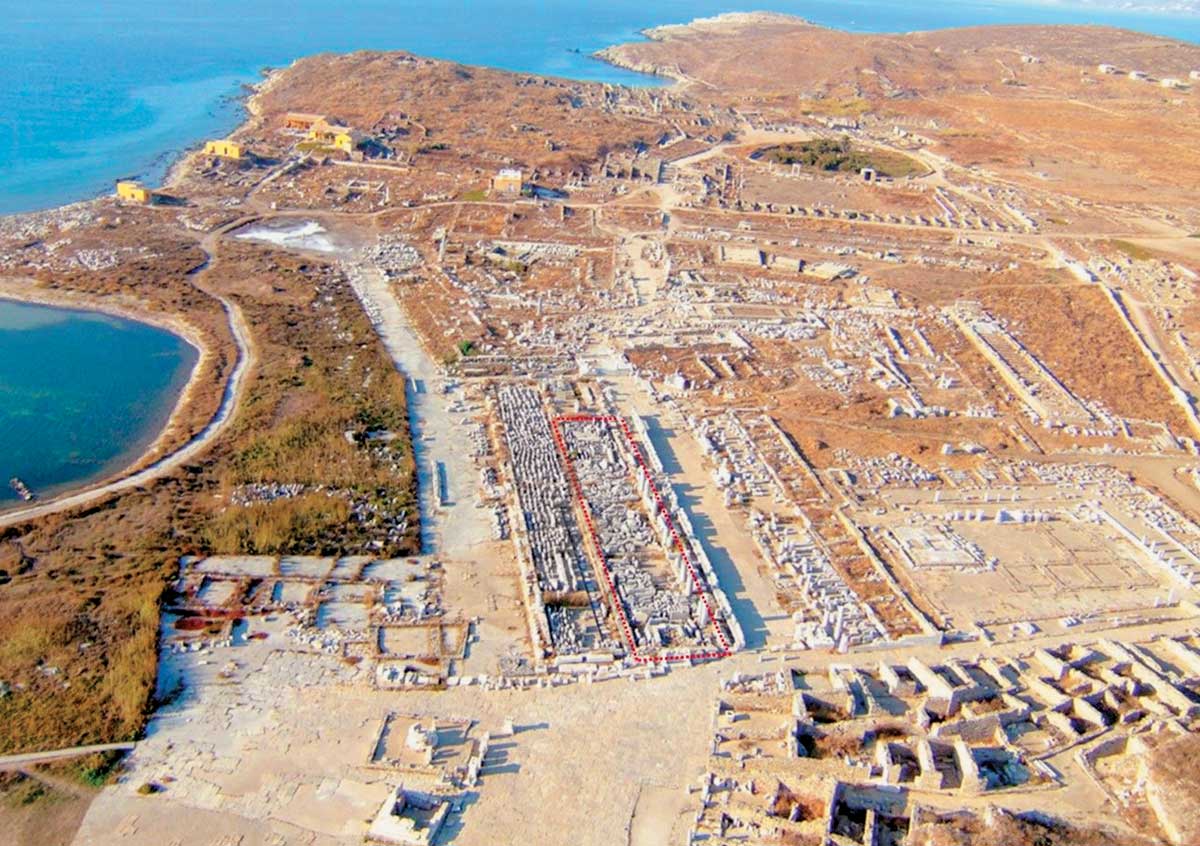
Aerial view of the Stoa of Philip V in Delos [Credit: Ethnos]
The project will launch a new era for the 'sacred isle' of Delos, which was considered the most important sanctuary of antiquity and the birthplace of the gods Apollo and Artemis. The project will begin with the Stoa of Philip V, which is one of the first monuments that a visitor comes across but also the hardest to understand, since it is missing its '3rd dimension'.

The Cyclades Antiquities Ephorate, using the 550,000-euro donation from the Kanellopoulos Foundation, will now take action to restore the damage and the result of wear caused by salt water to the various architectural elements on the ground.

According to the head of the Cyclades Antiquities Ephorate Dimitris Athanasoulis, the restoration work on Delos - as in the case of the Philip V Stoa - was essential for the protection of the monuments, not just to help visitors understand them.

"Delos is a small island, where the salt corrodes everything. Architectural elements in such a hostile environment degenerate rapidly. Their restoration on the monument will greatly reduce the wear," he said.

While the urban neighbourhoods on Delos were well-preserved, Athanasoulis said, the same was not true of the sanctuary. He said the Ephorate's strategy was to use EU and state funds on the "emergency" projects and try to find sponsors and grants for the rest. He pointed out that the needs on Delos, due to the special conditions prevailing on the island, were similar to those in Pompeii where millions of euros in European funds were given each year.

Source: ANA-MPA [April 09, 2017]

Restoration works at ‘sacred isle’ of Delos approved

Greece's Central Archaeological Council on Sunday gave the go-ahead to a project to help restore some of the most important monuments on...

Wednesday, April 5, 2017


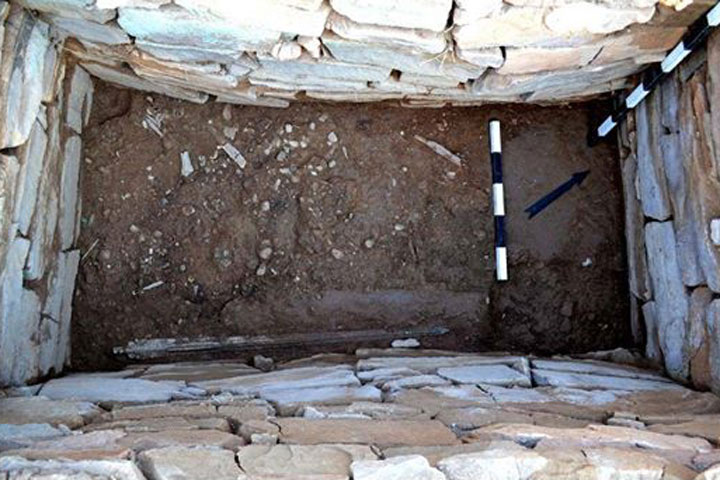
A shaft grave dated to the early Mycenaean period (ca. 1600 BC) was discovered during the 2016 excavation season at Plassi in Marathon, a short distance from the Tumulus of Marathon, revealing the significance of Marathon as a place of remembrance for ancient Athens, before and after the great battle of 490 BC.

Mycenaean warrior tomb unearthed at Marathon
The excavation of the grave at Plassi, Marathon [Credit: © Department of Archaeology 
and History of Art, NKUA]
The grave's occupant was evidently a warrior who was buried with a sword, a spear, a knife and arrows.

Mycenaean warrior tomb unearthed at Marathon
The Warrior Grave of early Mycenaean period at Plassi, Marathon [Credit: © Department of Archaeology 
and History of Art, NKUA]
Almost a millennium later, during the early Archaic period (c. 700 BC), the grave was discovered by the inhabitants of Marathon, who left the weapons in the grave but collected the bones of the deceased with great caution, possibly assuming that they belonged to a mythical hero of the past, and erected a sanctuary above the grave to honour him.

Mycenaean warrior tomb unearthed at Marathon
Rectangular precinct of the sanctuary which had been erected above the Mycenaea grave at Plassi, Marathon 
[Credit: © Department of Archaeology and History of Art, NKUA]
This sanctuary was destroyed at the time of the great battle, probably by the Persian army, and was subsquently abandoned, since the dominant site of historical memory in the area shifted to the Tumulus of Marathon.

Mycenaean warrior tomb unearthed at Marathon
View of the excavation at Plassi of Marathon [Credit: © Department of Archaeology 
and History of Art, NKUA]
For more information see the Marathon Excavation website.

Source: ANA-MPA [April 05, 2017]

Mycenaean warrior tomb unearthed at Marathon

A shaft grave dated to the early Mycenaean period (ca. 1600 BC) was discovered during the 2016 excavation season at Plassi in Marathon, a sh...

Sunday, April 2, 2017


Eight crates containing 33 archaeological artefacts and 600 coins, including some ancient masterpieces dating to the 12th and 13th centuries BC, arrived at the National Archaeological Museum in Athens from Munich on Friday.

Germany returns 33 smuggled artefacts to Greece
The finds were linked with the antiquities smuggling ring which was “dismantled” last October in Patras 
[Credit: ANA-MPA]
The crates full of archaeological treasures were transported to the museum with great secrecy and opened in the museum amphitheatre in the presence of Culture Minister Lydia Koniordou, with the Athens-Macedonian News Agency invited to record the opening of the crates as the museum curators took delivery.

The remarkable finds, most in very good condition, included amphorae, bird-shaped vases, a ceramic statue of a chariot driver and two riders and other small objects, most of which were possibly grave goods taken from the northwestern Peloponnese.

“Today, this is a special, touching and very important moment. What you feel from the expressions of the archaeologists and curators, the joy on their face every time the very important finds are unveiled one by one,” said Koniordou. Their return from Munich, where they were taken illegally, was “truly touching,” the minister added, noting that it was a huge success for Greek and German law enforcement agencies, which had cooperated seamlessly in a joint effort to which the Greek general consul in Munich had also contributed greatly.

Germany returns 33 smuggled artefacts to Greece
The artefacts were transferred to the conservation workshop of the National Archaeological Museum 
[Credit: ANA-MPA]
The minister said that the 33 objects dated to the late Bronze Age, had very interesting shapes and patterns, while most appeared to come from the same pottery workshop. There were also small objects from the Geometric period that were “real masterpieces” and 600 coins, she said.

“It is a non-negotiable principle of the Greek state to combat illegal antiquities smuggling and protect cultural heritage by any means. It is our desire that these illegally acquired ancient treasures should return to the areas from which they were stolen. We are already discussing how specific antiquities will be presented at the best time and in the best way to the public,” Koniordou said.

The finds linked to an international ring of illegal antiquities traders dismantled in Patras last October have been transferred to museum conservation workshops, while a committee has been set up to assess their authenticity and value.

Author: Kerry Kolasa-Sikiaridi | Source: Greek Reporter [April 02, 2017]

Germany returns 33 smuggled artefacts to Greece

Eight crates containing 33 archaeological artefacts and 600 coins, including some ancient masterpieces dating to the 12th and 13th centuries...


© 2015 - Distributed By Free Blogger Templates | Lyrics | Songs.pk | Download Ringtones | HD Wallpapers For Mobile