The Cleveland Museum of Art and The Ministry of Cultural Heritage and Activities and Tourism of the Republic of Italy (Ministry) today announced that they have reached an agreement for the transfer of an early 1st century AD marble portrait head of Drusus Minor (Drusus Julius Caesar, 13 BC-AD 23) to the Republic of Italy.
Head of Drusus Minor (13 BC-AD 23), probably after AD 23 and likely before AD 37. Roman, 1st cent. Marble; overall: h. 35 cm (13 3/4 in) [Credit: The Cleveland Museum of Art]
The sculpture, previously sold at a public auction in Paris in 2004, was acquired by CMA in 2012, after extensive research to confirm its ownership history. When the museum acquired the work, it was believed that the sculpture originally came from North Africa. When, more recently, CMA became aware of the fact that the sculpture may have been illicitly removed from a site near Naples towards the end of World War II, the museum promptly contacted the Ministry. Acting in cooperation with officials of the Ministry, and with the assistance of the Carabinieri for the Protection of Cultural Heritage, CMA was able to confirm the World War II events. As a result, CMA determined to transfer the sculpture to Italy
In 2008, the Cleveland Museum of Art entered into a cultural cooperation agreement with the Ministry that formed the basis for a new relationship between CMA and the Republic of Italy. That agreement also provided a framework for the museum to approach the Ministry and obtain the information necessary to allow the museum to decide to transfer the sculpture.
“We have had an excellent relationship with the Ministry for many years,” said William Griswold, CMA director. “When we became aware of facts that were inconsistent with our understanding of the provenance of the sculpture, contacting the Ministry directly was an easy decision in light of our many years of working with our Italian colleagues. We worked collaboratively with the Ministry first to determine the circumstances of the work’s removal and then to finalize the decision to transfer the work.”
"This return is the result of an important and fruitful cultural agreement and the full cooperation of CMA with the Italian authorities,” said the Minister of Cultural Heritage and Activities and of Tourism, Dario Franceschini. “Now we await the return of the work, which, once in Italy will be returned as soon as possible to Naples and its communities, from where it was removed."
Gunmen attacked security forces near St. Catherine's Monastery in Egypt's south Sinai on Tuesday, killing at least one police officer and injuring four others, the Health Ministry said, just a week after two deadly church bombings killed 45.
The Monastery of St. Catherine, near Mount Sinai in Egypt, where a policeman was killed and four others were wounded on Monday [Credit Pedro Costa Gomes/AFP/Getty Images]
Islamic State claimed responsibility for the attack on a police checkpoint about 800 meters from the entrance to the monastery, one of the world's most important Christian sites.
The attack comes just 10 days before Pope Francis is scheduled to visit Egypt and just over a week after two deadly suicide bombings on Christian churches, also claimed by Islamic State, plunged the country into mourning and marked one of the bloodiest days for the country's Christian minority in decades.
St . Catherine's, founded in the 6th century and located at the foot of Mount Sinai, is one of the oldest Christian monasteries in the world and a UNESCO world heritage site. It is part of the Eastern Orthodox church.
Egypt's Christian minority, which makes up about 10% of the country's 92 million people, has increasingly been targeted by Islamist militants, with three deadly church attacks in the span of four months.
In February, scores of Christian families and students fled North Sinai province after a spate of targeted killings.
A successful assault on St. Catherine's would be the latest challenge to President Abdel Fattah al-Sisi, who has pledged to protect the religious minority as part of his campaign against extremism.
Egypt has for years been battling an Islamist insurgency in the rugged and thinly populated northern Sinai, which gained pace after the military overthrew President Mohamed Mursi of the Muslim Brotherhood in 2013 following mass protests against his rule.
Attacks in Egypt's southern Sinai, a popular destination for tourists dotted with Red Sea resorts, are by contrast rare.
Security sources told Reuters that security had been put on high alert at tourist facilities across southern Sinai after the attack .
The attack in southern Sinai comes as Russia is expected to make a long-awaited decision on whether to restore flights to the Sharm el-Sheikh resort after a Russian airliner was downed in 2015, dealing a serious blow to the area's tourism industry, which relies heavily on Russian visitors.
Egypt's tourism industry, a crucial source of hard currency, has suffered in the years of turmoil that followed the overthrow of President Hosni Mubarak in 2011, as well as from the suspected bombing of the Russian plane, which killed all 224 on board.
Israel took the unusual step earlier this month of barring its citizens from crossing into the Sinai peninsula, saying the threat of attack s in the area inspired by Islamic State and other jihadi groups was high.
Author: Ali Abdelaty | Source: Reuters [April 19, 2017]
Italian police say a tourist from Ecuador has been cited for inscribing the names of his son and wife and "2017" inside the ancient Roman Colosseum.
A woman walks past a writing inscribed on a wall inside the Colosseum, Tuesday, April 11, 2017. Italian police say a tourist from Ecuador has been cited for inscribing the name of his son and wife and the year, 2017, on Monday, April 10, 2017 inside the ancient Roman Colosseum. Carabinieri Major Lorenzo Iacobone said the tourist was observed in the act of vandalism by an official tour guide, who reported it to police [Credit: AP/Alessandra Tarantino]
Rome Mayor Vriginia Raggi denounced the alleged vandalism in a Twitter message on Tuesday, writing "Rome deserves respect. Whoever harms the Colosseum, harms all Romans and all who love the city."
Carabinieri Major Lorenzo Iacobone says the tourist was observed in the act of etching by an official tour guide, who reported it to police.
A view of a writing inscribed on a wall inside the Colosseum, Tuesday, April 11, 2017. Italian police say a tourist from Ecuador has been cited for inscribing the name of his son and wife and the year, 2017, on Monday, April 10, 2017 inside the ancient Roman Colosseum. Carabinieri Major Lorenzo Iacobone said the tourist was observed in the act of vandalism by an official tour guide, who reported it to police [Credit: AP/Alessandra Tarantino]
It will be up to a judge to determine a penalty. In the past, tourists cited for defacing ancient sites have been handed fines as stiff as 20,000 euros ($21,000.)
Labor unions have complained about a lack of personnel to prevent visitors from leaving their marks on antiquities.
Scientists from the environmental pollution control laboratory of the Aristotle University of Thessaloniki collected for the first time samples of solid deposits from the Arch of Galerius - or “Kamara” as it is locally known - in Thessaloniki, to establish the degree of damage caused by air pollution.
Arch of Galerius, Thessaloniki [Credit: WikiCommons]
The project is organized in cooperation with the Thessaloniki Ephorate of Antiquities. Chemistry professor Konstantina Samara, who is also head of the laboratory at AUT, said in an interview that particulate matter is deposited on the monuments and the ingredients they contain accelerate the deterioration of monuments, especially those made of marble.
"We collected samples of solid deposits and crust to make specific analyzes - chemical, morphological, mineral/chemical – to provide some useful information to the Ephorate who will judge when and if the monument needs new conservation work,” she said.
Detail of frieze from the Arch of Galerius, Thessaloniki [Credit: WikiCommons]
Samara said the lab will also examine the evolution of air quality through time because the atmospheric pollutants do not remain at levels they were at 20 years ago, like sulfur dioxide.
“We want to examine the relationship between air pollution and the damage observed at the monument,” she said, adding that the answer to this question will help any new conservation project for the Arch.
The 4th-century monument was commissioned by Roman Emperor Galerius along with the neighbouring Rotunda to celebrate the victorious campaign against the Sassanid Persians in 298 A.D. and the capture of their capital Ctesiphon.
The European Commission is allocating almost €50 million from the European Regional Development Fund to the continuation of the renovation and preservation works on the iconic Italian archaeological site.
Restoration crews work on a building at the ancient Roman city of Pompeii [Credit: Carlo Hermann/AFP/Getty]
After the completion of the restoration works co-financed by the EU Cohesion Policy, the Ancient Roman city of Pompeii, classified as a UNESCO World Heritage Site, is expected to welcome almost 200 000 additional tourists per year.
Regional Policy Commissioner Corina Creţu, who visited the project in February, said: "In Pompeii we restore and preserve works of art from the past, but we are really doing it for our future; so our grandchildren can enjoy this unique site, part of our common History and cultural identity. And we are also contributing significantly to the economic development of the Campania region, by boosting tourism and entrepreneurship."
The €50 million investment package finances the consolidation of the structures and ancient buildings of the archaeological site in order to restore its urban character, the construction of a water canalisation and drainage system, other restoration and enhancement works as well as training for the staff.
Background
The EU started supporting renovation works in Pompeii in the 2000-2006 financial period, and adopted the Pompeii "major project", worth €105 million overall, in 2007-2013. Today's decision will allow this project to be completed with funds from the 2014-2020 period.
The UNESCO site of Pompeii has been under excavation to varying degrees since 1748. Exposure of the excavated site as well as poor excavation techniques mean that the site has deteriorated over time.
The Pompeii major project aims to stop and reverse the deterioration of the site while consolidating disparate sites into a single excavated area. In 2016, the site was also made wheel chair accessible, with the help of EU funds.
Until now, a heavy glass pane weighing approximately 80 kilos has prevented a valuable, centuries-old silk tunic attributed to Saint Ambrose from being restored in Milan. With a team of restorers and art transporters, an archaeologist at the University of Bonn has now managed to free the work of art, the tunic, from its heavy load, preserve the fabric and thus retain it for posterity.
Already in the early Christian church, relics were widespread. The religiously revered legacies of the saints also include, for instance, textiles. Valuable silk garments in Milan are thus attributed to Saint Ambrose. The patron saint of the city lived in the fourth century, and his remains rest there in the Basilica of Sant'Ambrogio, which bears his name. As bishop of the imperial residence of Milan, Ambrose pushed for the veneration of relics, and the Ambrosian chants, for instance, also date back to his time.
"The silk garments that are venerated as relics of the saint also include an exquisitely beautiful tunic," says Prof. Sabine Schrenk from the department of Christian Archaeology at the University of Bonn. The ravages of time have taken their toll on the valuable textile, yet it was not possible to perform new preservation work because the silk tunic has been stored in Milan for many years under a heavy glass pane weighing around 80 kilos. "The glass was intended to protect the relic," reports Schrenk. "However, the silk textile created waves underneath, and the great weight of the glass pane thus damaged the centuries-old fibers."
Experts have extensive experience with valuable silk textiles
Preserving the garment was a major challenge: how can the glass be removed from the silk cloth without it breaking or it tearing the fibers that have adhered to it? As Sabine Schrenk and the Colgne-based textile restorer Ulrike Reichert had already successfully preserved numerous silk fabrics in Sant'Ambrogio both of the experts have long been considering how such a tricky venture could succeed.
Schrenk and Reichert devised a plan with those in charge at Sant'Ambrogio, Abate Erminio de Scalzi and Monsignore Biaggio Pizzi, as well as with the curators of monuments from the diocese and city, Dr. Carlo Capponi and Dr. Antonella Ranaldi. The art transporting company APICE from Milan played an important role in this: well accustomed to shipping heavy paintings and sculptures, the experts led by Fabiano Panzironi took on the heavy task of transporting and lifting the glass pane installation.
The silk tunic measuring an impressive approx. 170 x 280 centimeters was stored in a drawer cabinet in the gallery of Sant'Ambrogio. However, this room was unsuitable for the preservation work. The transporters thus packed the glass panes with the valuable cargo between two large wooden boards, and the huge artwork was then carried vertically along the narrowest, winding corridors into the basilica's archive, which was transformed into a workshop for a month. "This transportation was highly risky," reports the restorer Ulrike Reichert. In some places, the art transporters had to proceed millimeter by millimeter to ensure the transit was ultimately successful.
A sandwich made from wood, glass and silk tunic
Once they arrived in the workshop, the six art transporters heaved the glass, silk tunic and wood sandwich onto a large table. The most dangerous moment of the preservation was now imminent. While the art transporters lifted the glass pane very slightly using suction handles, Ulrike Reichert used a flat stick to very carefully separate adhering parts of the silk tunic from the glass pane square centimeter by square centimeter. "This work took a long time -- for the helpers, it was a feat of strength to keep the heavy pane in the air the whole time," says Schrenk.
Then came the key moment: will the upper glass pane break when lifted and tear the tunic? Very carefully, the specialists lift the heavy pane centimeter by centimeter using the suction handles. The silk fibers remain intact! The carriers quickly lift the glass pane to one side and place it down on the table. The valuable fabric is now accessible for preservation. The fine silk fibers are carefully freed from dust and the valuable tunic is then protected against environmental influences with a lightweight acrylic glass. "The success shows that it was right to take the gamble," says Schrenk. "The great team mastered this challenge together."
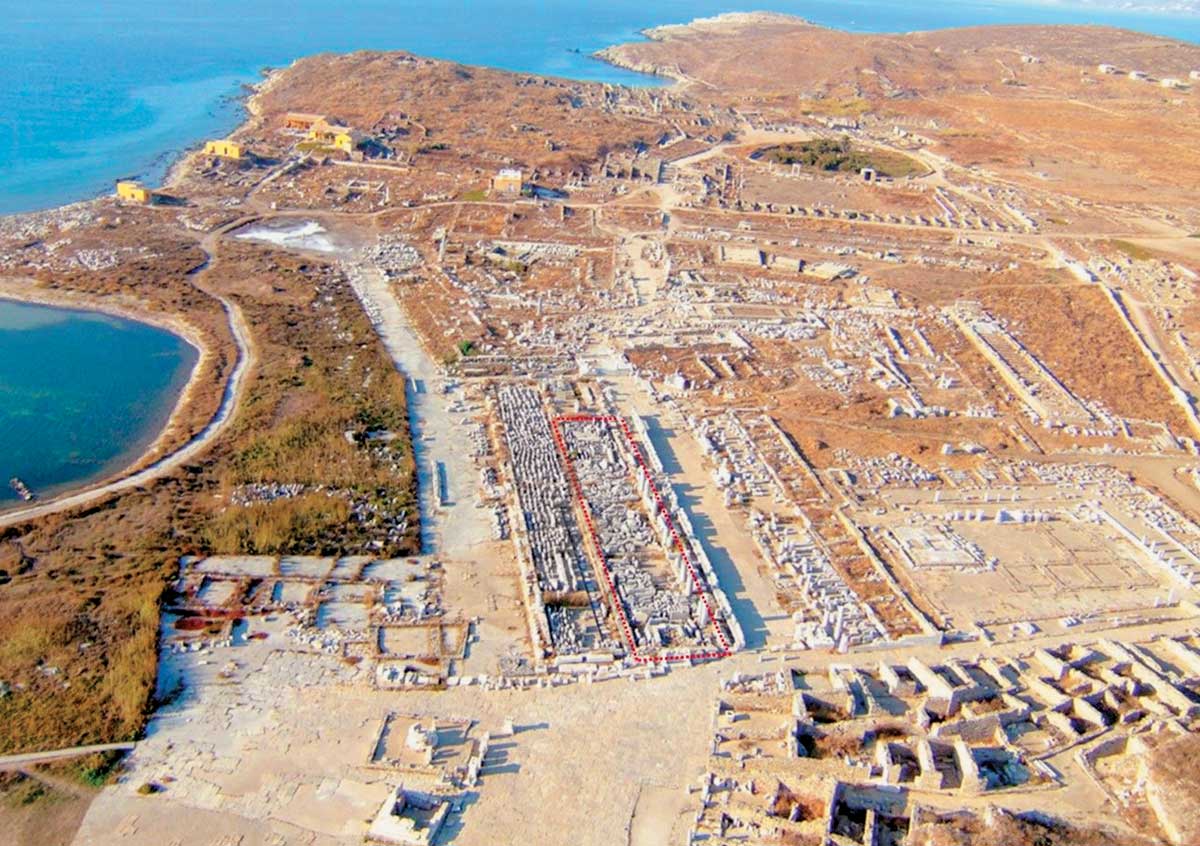
Greece's Central Archaeological Council on Sunday gave the go-ahead to a project to help restore some of the most important monuments on the island of Delos, using a grant donated by the Paul and Alexandra Canellopoulos Foundation.
Aerial view of the Stoa of Philip V in Delos [Credit: Ethnos]
The project will launch a new era for the 'sacred isle' of Delos, which was considered the most important sanctuary of antiquity and the birthplace of the gods Apollo and Artemis. The project will begin with the Stoa of Philip V, which is one of the first monuments that a visitor comes across but also the hardest to understand, since it is missing its '3rd dimension'.
The Cyclades Antiquities Ephorate, using the 550,000-euro donation from the Kanellopoulos Foundation, will now take action to restore the damage and the result of wear caused by salt water to the various architectural elements on the ground.
According to the head of the Cyclades Antiquities Ephorate Dimitris Athanasoulis, the restoration work on Delos - as in the case of the Philip V Stoa - was essential for the protection of the monuments, not just to help visitors understand them.
"Delos is a small island, where the salt corrodes everything. Architectural elements in such a hostile environment degenerate rapidly. Their restoration on the monument will greatly reduce the wear," he said.
While the urban neighbourhoods on Delos were well-preserved, Athanasoulis said, the same was not true of the sanctuary. He said the Ephorate's strategy was to use EU and state funds on the "emergency" projects and try to find sponsors and grants for the rest. He pointed out that the needs on Delos, due to the special conditions prevailing on the island, were similar to those in Pompeii where millions of euros in European funds were given each year.
Stone inscriptions dating back to the 12th to 15th Century AD have been found neglected at Lord Uma Koppulingeswara temple at Palivela village of Kothapeta mandal in East Godavari. Rare inscriptions of Veerabhadra Reddy of Rajamahendravara Reddy kingdom, who ruled the Godavari area from 14th to 15th Century AD, were found on the walls and pillars of the temple in Telugu script.
Stone inscriptions dating back to the 12th to 15th Century AD have been found neglected at Lord Uma Koppulingeswara temple at Palivela village of Kothapeta mandal in East Godavari [Credit: Deccan Chronicle]
The stone inscriptions clearly mention king Veerabhadra Reddy and his queen Anitalli who made generous donations to temple deities during Salivahana era. An inscription, dated Salivanana era 1338, mentions the ‘Kalyana Mantapa’ in the temple that was constructed by Allada Reddy Dodda of the Rajamahendravara Reddy dynasty. Reddy Dodda was the younger brother of Veerabhadra Reddy and he ordered performing of Kalyana of Lord Uma Koppulingeswara. The practice of performing Kalyana is still being followed at the temple.
Some inscriptions dated Salivahana era 1239 of Kakatiya Prataparudra area were also found on the temple premises and they are in a bad condition for want of maintenance. An inscription, belonging to the 10th century AD of Velanati Chodas, was being used by the devotees to break coconuts to offer to the Lord at the temple. Archaeologist Varanasi Rahul said, “It is time the state government takes interest to protect and preserve ancient stone inscriptions, as these are getting either damaged or ruined for want of care.”
Restoration work has been initiated on the 'Gate of Constantinople' (Turkish İstambul Kapisi), the most magnificent part of the city walls in the northwestern city of İznik (Greek Nikaia) located in northeastern Turkey.
Aerial view of the Gate of Constantinople at Iznik (Nikaia) [Credit: DHA]
Nikaia is one of the important pilgrimage centres for the world of Christianity as the 1st and 7th Ecumenical Councils were held there in 325 and 787 AD. The city was captured from the Byzantines in 1331 by Orhan I and for a short period the town became the capital of the expanding Ottoman emirate.
The restoration project, carried out by the Bursa Metropolitan Municipality, to turn the sunken basilica in the lake into a museum and others works in the ancient theatre, tile furnaces, Abdulvahap Hill, khans and madrasahs have been continuing in the city.
Works have been accelerated for Nikaia, the capital of the Eastern Roman Empire that holds great significance for Christians and Muslims alike, to enter the UNESCO World Heritage List.
The Gate of Constantinople, which is 4,970 metres in length, with 12 secondary gates and 114 towers, which are 10-15 metres away from each other, features the delicacies of war and defense strategies of the era.
The Gate of Constantinople at Iznik (Nikaia), 2008 [Credit: WikiCommons]
The Gate of Constantinople, which was the central gate of Nikaia, is the most magnificent gate of the city walls as it opens to Constantinople.
The gate has changed after undergoing many sieges, natural disasters and interventions through the centuries, but has survived until now. After the restoration process, the gate will become a unique work showing the traces of both the Greek and Ottoman civilizations.
At a ceremony held to mark the beginning of the restoration, Bursa Mayor Recep Altepe said they accelerated works for the historical heritages in the city, which is a candidate for UNESCO.
“We are working on all historical artefacts from the Roman Theatre to the Green Mosque. This is a long-time dream to revive the walls in İznik, which is known as a city of walls. We initiated works in the İstambul Kapisi. Following the first stage of works, all gates, walls and towers will have their unique identity,” he added.
İznik Mayor Osman Sargın said the city had Turkey’s longest city walls. “The cleaning of the walls is almost coming to an end. Those who will enter the walls in the south will be able to walk to the north easily in this historic atmosphere,” he added.
A wooden crucifix sculpted by Michelangelo at 18 has been restored to pride of place in Florence's Santo Spirito, the church the Renaissance master had created it for.
View of a wooden crucifix sculpted by Italian artist Michelangelo at the Santo Spirito basilica in Florence [Credit: Alberto Pizzoli/AFP]
After the death of his first benefactor Lorenzo de Medici in 1492, Michelangelo lived for a year with a community of Augustine monks associated with the famous basilica, studying anatomy in the hospital they ran.
Michelangelo crucifix hangs in new location in the basilica of Santo Spirito in Florence [Credit: Niccolo Cambi/Massimo Sestini]
As a thank you for their welcome, he left them a 1.40 metre (four and a half foot) sculpture of a nude Jesus Christ on the cross.
Detail of crucifix hanging in Santo Spirito in Florence [Credit: Niccolo Cambi/Massimo Sestini]
The masterpiece was thought lost for decades before it was found in the 1960s, in a convent corridor and so badly overpainted it was barely recognisable.
Side view of crucifix hanging at Santo Spirito in Florence [Credit: Alberto Pizzoli/AFP]
Now restored, it recently went on tour in Italy before returning Tuesday to take up a new setting in Santo Spirito: suspended above the church's old sacristry in a way that allows visitors to inspect it from all angles.
Restored Michelangelo crucifix hanging at Santo Spirito in Florence [Credit: Maurizio Degl'Innocenti, ANSA]
"The Santo Spirito district, with its extraordinary basilica, is a place that needs protecting and to be brought to life," said Simonetta Brandolini d'Adda, president of the Friends of Florence group which helped organise the new installation for "this serene, sublime Christ."
The restoration project of the Edicule in the Church of the Holy Sepulchre in Jerusalem has recently been completed, but scientists warn that the church may still suffer ‘catastrophic’ collapse.
The ornate shrine known as the Edicule encloses what is believed to be the tomb of Jesus Christ inside the Church of the Holy Sepulchre in Jerusalem. The shrine has just undergone a year-long restoration [Credit: Oded Balilty, AP for National Geographic]
According to National Geographic, scientists at the National Technical University of Athens said some portions of the shrine’s foundation actually sit on rubble of earlier buildings, and unexplained tunnels and voids. The foundation mortar of the structure has also crumbled due to long term exposure to moisture. The discovery was made with ground-penetrating radar and robotic cameras.
The 19th-century Edicule after restoration [Credit: Oded Balilty, AP for National Geographic]
“When it fails, the failure will not be a slow process, but catastrophic,” Antonia Moropoulou, NTUA’s chief scientific supervisor told the National Geographic.
To address this risk, scientists at the National Technical University of Athens are proposing a 10-month project that would cost $6 million euros which would involve removing the fractured foundation and installing drainage system around the perimeter of the rotunda.
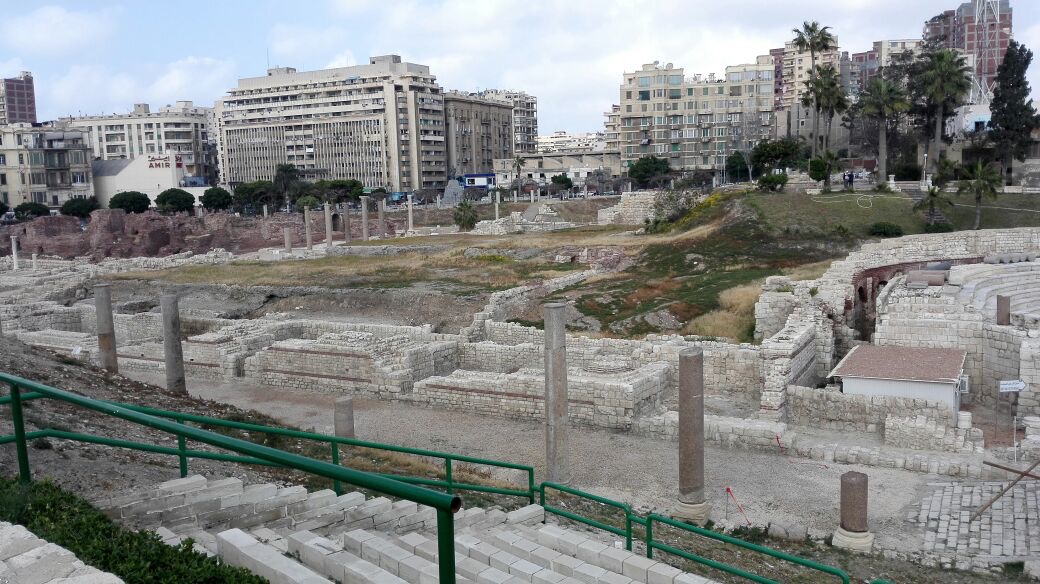
Egyptian Minister of Antiquities Khaled El-Enany and members of parliment inaugurated Alexandria's cistern and imperial bath complex area in the Kom El-Dikka archaeological site.
The bath complex in Kom Al-Dikka [Credit: Ministry of Antiquities, Egypt]
The area had been undergoing excavation and restoration since 1960 by an Egyptian-Polish mission from Warsaw University.
Mahmoud Afifi, head of the ministry's Ancient Egyptian Antiquities Department, said that the newly inaugurated area will be included within the Kom Al-Dikka tourist path, which includes the Roman amphitheater, the bird villa and residential houses from the Hellenistic period until the Islamic era.
El-Enany describes the bathing complex as "one of the finest edifices of its time," and that the bathing halls had welcomed hundreds of bathers at a time.
The bath complex in Kom Al-Dikka [Credit: Ministry of Antiquities, Egypt]
The complex also includes palestrae for physical exercises, colonnade passages and amenities such as public latrines.
Water was supplied to the complex using huge cisterns and heated by a complex system of furnaces and pipes.
The minister and the parlimentary delegates also paid a visit to the planned Mosaic museum in downtown Alexandria to inspect the ongoing work and address any obstacles to its completion.
The bath complex in Kom Al-Dikka [Credit: Ministry of Antiquities, Egypt]
During the tour, Mohamed Abdelmaguid, director-general of the Underwater Archaeological Department, introduced a three-phase plan to develop the Qayet Bey Citadel and its surroundings.
Abdelmaguid also reviewed a plan for the construction of the first underwater museum beneath the city's eastern harbour, which once was the ancient Alexandria royal area.
Abdelmaguid suggests the building of an underwater park to promote diving as well as the establishment of a training centre for underwater archaeology.
Eight crates containing 33 archaeological artefacts and 600 coins, including some ancient masterpieces dating to the 12th and 13th centuries BC, arrived at the National Archaeological Museum in Athens from Munich on Friday.
The finds were linked with the antiquities smuggling ring which was “dismantled” last October in Patras [Credit: ANA-MPA]
The crates full of archaeological treasures were transported to the museum with great secrecy and opened in the museum amphitheatre in the presence of Culture Minister Lydia Koniordou, with the Athens-Macedonian News Agency invited to record the opening of the crates as the museum curators took delivery.
The remarkable finds, most in very good condition, included amphorae, bird-shaped vases, a ceramic statue of a chariot driver and two riders and other small objects, most of which were possibly grave goods taken from the northwestern Peloponnese.
“Today, this is a special, touching and very important moment. What you feel from the expressions of the archaeologists and curators, the joy on their face every time the very important finds are unveiled one by one,” said Koniordou. Their return from Munich, where they were taken illegally, was “truly touching,” the minister added, noting that it was a huge success for Greek and German law enforcement agencies, which had cooperated seamlessly in a joint effort to which the Greek general consul in Munich had also contributed greatly.
The artefacts were transferred to the conservation workshop of the National Archaeological Museum [Credit: ANA-MPA]
The minister said that the 33 objects dated to the late Bronze Age, had very interesting shapes and patterns, while most appeared to come from the same pottery workshop. There were also small objects from the Geometric period that were “real masterpieces” and 600 coins, she said.
“It is a non-negotiable principle of the Greek state to combat illegal antiquities smuggling and protect cultural heritage by any means. It is our desire that these illegally acquired ancient treasures should return to the areas from which they were stolen. We are already discussing how specific antiquities will be presented at the best time and in the best way to the public,” Koniordou said.
The finds linked to an international ring of illegal antiquities traders dismantled in Patras last October have been transferred to museum conservation workshops, while a committee has been set up to assess their authenticity and value.