Header

Modul
Showing posts with label Southern Europe. Show all posts

Wednesday, April 19, 2017


The Cleveland Museum of Art and The Ministry of Cultural Heritage and Activities and Tourism of the Republic of Italy (Ministry) today announced that they have reached an agreement for the transfer of an early 1st century AD marble portrait head of Drusus Minor (Drusus Julius Caesar, 13 BC-AD 23) to the Republic of Italy.

Cleveland Museum of Art to transfer Roman sculpture of Drusus Minor to Italy
Head of Drusus Minor (13 BC-AD 23), probably after AD 23 and likely before AD 37. Roman, 1st cent. 
Marble; overall: h. 35 cm (13 3/4 in) [Credit: The Cleveland Museum of Art]
The sculpture, previously sold at a public auction in Paris in 2004, was acquired by CMA in 2012, after extensive research to confirm its ownership history. When the museum acquired the work, it was believed that the sculpture originally came from North Africa. When, more recently, CMA became aware of the fact that the sculpture may have been illicitly removed from a site near Naples towards the end of World War II, the museum promptly contacted the Ministry. Acting in cooperation with officials of the Ministry, and with the assistance of the Carabinieri for the Protection of Cultural Heritage, CMA was able to confirm the World War II events. As a result, CMA determined to transfer the sculpture to Italy

In 2008, the Cleveland Museum of Art entered into a cultural cooperation agreement with the Ministry that formed the basis for a new relationship between CMA and the Republic of Italy. That agreement also provided a framework for the museum to approach the Ministry and obtain the information necessary to allow the museum to decide to transfer the sculpture.

“We have had an excellent relationship with the Ministry for many years,” said William Griswold, CMA director. “When we became aware of facts that were inconsistent with our understanding of the provenance of the sculpture, contacting the Ministry directly was an easy decision in light of our many years of working with our Italian colleagues. We worked collaboratively with the Ministry first to determine the circumstances of the work’s removal and then to finalize the decision to transfer the work.”

"This return is the result of an important and fruitful cultural agreement and the full cooperation of CMA with the Italian authorities,” said the Minister of Cultural Heritage and Activities and of Tourism, Dario Franceschini. “Now we await the return of the work, which, once in Italy will be returned as soon as possible to Naples and its communities, from where it was removed."

Source: The Cleveland Museum of Art [April 19, 2017]

Cleveland Museum of Art to transfer Roman sculpture of Drusus Minor to Italy

The Cleveland Museum of Art and The Ministry of Cultural Heritage and Activities and Tourism of the Republic of Italy (Ministry) today annou...

A large set of tracks made by archosauromorphs in the Pyrenees mountain range may include a new type of footprint made by reptiles that lived 247 million years ago, according to a study published in the open-access journal PLOS ONE.

Ancient reptile tracks in the Pyrenees may include evidence of new type of footprint
A large set of tracks made by archosauromorphs in the Pyrenees mountain range may include a new type 
of footprint made by reptiles that lived 247 million years ago, according to a study 
[Credit: Universitat Autònoma de Barcelona/PLOS]
The Permian mass extinction resulted in the loss of 90 percent of species. The environmental and climactic conditions hindered the recovery of vertebrate species following this devastating event.

To investigate which vertebrates lived during beginning of the Mesozoic Era, which followed the Permian extinction, Mujal and colleagues examined trace fossils of vertebrates in the Pyrenees mountains in Catalonia from approximately 247 to 248 million years ago. The researchers made 3D models and created silicone molds of these ephemeral fossils, enabling them to preserve the fossils in scientific collections.

Ancient reptile tracks in the Pyrenees may include evidence of new type of footprint
Tracks of Prorotodactylus mesaxonichnus [Credit: Eudald Mujal et al./PLOS]
The researchers identified that most tracks were made by archosauromorphs, the ancestors of crocodiles and dinosaurs. The majority were small, about half a meter in length, although a few specimens were longer than three meters.

The researchers also identified a new footprint, Prorotodactylus mesaxonichnus, and the new fossil evidence from the Pyrenean tracks suggests that at least the Pyrenean Prorotodactylus genus is related to archosauromorphs, rather than being a dinosauromorph as previously thought from other records.

Ancient reptile tracks in the Pyrenees may include evidence of new type of footprint
Fossil assemblage, paleoenvironment and biochronologic interval [Credit: Eudald Mujal et al./PLOS]
The authors suggest that the abundance of archosauromorph fossils in the Pyrenees provides evidence that archosauromorphs may have played a large role in vertebrate recovery following the Permian mass extinction. Further research could explore how the archosauromorph lineage may have evolved and spread following this time period.

"Trace fossils are evidence that archosauromorphs dominated the fluvial environments of the Catalan Pyrenees during the Triassic vertebrate recovery, early after the end-Permian mass extinction," says Mujal.

Source: PLOS [April 19, 2017]

Ancient reptile tracks in the Pyrenees may include evidence of new type of footprint

A large set of tracks made by archosauromorphs in the Pyrenees mountain range may include a new type of footprint made by reptiles that live...

Thursday, April 13, 2017


Italian police say a tourist from Ecuador has been cited for inscribing the names of his son and wife and "2017" inside the ancient Roman Colosseum.

Ecuadoran tourist cited for writing names on Roman Colosseum
A woman walks past a writing inscribed on a wall inside the Colosseum, Tuesday, April 11, 2017. Italian police say a tourist 
from Ecuador has been cited for inscribing the name of his son and wife and the year, 2017, on Monday, April 10, 2017 
inside the ancient Roman Colosseum. Carabinieri Major Lorenzo Iacobone said the tourist was observed in the act of 
vandalism by an official tour guide, who reported it to police [Credit: AP/Alessandra Tarantino]
Rome Mayor Vriginia Raggi denounced the alleged vandalism in a Twitter message on Tuesday, writing "Rome deserves respect. Whoever harms the Colosseum, harms all Romans and all who love the city."

Carabinieri Major Lorenzo Iacobone says the tourist was observed in the act of etching by an official tour guide, who reported it to police.

Ecuadoran tourist cited for writing names on Roman Colosseum
A view of a writing inscribed on a wall inside the Colosseum, Tuesday, April 11, 2017. Italian police say a tourist from 
Ecuador has been cited for inscribing the name of his son and wife and the year, 2017, on Monday, April 10, 2017 
inside the ancient Roman Colosseum. Carabinieri Major Lorenzo Iacobone said the tourist was observed in 
the act of vandalism by an official tour guide, who reported it to police [Credit: AP/Alessandra Tarantino]
It will be up to a judge to determine a penalty. In the past, tourists cited for defacing ancient sites have been handed fines as stiff as 20,000 euros ($21,000.)

Labor unions have complained about a lack of personnel to prevent visitors from leaving their marks on antiquities.

Source: Associated Press [April 13, 2017]

Ecuadoran tourist cited for writing names on Roman Colosseum

Italian police say a tourist from Ecuador has been cited for inscribing the names of his son and wife and "2017" inside the ancien...

Scientists from the environmental pollution control laboratory of the Aristotle University of Thessaloniki collected for the first time samples of solid deposits from the Arch of Galerius - or “Kamara” as it is locally known - in Thessaloniki, to establish the degree of damage caused by air pollution.

Scientists to examine air pollution damage on Thessaloniki's Arch of Galerius
Arch of Galerius, Thessaloniki [Credit: WikiCommons]
The project is organized in cooperation with the Thessaloniki Ephorate of Antiquities.
Chemistry professor Konstantina Samara, who is also head of the laboratory at AUT, said in an interview that particulate matter is deposited on the monuments and the ingredients they contain accelerate the deterioration of monuments, especially those made of marble.

"We collected samples of solid deposits and crust to make specific analyzes - chemical, morphological, mineral/chemical – to provide some useful information to the Ephorate who will judge when and if the monument needs new conservation work,” she said.

Scientists to examine air pollution damage on Thessaloniki's Arch of Galerius
Detail of frieze from the Arch of Galerius, Thessaloniki [Credit: WikiCommons]
Samara said the lab will also examine the evolution of air quality through time because the atmospheric pollutants do not remain at levels they were at 20 years ago, like sulfur dioxide.

“We want to examine the relationship between air pollution and the damage observed at the monument,” she said, adding that the answer to this question will help any new conservation project for the Arch.

The 4th-century monument was commissioned by Roman Emperor Galerius along with the neighbouring Rotunda to celebrate the victorious campaign against the Sassanid Persians in 298 A.D. and the capture of their capital Ctesiphon.

Source: ANA-MPA [April 13, 2017]

Scientists to examine air pollution damage on Thessaloniki's Arch of Galerius

Scientists from the environmental pollution control laboratory of the Aristotle University of Thessaloniki collected for the first time samp...

The European Commission is allocating almost €50 million from the European Regional Development Fund to the continuation of the renovation and preservation works on the iconic Italian archaeological site.

Pompeii: EU funds to highlight jewel of European heritage
Restoration crews work on a building at the ancient Roman city of Pompeii 
[Credit: Carlo Hermann/AFP/Getty]
After the completion of the restoration works co-financed by the EU Cohesion Policy, the Ancient Roman city of Pompeii, classified as a UNESCO World Heritage Site, is expected to welcome almost 200 000 additional tourists per year.

Regional Policy Commissioner Corina Creţu, who visited the project in February, said: "In Pompeii we restore and preserve works of art from the past, but we are really doing it for our future; so our grandchildren can enjoy this unique site, part of our common History and cultural identity. And we are also contributing significantly to the economic development of the Campania region, by boosting tourism and entrepreneurship."

The €50 million investment package finances the consolidation of the structures and ancient buildings of the archaeological site in order to restore its urban character, the construction of a water canalisation and drainage system, other restoration and enhancement works as well as training for the staff.

Background

The EU started supporting renovation works in Pompeii in the 2000-2006 financial period, and adopted the Pompeii "major project", worth €105 million overall, in 2007-2013. Today's decision will allow this project to be completed with funds from the 2014-2020 period.

The UNESCO site of Pompeii has been under excavation to varying degrees since 1748. Exposure of the excavated site as well as poor excavation techniques mean that the site has deteriorated over time.

The Pompeii major project aims to stop and reverse the deterioration of the site while consolidating disparate sites into a single excavated area. In 2016, the site was also made wheel chair accessible, with the help of EU funds.

Source: European Commission [April 13, 2017]

Pompeii: EU funds to highlight jewel of European heritage

The European Commission is allocating almost €50 million from the European Regional Development Fund to the continuation of the renovation a...

Wednesday, April 12, 2017


The oldest remains of the ancient city of Nea Paphos in Cyprus have been discovered by Polish archaeologists during excavations. Approximately 2,400 year old remains of walls and floors are located in the part of the city inhabited by its richest citizens.

Archaeologists find oldest ancient structures of Nea Paphos in Cyprus
The oldest traces of ancient Nea Paphos were discovered over a very small surface, making it difficult 
to reconstruct the ancient houses [Credit: Henryk Meyza]
Paphos is one of the most important archaeological sites in Cyprus. In the Graeco-Roman period, it served as the capital of the island. It was built in its western part at the end of the 4th century BC. Because of its importance, it is listed on the UNESCO World Heritage List.

"During the last excavation season we managed to reach some of the first buildings erected in this ancient city", said Dr. Henryk Meyza of the Institute of Mediterranean and Oriental Cultures of the Polish Academy of Sciences. His team conducts research in the residential district. The first excavation work here was performed in 1965 by Prof. Kazimierz Michałowski. The work of the mission of the Polish Centre of Mediterranean Archaeology of the University of Warsaw, currently headed by Dr. Meyza, is conducted in the same area.

The extensive and luxurious buildings located in the area studied by Polish archaeologists had been functioning for almost a thousand years, from the 4th century BC to the 7th century AD.

"From the beginning, they were erected on a regular grid of streets, which cut the area into about 100 by 35 m lots. The houses were rebuilt and erected in a similar way over successive decades. This was also because the construction of this district was preceded by the construction of a water drainage system in the stone substrate that was used throughout the history of the city", said Dr. Meyza.

Archaeologists find oldest ancient structures of Nea Paphos in Cyprus
Remains of a water tank [Credit: Henryk Meyza]
In recent years the efforts of the Warsaw team of Polish archaeologists in Cyprus (another team led by Prof. Ewdoksia Papuci-WÅ‚adyka from the Institute of Archaeology of the Jagiellonian University studies the agora of the city) focused on excavations within one of the houses, referred to as the  'Hellenistic House' (due to the preliminary dating of the 4th century BC). As with other houses in the area, the layout was quite simple - the buildings centered around three courtyards, of which the main or central courtyard had a rectangular shape surrounded by a colonnade, with a garden in the middle.

"The house has been researched since the 1980s, but because of its large stylistic heterogeneity it has always been a mystery to us. It was only in recent years that we learned how many redevelopments and changes in its layout had taken place. The central part housed pools of different sizes, and the largest, square pool had a side length of about 7 m. The last phase of development, with the garden, was built only in the late 1st or early 2nd century AD, already in the Roman period", said Dr. Meyza.

While trying not to destroy the later walls, archaeologists attempted to get to the deepest layers, where the oldest buildings were hidden. It turned out that these were built in the times when the city was founded, i.e. at the turn of the 4th/3rd century BC (as is known from written sources).

The last king of the independent ancient Cypriot state of Paphos was the founder of this city noted Dr Meyza. Former residence (Palea Paphos, or Old Paphos) ceased to serve its purpose mainly because it no longer had access to the port. In the meantime, the new location (Nea Paphos, or New Paphos) had a convenient harbour, and then large piers were also built.

Archaeologists find oldest ancient structures of Nea Paphos in Cyprus
The "Hellenistic house" and "Theseus villa" - ancient buildings studied by the Polish team of scientists 
[Credit: Maciej Jawornicki]
The archaeologist emphasised that the discovered remains of the house of the first centuries of the city were "not aesthetically fascinating, but offered an insight into the contemporary architecture."

"The remains of the first houses erected within a residential area are not impressive in terms of craftsmanship. The floors were made of clay. Only in later houses they were replaced with stone slabs or meticulously made mosaics", said Dr. Meyza.

Unfortunately, researchers are unable to reconstruct what Neo Paphos might have looked like at the time of its foundation. Excavations are carried out only in those places that allow archaeologists to look under the surface without damaging the well-preserved remains of the walls from later times. These are mostly empty courtyards, but already on that basis archaeologists have managed to arrive at some conclusions.

"Over time, the new capital became the largest centre of the Hellenic fleet next to Alexandria in Egypt. At that time Cyprus had an extensive supply of timber for the construction of large ships, mainly cedars, and among other things for this reason it was a valuable asset to the Greek rulers of Egypt (ie., the Ptolemaic dynasty). They contributed to expanding the city and elevating its rank. However, the majority of visible remains come from later times", said Dr. Meyza.

The scientist estimates that various international archaeological missions operating for decades within Nea Paphos have studied at best 10 percent of the city area. "Many spectacular discoveries can still lie ahead", he concluded.

Source: PAP - Science and Scholarship in Poland [April 12, 2017]

Archaeologists find oldest ancient structures of Nea Paphos in Cyprus

The oldest remains of the ancient city of Nea Paphos in Cyprus have been discovered by Polish archaeologists during excavations. Approximate...

Tuesday, April 11, 2017


Archaeologists have discovered a pair of ancient teeth in northern Italy that show evidence of primitive dental work, each containing an unusual hole that extends down to the pulp chamber.

Earliest example of dental fillings found In Italy
A scan of the two teeth with bitumen filling [Credit: Stefano Benazz/New Scientist]
In what likely would have been a very painful procedure, researchers say the Ice Age ‘dentist’ used a sharp stone to remove diseased cavity tissue, and then filled the holes with the tar-like substance bitumen.

The teeth were discovered at the Riparo Fredian site in Italy, and are thought to date back to the Upper Paleolithic, between 13,000 and 12,740 years ago.

While a previously discovered set of teeth indicated that dental practices occurred as far back as 14,000 years ago, the researchers say the new find marks the earliest example of the use of a filling, according to a study published in the American Journal of Physical Anthropology.

In a microscopic analysis of the Ice Age teeth, which came from the same person, the researchers found scratches and other marks on the inner walls that would have come from something other than chewing.

Each of the teeth has a large, deep hole, indicating they had been ‘drilled’ into with a sharp object.

And, the researchers found evidence that they had once been filled with bitumen, a tar-like binding substance.

Earliest example of dental fillings found In Italy
Humans developed therapeutic dental practices thousands of years before foods such as cereals 
and honey entered our diet [Credit: Gregorio Oxilia/New Scientist]
Along with this, they found bits of straw and what could be hair.

While it’s not yet clear what purpose these substances served, it’s thought that they may have been used as an antiseptic or to reduce pain.

Holes of this kind may also have been drilled for ornamental purposes, the researchers say, allowing for the insertion of jewelry.

But, the discovery of bitumen suggests the procedure was done out of medical necessity to remove decayed matter from the teeth and prevent further loss.

According to the researchers, this ancient patient lived before the widespread introduction of agriculture, when increased intake of high-carb, grain-based foods led to a rise in dental problems.

While the sample size is small, with just two teeth from the same person, the researchers say the find suggests dental care – including drilling and filling teeth – was widespread in the Ice Age.

The discovery ‘confirms the practice of dentistry – specifically, a pathology-induced intervention – among Late Pleistocene hunter gatherers,’ the authors wrote.

‘As such, it appears that fundamental perceptions of biomedical knowledge and practice were in place long before the socioeconomic changes associated with the transition to food production in the Neolithic.’

Author: Cheyenne Macdonald | Source: DailyMail [April 11, 2017]

Earliest example of dental fillings found In Italy

Archaeologists have discovered a pair of ancient teeth in northern Italy that show evidence of primitive dental work, each containing an unu...

Until now, a heavy glass pane weighing approximately 80 kilos has prevented a valuable, centuries-old silk tunic attributed to Saint Ambrose from being restored in Milan. With a team of restorers and art transporters, an archaeologist at the University of Bonn has now managed to free the work of art, the tunic, from its heavy load, preserve the fabric and thus retain it for posterity.

Long-awaited rescue for valuable silk tunic
The valuable silk tunic is now accessible for the upcoming conservation work 
[Credit: © Sabine Schrenk]
Already in the early Christian church, relics were widespread. The religiously revered legacies of the saints also include, for instance, textiles. Valuable silk garments in Milan are thus attributed to Saint Ambrose. The patron saint of the city lived in the fourth century, and his remains rest there in the Basilica of Sant'Ambrogio, which bears his name. As bishop of the imperial residence of Milan, Ambrose pushed for the veneration of relics, and the Ambrosian chants, for instance, also date back to his time.

"The silk garments that are venerated as relics of the saint also include an exquisitely beautiful tunic," says Prof. Sabine Schrenk from the department of Christian Archaeology at the University of Bonn. The ravages of time have taken their toll on the valuable textile, yet it was not possible to perform new preservation work because the silk tunic has been stored in Milan for many years under a heavy glass pane weighing around 80 kilos. "The glass was intended to protect the relic," reports Schrenk. "However, the silk textile created waves underneath, and the great weight of the glass pane thus damaged the centuries-old fibers."

Experts have extensive experience with valuable silk textiles

Preserving the garment was a major challenge: how can the glass be removed from the silk cloth without it breaking or it tearing the fibers that have adhered to it? As Sabine Schrenk and the Colgne-based textile restorer Ulrike Reichert had already successfully preserved numerous silk fabrics in Sant'Ambrogio both of the experts have long been considering how such a tricky venture could succeed.


Schrenk and Reichert devised a plan with those in charge at Sant'Ambrogio, Abate Erminio de Scalzi and Monsignore Biaggio Pizzi, as well as with the curators of monuments from the diocese and city, Dr. Carlo Capponi and Dr. Antonella Ranaldi. The art transporting company APICE from Milan played an important role in this: well accustomed to shipping heavy paintings and sculptures, the experts led by Fabiano Panzironi took on the heavy task of transporting and lifting the glass pane installation.

The silk tunic measuring an impressive approx. 170 x 280 centimeters was stored in a drawer cabinet in the gallery of Sant'Ambrogio. However, this room was unsuitable for the preservation work. The transporters thus packed the glass panes with the valuable cargo between two large wooden boards, and the huge artwork was then carried vertically along the narrowest, winding corridors into the basilica's archive, which was transformed into a workshop for a month. "This transportation was highly risky," reports the restorer Ulrike Reichert. In some places, the art transporters had to proceed millimeter by millimeter to ensure the transit was ultimately successful.

A sandwich made from wood, glass and silk tunic

Once they arrived in the workshop, the six art transporters heaved the glass, silk tunic and wood sandwich onto a large table. The most dangerous moment of the preservation was now imminent. While the art transporters lifted the glass pane very slightly using suction handles, Ulrike Reichert used a flat stick to very carefully separate adhering parts of the silk tunic from the glass pane square centimeter by square centimeter. "This work took a long time -- for the helpers, it was a feat of strength to keep the heavy pane in the air the whole time," says Schrenk.

Then came the key moment: will the upper glass pane break when lifted and tear the tunic? Very carefully, the specialists lift the heavy pane centimeter by centimeter using the suction handles. The silk fibers remain intact! The carriers quickly lift the glass pane to one side and place it down on the table. The valuable fabric is now accessible for preservation. The fine silk fibers are carefully freed from dust and the valuable tunic is then protected against environmental influences with a lightweight acrylic glass. "The success shows that it was right to take the gamble," says Schrenk. "The great team mastered this challenge together."

Source: Universität Bonn [April 11, 2017]

Long-awaited rescue for valuable silk tunic

Until now, a heavy glass pane weighing approximately 80 kilos has prevented a valuable, centuries-old silk tunic attributed to Saint Ambrose...

Sunday, April 9, 2017


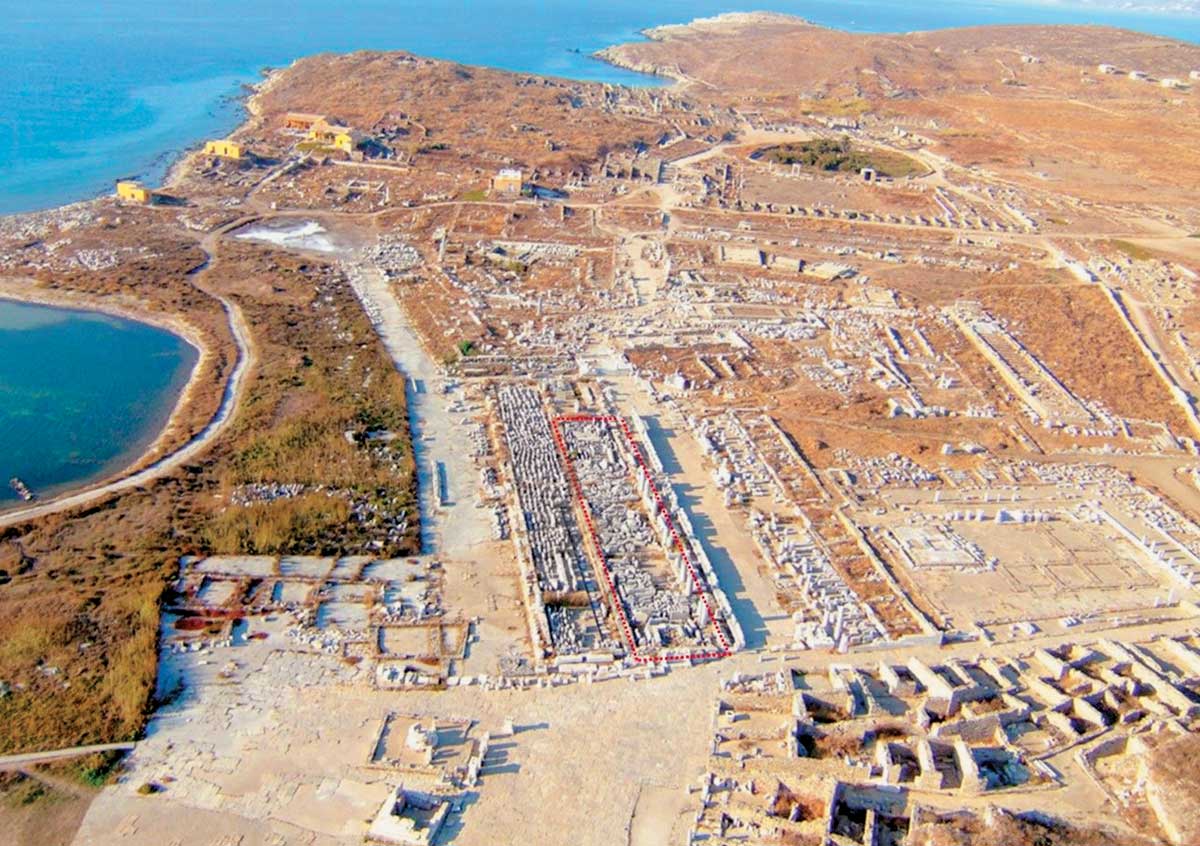
Greece's Central Archaeological Council on Sunday gave the go-ahead to a project to help restore some of the most important monuments on the island of Delos, using a grant donated by the Paul and Alexandra Canellopoulos Foundation.

Restoration works at ‘sacred isle’ of Delos approved
Aerial view of the Stoa of Philip V in Delos [Credit: Ethnos]
The project will launch a new era for the 'sacred isle' of Delos, which was considered the most important sanctuary of antiquity and the birthplace of the gods Apollo and Artemis. The project will begin with the Stoa of Philip V, which is one of the first monuments that a visitor comes across but also the hardest to understand, since it is missing its '3rd dimension'.

The Cyclades Antiquities Ephorate, using the 550,000-euro donation from the Kanellopoulos Foundation, will now take action to restore the damage and the result of wear caused by salt water to the various architectural elements on the ground.

According to the head of the Cyclades Antiquities Ephorate Dimitris Athanasoulis, the restoration work on Delos - as in the case of the Philip V Stoa - was essential for the protection of the monuments, not just to help visitors understand them.

"Delos is a small island, where the salt corrodes everything. Architectural elements in such a hostile environment degenerate rapidly. Their restoration on the monument will greatly reduce the wear," he said.

While the urban neighbourhoods on Delos were well-preserved, Athanasoulis said, the same was not true of the sanctuary. He said the Ephorate's strategy was to use EU and state funds on the "emergency" projects and try to find sponsors and grants for the rest. He pointed out that the needs on Delos, due to the special conditions prevailing on the island, were similar to those in Pompeii where millions of euros in European funds were given each year.

Source: ANA-MPA [April 09, 2017]

Restoration works at ‘sacred isle’ of Delos approved

Greece's Central Archaeological Council on Sunday gave the go-ahead to a project to help restore some of the most important monuments on...

Friday, April 7, 2017


Portuguese and German researchers are currently in the process of identifying underground structures and remnants in a dig that is currently taking place in the Western Algarve.

Scientists study Roman heritage in Portugal's Algarve
The site at Boca do Rio in Vila do Bispo is thought to be one of the most important of the Roman occupation 
between the 1st and 5th centuries [Credit: The Portugal News]
The site at Boca do Rio in Vila do Bispo is thought to be one of the most important of the Roman occupation between the 1st and 5th centuries. In addition to learning more about the Algarve’s Roman heritage, scientists are also hoping to determine if there were other tsunamis besides the one that struck Portugal in 1755.

The dig is being spearheaded by Professor Felix Teichner of the University of Marburg (Germany) and also involves researchers from the German universities of Cologne and Aix-la-Chapelle.

Geo-radars are being used in the probes, which are devices with the capacity to analyse in detail the terrain and below-ground buildings, using the reflection of electromagnetic waves.

“These are non-invasive works, using a combination of different methods that allow us to discover evidence of human origin hidden underground, to create a solid project, to know exactly what we want from research for the future”, said João Pedro Bernardes, a Portuguese geologist who is collaborating on and coordinating the project.

Scientists study Roman heritage in Portugal's Algarve
In addition to learning more about the Algarve’s Roman heritage, scientists are also hoping to determine if there were 
other tsunamis besides the one that struck Portugal in 1755 [Credit: The Portugal News]
“From the Palaeolithic diet to what kind of illnesses these people gained from activities linked to fishing. What they ate and what impact that food had; that is what archaeology does, it discovers the activity of everyday life”, he explained .

The objective, the Algarve University researcher elaborated, is not only to focus the project on a specific era, but also to see the evolution of fishing techniques from the first century to the present day and “giving value to an archaeological site of great importance” in the identity of southwest Europe and a fishing and sea-going people.

“This overlap of occupations that this site contains makes it the ideal place to study evolution”, he said.

Vila do Bispo Mayor, Adelino Soares, said the identification of the region’s historical heritage “justifies the investment that has been made in supporting research, with a reflection on economic and tourist enhancement.”

“This forms part of a strategy of territorial development, of historical and cultural identification and of capturing another type of tourism”, he concluded.

Source: The Portugal News [April 07, 2017]

Scientists study Roman heritage in Portugal's Algarve

Portuguese and German researchers are currently in the process of identifying underground structures and remnants in a dig that is currently...

Wednesday, April 5, 2017


A 2,300-year-old aqueduct uncovered by workers on Rome's new Metro line has been hailed as "a sensational discovery of enormous importance" by the city's Superintendency for Archaeology.

Rome Metro workers discover ancient aqueduct
The aqueduct dates from the 3rd century BC and is the oldest in Rome
[Credit: Archaeological Superintendency Rome]
The find was made in the heart of the city, in Piazza Celimontana, during construction work for line C of Rome’s metro, right in front of the Celio military hospital. Here – almost 20 metres deep, where it is normally impossible to dig and study in safety – there lies what archaeologists have called “a sensational discovery of enormous importance, because it is almost certainly the most ancient Roman aqueduct, dating from the third century before Christ”.

Stratigraphy of the city revealed

The discovery was announced on Monday, 3 April, but occurred in late 2016, confirmed Simona Morretta, the heritage department’s head archaeologist for the Celio area: “The ruins emerged during work on a ventilation shaft about 32 metres wide and involving an area of about 800 square metres for line C of the metro, which started over two years ago”.

Details of the discovery, that we are reporting here for the first time, will be presented on Wednesday, 5 April at a conference at Rome’s Sapienza university. Morretta and Paola Palazzo, who directed the excavation with the “Archeologia” cooperative, will illustrate to the academic community their report, entitled “a stretch of a Republican aqueduct discovered during excavation work for line C of the Metro in Piazza Celimonana”.

“It is only thanks to the concrete bulkheads built for work on the metro,” explained Morretta, “that we could get down to that level, studying for the first time the entire stratigraphy of Rome – starting from the existing houses and descending to an Iron Age tomb with grave goods, including two bowls, from the late 10th-early 9th century BC”.

Rome Metro workers discover ancient aqueduct
The section unearthed of the 2,300-year-old construction is 32 metres long. An Iron Age tomb 
with grave goods also found [Credit: Archaeological Superintendency Rome]
At a depth of 18 metres

The tomb, found at a depth of 18 metres below the current ground level, is the first find of its kind in the Celio district, “but Rome, as we know, has always been built on itself, layer upon layer, often using former constructions as foundations”.

The discovery also includes a 3,000-year-old tomb, then, but of much greater interest is the aqueduct: “There emerged at a depth of 17.40 metres a stretch of aqueduct as long as the entire diameter of the ventilation shaft – 32 metres – and about two metres high, built in blocks of grey ‘cappellaccio’ tuff. It surely continues, both east and west, beyond the bulkheads.”

A ten-metre section of aqueduct has now been dismantled block by block, catalogued, and “piled up” back on the surface. There are plans to to reassemble it where the public can see it: “It was not possible to visit it 20 metres below ground, so we hope to rebuild it elsewhere in the future. It must be said, however, that such discoveries are only possible thanks to the work being done for the metro; excavations do not usually go so deep, and on this occasion were only possible because of the bulkheads. It was an extraordinary opportunity for us archaeologists”.


An impressive work

The Aqueduct is a serial structure, but is still able to provide a great deal of precise, and new information. “We still do not know how the aqueduct developed, i.e. where it started and ended. The authority to turn to in this case, as always, is Frontinus, author of a famous treatise on Rome’s aqueducts, written in 102 AD. Frontinus describes them all, and also tells us that some aqueducts passed through the Celio district. However, nothing had ever been found. In addition, on the basis of the dating of the material found, our aqueduct must have been built shortly before the middle of the 3rd century, in the mid-Republican Age, i.e. about 2,300 years ago."

"The question is: which aqueduct does the find belong to? We do not know yet. The Anio Vetus – whose name came from the Anio valley, the source of its waters – dates back to 272 BC. The period matches, yet even though this coincidence would seem to suggest a link, Frontinus says the Anio Vetus did not pass through Celio. It is thus more likely to be part of the Aqua Appia, the first aqueduct built in Rome. We must assume that a public work of this impressive size would have taken decades to build, so the dating could in fact coincide. We also know that the Aqua Appia was extremely deep, as is the section unearthed”.

Later used as a sewer

Moreover, the work was found completely buried. “It is precisely the intact layers of earth,” concluded Morretta, “that allowed us to establish when it ceased to be used, namely in the early Imperial Age. Subsequently, in late antiquity, the aqueduct was used as a sewer. Another curiosity is that the layers of earth revealed large amounts of leftovers from meals, which were an exceptional mine of information for our archaeozoologist. I have just received their report, which was extremely interesting. And now we know exactly what was eaten by Roman aristocrats living in the large villas in the area. All sorts of things were found in the sewers: remains of pets, parts of wild boars, plenty of rare birds, and exotic foods. There were not only the remains of hens, cocks and capons, but also of swans and pheasants, as well as huge seawater fish such as grouper”.

Author: Edoardo Sassi, transl. Simon Tanner | Source: Corriere Della Sera [April 05, 2017]

Rome Metro workers discover ancient aqueduct

A 2,300-year-old aqueduct uncovered by workers on Rome's new Metro line has been hailed as "a sensational discovery of enormous imp...

The eastern necropolis of the ancient city of Serdica has been found during construction work at the site of the former Serdica cinema in Sofia, which is to be the location of the Hyatt Regency Sofia hotel in the Bulgarian capital.

Eastern necropolis of ancient Serdica found at Sofia construction site

At the site, next to the Vassil Levski Monument, six family tombs and 20 pit burials were found, though it appears they were damaged during the construction of buildings at the site in the 20th century.

According to a report on April 4 by public broadcaster Bulgarian National Television, archaeologists were not surprised by the find, because they knew roughly where the site of the eastern necropolis was.

The family tombs appear to have been damaged during construction work in the 1950s and 1960s.

Yulian Meshekov, leader of the archaeological excavations, said that the tombs were cut practically at foundation level, with little of their higher reaches preserved, probably as a result of the construction work in those past decades.

Eastern necropolis of ancient Serdica found at Sofia construction site

The tombs are believed to date from the early Christian period, between the fourth and sixth centuries, when it was not customary to leave burial gifts. There were no remains in them, which means that over the centuries, they had been subject to vandalism.

Human remains were found in the 23 intact pit burials between the tombs.

The bones will be sent to Austria for carbon analysis. The dating of the burials will help to shed light on the history of the site.

The report noted that it is yet to be decided whether the broken tombs will be preserved or covered by the new construction.

Three children’s graves found at necropolis in Plovdiv’s Great Basilica site

Archaeological work has also resumed at the Great Basilica site in Bulgaria’s second city Plovdiv, with the first day of the 2017 season resulting in the finding of three children’s graves at the necropolis and a beautifully-crafted chapiter of a pillar.

Three children’s graves found at necropolis in Plovdiv’s Great Basilica site

The Great Basilica, understood to date from the fourth to the fifth centuries, in the largest early Christian church yet found on the Balkans. The site is near Plovdiv’s 19th century Roman Catholic St Ludwig church.

Zheni Tankova, head of the archaeological team, said that expectations were very high high. Last year alone, the dig team uncovered 250 square metres of mosaic, and this year the process is continuing, Plovdiv website podtepeto.com reported.

The first group of volunteers who will assist at the Great Basilicia site will arrive on April 28. Their tasks will include uncovering the mosaics from beneath the sand, over a large area.

Three children’s graves found at necropolis in Plovdiv’s Great Basilica site

“At this point, we will see the greatest beauty, because all the mosaics will be revealed,” Tankova said.

Work on the object itself should be completed in late June, but it is not certain whether the dig team will be able to meet that deadline.

“We don’t know whether we’ll succeed because it does not depend only on us, but on the structures that emerge. The cleaning is a slow process, and more graves continue to appear, which further slows the process. Further, we also find structures that do not belong to the basilica building. Apparently they are some later alterations,” Tankova said.

Three children’s graves found at necropolis in Plovdiv’s Great Basilica site

It is not yet clear whether the beautiful mosaics will be raised for restoration elsewhere, or whether work will be done on them at the site.

The aim is for the project to be completed, for the exhibition of the archaeological finds, by 2019 when Plovdiv will be European Capital of Culture.

Source: The Sofia Globe [April 05, 2017]

Eastern necropolis of ancient Serdica found at Sofia construction site

The eastern necropolis of the ancient city of Serdica has been found during construction work at the site of the former Serdica cinema in So...

A wooden crucifix sculpted by Michelangelo at 18 has been restored to pride of place in Florence's Santo Spirito, the church the Renaissance master had created it for.

Restored Michelangelo crucifix gets pride of place at Santo Spirito basilica in Florence
View of a wooden crucifix sculpted by Italian artist Michelangelo at the Santo Spirito basilica in Florence 
[Credit: Alberto Pizzoli/AFP]
After the death of his first benefactor Lorenzo de Medici in 1492, Michelangelo lived for a year with a community of Augustine monks associated with the famous basilica, studying anatomy in the hospital they ran.

Restored Michelangelo crucifix gets pride of place at Santo Spirito basilica in Florence
Michelangelo crucifix hangs in new location in the basilica of Santo Spirito in Florence 
[Credit: Niccolo Cambi/Massimo Sestini]
As a thank you for their welcome, he left them a 1.40 metre (four and a half foot) sculpture of a nude Jesus Christ on the cross.

Restored Michelangelo crucifix gets pride of place at Santo Spirito basilica in Florence
Detail of crucifix hanging in Santo Spirito in Florence 
[Credit: Niccolo Cambi/Massimo Sestini]
The masterpiece was thought lost for decades before it was found in the 1960s, in a convent corridor and so badly overpainted it was barely recognisable.

Restored Michelangelo crucifix gets pride of place at Santo Spirito basilica in Florence
Side view of crucifix hanging at Santo Spirito in Florence
[Credit: Alberto Pizzoli/AFP]
Now restored, it recently went on tour in Italy before returning Tuesday to take up a new setting in Santo Spirito: suspended above the church's old sacristry in a way that allows visitors to inspect it from all angles.

Restored Michelangelo crucifix gets pride of place at Santo Spirito basilica in Florence
Restored Michelangelo crucifix hanging at Santo Spirito in Florence 
[Credit: Maurizio Degl'Innocenti, ANSA]
"The Santo Spirito district, with its extraordinary basilica, is a place that needs protecting and to be brought to life," said Simonetta Brandolini d'Adda, president of the Friends of Florence group which helped organise the new installation for "this serene, sublime Christ."

Source: AFP [April 06, 2017]

Restored Michelangelo crucifix gets pride of place at Santo Spirito basilica in Florence

A wooden crucifix sculpted by Michelangelo at 18 has been restored to pride of place in Florence's Santo Spirito, the church the Renaiss...

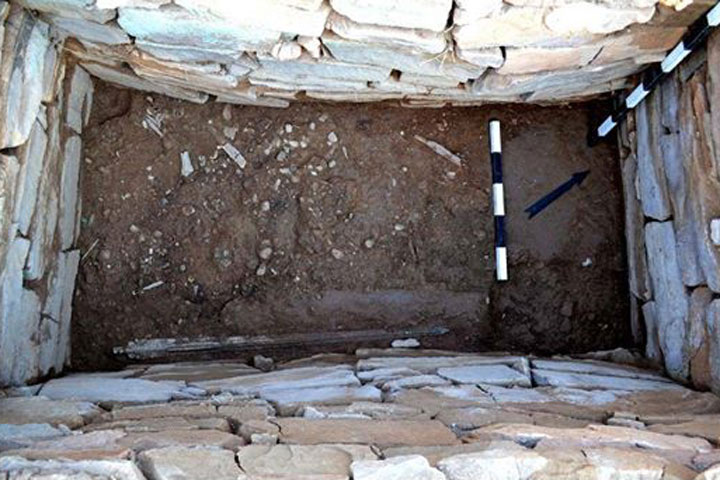
A shaft grave dated to the early Mycenaean period (ca. 1600 BC) was discovered during the 2016 excavation season at Plassi in Marathon, a short distance from the Tumulus of Marathon, revealing the significance of Marathon as a place of remembrance for ancient Athens, before and after the great battle of 490 BC.

Mycenaean warrior tomb unearthed at Marathon
The excavation of the grave at Plassi, Marathon [Credit: © Department of Archaeology 
and History of Art, NKUA]
The grave's occupant was evidently a warrior who was buried with a sword, a spear, a knife and arrows.

Mycenaean warrior tomb unearthed at Marathon
The Warrior Grave of early Mycenaean period at Plassi, Marathon [Credit: © Department of Archaeology 
and History of Art, NKUA]
Almost a millennium later, during the early Archaic period (c. 700 BC), the grave was discovered by the inhabitants of Marathon, who left the weapons in the grave but collected the bones of the deceased with great caution, possibly assuming that they belonged to a mythical hero of the past, and erected a sanctuary above the grave to honour him.

Mycenaean warrior tomb unearthed at Marathon
Rectangular precinct of the sanctuary which had been erected above the Mycenaea grave at Plassi, Marathon 
[Credit: © Department of Archaeology and History of Art, NKUA]
This sanctuary was destroyed at the time of the great battle, probably by the Persian army, and was subsquently abandoned, since the dominant site of historical memory in the area shifted to the Tumulus of Marathon.

Mycenaean warrior tomb unearthed at Marathon
View of the excavation at Plassi of Marathon [Credit: © Department of Archaeology 
and History of Art, NKUA]
For more information see the Marathon Excavation website.

Source: ANA-MPA [April 05, 2017]

Mycenaean warrior tomb unearthed at Marathon

A shaft grave dated to the early Mycenaean period (ca. 1600 BC) was discovered during the 2016 excavation season at Plassi in Marathon, a sh...

Sunday, April 2, 2017


Eight crates containing 33 archaeological artefacts and 600 coins, including some ancient masterpieces dating to the 12th and 13th centuries BC, arrived at the National Archaeological Museum in Athens from Munich on Friday.

Germany returns 33 smuggled artefacts to Greece
The finds were linked with the antiquities smuggling ring which was “dismantled” last October in Patras 
[Credit: ANA-MPA]
The crates full of archaeological treasures were transported to the museum with great secrecy and opened in the museum amphitheatre in the presence of Culture Minister Lydia Koniordou, with the Athens-Macedonian News Agency invited to record the opening of the crates as the museum curators took delivery.

The remarkable finds, most in very good condition, included amphorae, bird-shaped vases, a ceramic statue of a chariot driver and two riders and other small objects, most of which were possibly grave goods taken from the northwestern Peloponnese.

“Today, this is a special, touching and very important moment. What you feel from the expressions of the archaeologists and curators, the joy on their face every time the very important finds are unveiled one by one,” said Koniordou. Their return from Munich, where they were taken illegally, was “truly touching,” the minister added, noting that it was a huge success for Greek and German law enforcement agencies, which had cooperated seamlessly in a joint effort to which the Greek general consul in Munich had also contributed greatly.

Germany returns 33 smuggled artefacts to Greece
The artefacts were transferred to the conservation workshop of the National Archaeological Museum 
[Credit: ANA-MPA]
The minister said that the 33 objects dated to the late Bronze Age, had very interesting shapes and patterns, while most appeared to come from the same pottery workshop. There were also small objects from the Geometric period that were “real masterpieces” and 600 coins, she said.

“It is a non-negotiable principle of the Greek state to combat illegal antiquities smuggling and protect cultural heritage by any means. It is our desire that these illegally acquired ancient treasures should return to the areas from which they were stolen. We are already discussing how specific antiquities will be presented at the best time and in the best way to the public,” Koniordou said.

The finds linked to an international ring of illegal antiquities traders dismantled in Patras last October have been transferred to museum conservation workshops, while a committee has been set up to assess their authenticity and value.

Author: Kerry Kolasa-Sikiaridi | Source: Greek Reporter [April 02, 2017]

Germany returns 33 smuggled artefacts to Greece

Eight crates containing 33 archaeological artefacts and 600 coins, including some ancient masterpieces dating to the 12th and 13th centuries...


© 2015 - Distributed By Free Blogger Templates | Lyrics | Songs.pk | Download Ringtones | HD Wallpapers For Mobile