Header

Modul
Showing posts with label Germany. Show all posts

Wednesday, April 12, 2017


Led by scientists of the Senckenberg Research Institute and the University of Tübingen, the excavation team found the remains of a saber-toothed cat at the archaeological site in Schöningen. An examination of the skull fragments at the Dutch University of Leiden revealed the animal to be a representative of the European saber-toothed cat, Homotherium latidens. The recent discovery constitutes the third example of this large predatory cat from Schöningen.

Almost complete skull of saber-toothed cat discovered in Schöningen
Artistic rendition of Homotherium latidens [Credit: Mauricio Antón]
Long claws, razor-sharp, curved canine teeth and the size of a fully grown lion: the saber-toothed cat (Homotherium latidens) was a competitor as well as a dangerous predator that even posed a risk to the humans of its time.

"In the course of our excavation in May 2015, we came across conspicuous bone fragments," explains Dr. Jordi Serangeli, a scientist at the University of Tübingen and the excavation leader at the approximately 300,000-year-old archaeological site, and he continues, "In total, there are three individuals of Homotherium present in these relatively young sediment layers."

Almost complete skull of saber-toothed cat discovered in Schöningen
In-situ position of a skull fragment from the third Homotherium, which was discovered on 25 May 2015 
at the archaeological dig in Schöningen [Credit: Univ. Tübingen/Senckenberg]
Until the first discovery of a saber-toothed cat in 2012 at the Schöningen excavation site in Lower Saxony it had been assumed that the large cats were already extinct about 200,000 years earlier, i.e., around 500,000 years ago. "Our findings show that 300,000 years ago, the saber-toothed cats were not as rare as previously thought," adds Serangeli.

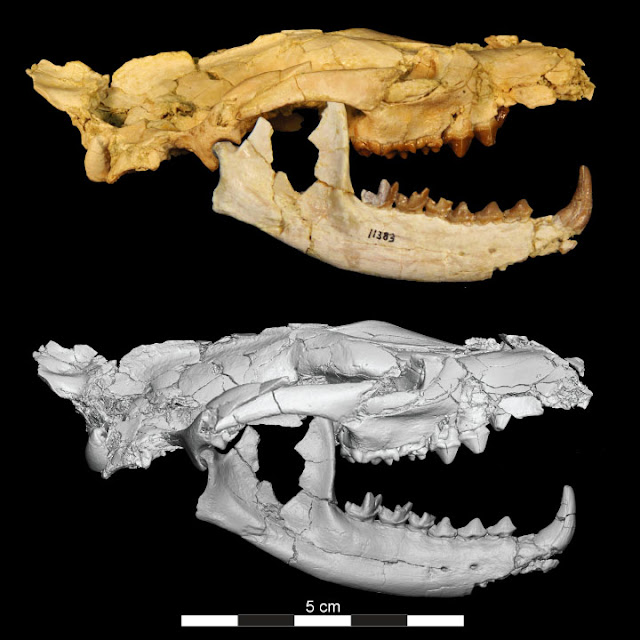
During a restoration in 2016, André Ramcharan and Ivo Verheijen at the University of Leiden were able to reassemble the eleven bone fragments into an almost complete neurocranium. "We then compared the reconstructed skull with recent and already extinct species of large carnivores and were thus able to demonstrate that the remains represented the head of a European saber-toothed cat," explains Professor Dr. Thijs van Kolfschoten of the University of Leiden.

Almost complete skull of saber-toothed cat discovered in Schöningen
The bones were initially scanned, restored and subsequently reassembled with the aid 
of a computer [Credit: University of Leiden]
The third saber-toothed cat specimen that was discovered offers a great potential: thanks to the excellent level of preservation at the Schöningen dig, the interior of the skull reflects the shape and structure of the Homotherium brain. By examining the detailed brain structures, the team of scientists hopes to gain insights into the visual and hearing abilities as well as the feeding habits of the large cats.

"The third Homotherium from Schöningen is invaluable for our understanding of the European saber-toothed cat," summarizes Professor Nicholas Conard of the Senckenberg Centre for Human Evolution and Palaeoenvironment and head of the Institute for Early Prehistory and Quaternary Ecology at the University of Tübingen.

Almost complete skull of saber-toothed cat discovered in Schöningen
The reconstructed neurocranium of the European saber-toothed cat 
[Credit: Univ. Tübingen/Senckenberg]
In the near future the international team from the Schöningen project intends to publish the results of its interdisciplinary studies regarding the three saber-toothed cats discovered to date. "Moreover, we expect that future digs will produce additional Homotherium finds," offers Serangeli as a preview.

The dig in Schöningen keeps a team of ten members employed full-time -- and during the main excavation season, the team is joined by five to ten students, who support the scientific excavation. Worldwide, about 50 scientists from 30 institutions and a wide variety of disciplines are involved in researching the discoveries from Schöningen. The dig is financed by the State of Lower Saxony.

Almost complete skull of saber-toothed cat discovered in Schöningen
Technician André Ramcharan (University of Leiden, Netherlands) compares a find with 
the cast skull of a Homotherium [Credit: University of Leiden]
The spectacular new discovery is put on display for the public at the palaeon in Schöningen as part of the special exhibition "The Ice Age Huntress." Thanks to the close cooperation between Senckenberg, the international partners and the der palaeon GmbH, it is possible to make spectacular scientific findings available to the public in a timely manner.

Source: Senckenberg Research Institute and Natural History Museum [April 12, 2017]

Almost complete skull of saber toothed cat discovered in Schöningen

Led by scientists of the Senckenberg Research Institute and the University of Tübingen, the excavation team found the remains of a saber-too...

Tuesday, April 11, 2017


The North Atlantic Oscillation (NAO) is the dominant atmospheric pressure mode over the North Atlantic that plays a significant role in determining the winter climate in Europe.

Stalagmites store paleoclimate data
Zoolithen Cave in Burggaillenreuth with flowstones, stalactites, and stalagmites
[Credit: Jasper Wassenburg]
Depending on the prevailing state of the NAO, Europe experiences mild or very cold winters and even strong storms. Geoscientists based at Johannes Gutenberg University Mainz (JGU) in Germany are currently reconstructing the fluctuations of the NAO over the last 10,000 years with the aim of being able to predict future developments.

For this purpose, they use stalagmites obtained from subterranean caves as natural climate archives and are examining new indicators of climate change to retrieve climate information that is as accurate as possible. Initial results indicate that it is likely that the NAO will respond to the melting of the Arctic ice cap in the future, with consequences for our climate, environment, and society as a whole.

Dr. Jasper Wassenburg works with stalagmites from caves in the Middle Atlas, a mountain range in the northwest of Morocco. Stalagmites are calcium carbonate deposits that grow from the floor of a cave upwards due to precipitation of calcium carbonate minerals deposited from the dripwater. Calcite is the most common form of calcium carbonate although in some cases it can also be aragonite. "Aragonite, if well preserved, can be dated with remarkable precision. So we prefer aragonite stalagmites over calcitic ones," explained Wassenburg, who is a member of the research team headed by Professor Denis Scholz at the Institute of Geosciences at Mainz University.

The incorporation of chemical elements in speleothems, which is the term scientists use for the secondary mineral deposits in caves, is often depending on changes in the environment. These elements are known as climate proxies because they provide indirect evidence of climatic history. Wassenburg's study of seven speleothem samples obtained from Morocco, India, France, Spain, and a cave known as the Hüttenbläserschachthöhle in Germany's Sauerland region is the first attempt to identify in detail the concentrations at which trace elements tend to be incorporated in aragonite. "We have been able to demonstrate that the concentration of uranium in aragonite stalagmites is a very precise indicator of prehistoric rainfall patterns," he added. This means that stalagmites can tell us qualitatively how much it rained 200,000 years ago.

Stalagmites store paleoclimate data
The Bab Mafraque cave in the Middle Atlas in Morocco with flowstones and stalactites 
[Credit: Jasper Wassenburg]
Reconstruction of the North Atlantic Oscillation as far back as the onset of the current interglacial period

Uranium and strontium concentrations and the relative ratios of oxygen isotopes were also analyzed in order to obtain information on past rainfall for a recent study of past NAO variability. The NAO index reflects the difference in atmospheric pressure between the Icelandic Low to the north and the Azores High to the south. One particular phenomenon of interest is that if the NAO brings dry weather to Europe, it rains in Morocco—and vice versa. The weather of the northwestern region of Morocco seems to react particularly sensitive to changes in the NAO. In this case, the samples used by Dr. Jasper Wassenburg came from a fairly small cave in which the host rock is dolomite. The Grotte de Piste is located in the Atlas Mountains at an elevation of some 1,250 meters above sea level. It is 70 to 80 meters in extent and 15 to 20 meters from floor to ceiling.

The results of analysis of the speleothems from the north-west of Morocco were compared with a rainfall reconstruction obtained from other cave deposits from the Bunkerhöhle or Bunker cave in western Germany. This enabled the climate researchers to trace back the fluctuations of the NAO over the past 11,000 years to the end of the last Ice Age. The best reconstruction previously available went back only 5,200 years. "We were surprised to discover that the situation during the early Holocene 11,000 years ago was quite different to that of today. The weather regimes in Europe and Morocco seem to have behaved similarly so that wet weather in Europe also meant more rain in Morocco," explained Wassenburg. This positive correlation disappeared at some point during the transition from the early Holocene to the mid-Holocene.

The researchers postulate that this was attributable to a major reduction in the melt water contribution from the Laurentide Ice Sheet that still covered large areas of North America at the end of the Ice Age. "The pattern of the North Atlantic Oscillation is not as stable as we thought," stated Professor Dennis Scholz and added that the NAO will probably also be influenced by today's melting of the Greenland Ice Sheet, with potential effects on the atmosphere, the oceans, and other biological phenomena, including farming and fishing. The team plans to conduct further research in order to reconstruct the changes of the NAO over the last 10,000 years.

The findings are published in Geochimica et Cosmochimica Acta and Nature Geoscience.

Source: University of Mainz [April 11, 2017]

Stalagmites store paleoclimate data

The North Atlantic Oscillation (NAO) is the dominant atmospheric pressure mode over the North Atlantic that plays a significant role in dete...

Sunday, April 2, 2017


Eight crates containing 33 archaeological artefacts and 600 coins, including some ancient masterpieces dating to the 12th and 13th centuries BC, arrived at the National Archaeological Museum in Athens from Munich on Friday.

Germany returns 33 smuggled artefacts to Greece
The finds were linked with the antiquities smuggling ring which was “dismantled” last October in Patras 
[Credit: ANA-MPA]
The crates full of archaeological treasures were transported to the museum with great secrecy and opened in the museum amphitheatre in the presence of Culture Minister Lydia Koniordou, with the Athens-Macedonian News Agency invited to record the opening of the crates as the museum curators took delivery.

The remarkable finds, most in very good condition, included amphorae, bird-shaped vases, a ceramic statue of a chariot driver and two riders and other small objects, most of which were possibly grave goods taken from the northwestern Peloponnese.

“Today, this is a special, touching and very important moment. What you feel from the expressions of the archaeologists and curators, the joy on their face every time the very important finds are unveiled one by one,” said Koniordou. Their return from Munich, where they were taken illegally, was “truly touching,” the minister added, noting that it was a huge success for Greek and German law enforcement agencies, which had cooperated seamlessly in a joint effort to which the Greek general consul in Munich had also contributed greatly.

Germany returns 33 smuggled artefacts to Greece
The artefacts were transferred to the conservation workshop of the National Archaeological Museum 
[Credit: ANA-MPA]
The minister said that the 33 objects dated to the late Bronze Age, had very interesting shapes and patterns, while most appeared to come from the same pottery workshop. There were also small objects from the Geometric period that were “real masterpieces” and 600 coins, she said.

“It is a non-negotiable principle of the Greek state to combat illegal antiquities smuggling and protect cultural heritage by any means. It is our desire that these illegally acquired ancient treasures should return to the areas from which they were stolen. We are already discussing how specific antiquities will be presented at the best time and in the best way to the public,” Koniordou said.

The finds linked to an international ring of illegal antiquities traders dismantled in Patras last October have been transferred to museum conservation workshops, while a committee has been set up to assess their authenticity and value.

Author: Kerry Kolasa-Sikiaridi | Source: Greek Reporter [April 02, 2017]

Germany returns 33 smuggled artefacts to Greece

Eight crates containing 33 archaeological artefacts and 600 coins, including some ancient masterpieces dating to the 12th and 13th centuries...


© 2015 - Distributed By Free Blogger Templates | Lyrics | Songs.pk | Download Ringtones | HD Wallpapers For Mobile