Header

Modul
Showing posts with label Palaeontology. Show all posts

Wednesday, April 19, 2017


A large set of tracks made by archosauromorphs in the Pyrenees mountain range may include a new type of footprint made by reptiles that lived 247 million years ago, according to a study published in the open-access journal PLOS ONE.

Ancient reptile tracks in the Pyrenees may include evidence of new type of footprint
A large set of tracks made by archosauromorphs in the Pyrenees mountain range may include a new type 
of footprint made by reptiles that lived 247 million years ago, according to a study 
[Credit: Universitat Autònoma de Barcelona/PLOS]
The Permian mass extinction resulted in the loss of 90 percent of species. The environmental and climactic conditions hindered the recovery of vertebrate species following this devastating event.

To investigate which vertebrates lived during beginning of the Mesozoic Era, which followed the Permian extinction, Mujal and colleagues examined trace fossils of vertebrates in the Pyrenees mountains in Catalonia from approximately 247 to 248 million years ago. The researchers made 3D models and created silicone molds of these ephemeral fossils, enabling them to preserve the fossils in scientific collections.

Ancient reptile tracks in the Pyrenees may include evidence of new type of footprint
Tracks of Prorotodactylus mesaxonichnus [Credit: Eudald Mujal et al./PLOS]
The researchers identified that most tracks were made by archosauromorphs, the ancestors of crocodiles and dinosaurs. The majority were small, about half a meter in length, although a few specimens were longer than three meters.

The researchers also identified a new footprint, Prorotodactylus mesaxonichnus, and the new fossil evidence from the Pyrenean tracks suggests that at least the Pyrenean Prorotodactylus genus is related to archosauromorphs, rather than being a dinosauromorph as previously thought from other records.

Ancient reptile tracks in the Pyrenees may include evidence of new type of footprint
Fossil assemblage, paleoenvironment and biochronologic interval [Credit: Eudald Mujal et al./PLOS]
The authors suggest that the abundance of archosauromorph fossils in the Pyrenees provides evidence that archosauromorphs may have played a large role in vertebrate recovery following the Permian mass extinction. Further research could explore how the archosauromorph lineage may have evolved and spread following this time period.

"Trace fossils are evidence that archosauromorphs dominated the fluvial environments of the Catalan Pyrenees during the Triassic vertebrate recovery, early after the end-Permian mass extinction," says Mujal.

Source: PLOS [April 19, 2017]

Ancient reptile tracks in the Pyrenees may include evidence of new type of footprint

A large set of tracks made by archosauromorphs in the Pyrenees mountain range may include a new type of footprint made by reptiles that live...

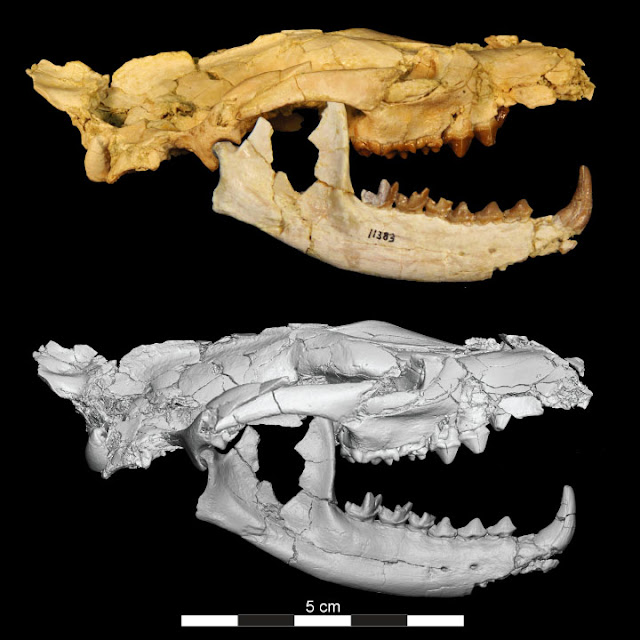
Analysis of Egyptian fossils has identified a new species of extinct carnivorous mammals called hyaenodonts, according to a study published in the open-access journal PLOS ONE

New species of hyaenodon found in Egypt
Hyaenodont skull [Credit: Matthew Borths]
Hyaenodonts preceded modern terrestrial carnivores in Africa and also lived in Europe, Asia, and North America. Some were tree-dwelling; others were terrestrial. The Afro-Arabian hyaenodont records are the oldest, making them key to understanding the evolution of these extinct meat-eaters.

The authors of the present study characterized 34 million-year-old Egyptian fossils of a new skunk-sized species of hyaenodont. They named it Masrasector nananubis, the species name referring to Anubis, the canine-headed Egyptian god associated with the afterlife.

This hyaenodont was a teratodontine, a carnivorous clade that has been difficult to align with other lineages due to poorly known cranial anatomy. The fossils of the new hyaenodont are the most complete known remains of a teratodontine from the Paleogene Period, and include largely complete skulls, jaws and limb bones.

Based on the morphology of the new hyaenodont's bones, the researchers concluded that teratodontines are a close sister group of Hyainailourinae, one of two major hyaenodont clades that were hypercarnivorous, eating mostly meat.

Comparison of the limb bones with those of other meat-eating mammals suggests that the new species was terrestrial and moved fast. The researchers state that the fossils of this new species will inform all future explorations of hyaenodont evolution and ecological diversity.

"Hyaenodonts were the the top predators in Africa after the extinction of the dinosaurs," says Borths. "This new species is associated with a dozen specimens, including skulls and arm bones, which means we can explore what it ate, how it moved, and consider why these carnivorous mammals died off as the relatives of dogs, cats, and hyenas moved into Africa."

Source: PLOS [April 19, 2017]

New species of hyaenodon found in Egypt

Analysis of Egyptian fossils has identified a new species of extinct carnivorous mammals called hyaenodonts, according to a study published ...

Tuesday, April 18, 2017


Four hundred and thirty million years ago, long before the evolution of barracudas or sharks, a different kind of predator stalked the primordial seas. The original sea monsters were eurypterids -- better known as sea scorpions.

Sea scorpions: The original sea monster
This illustration shows a sea scorpion attacking an early vertebrate 
[Credit: Nathan Rogers]
Related to both modern scorpions and horseshow crabs, sea scorpions had thin, flexible bodies. Some species also had pinching claws and could grow up to three metres in length. New research by University of Alberta scientists Scott Persons and John Acorn hypothesise that the sea scorpions had another weapon at their disposal: a serrated, slashing tail spine.

Armed and dangerous

"Our study suggests that sea scorpions used their tails, weaponized by their serrated spiny tips, to dispatch their prey," says Scott Persons, paleontologist and lead author on the study.

Sparked by the discovery of a new fossil specimen of the eurypterid Slimonia acuminata, Persons and Acorn make the biomechanical case that these sea scorpions attacked and killed their prey with sidelong strikes of their serrated tail.

The fossil, collected from the Patrick Burn Formation near Lesmahagow, Scotland, shows a eurypterid Slimonia acuminata, with a serrated-spine-tipped tail curved strongly to one side.

Powerful weapons

Unlike lobsters and shrimps, which can flip their broad tails up and down to help them swim, eurypterid tails were vertically inflexible but horizontally highly mobile.

"This means that these sea scorpions could slash their tails from side to side, meeting little hydraulic resistance and without propelling themselves away from an intended target," explains Persons. "Perhaps clutching their prey with their sharp front limbs eurypterids could kill pretty using a horizontal slashing motion."

Among the likely prey of Slimonia acuminata and other eurypterids were ancient early vertebrates.

The paper was published in The American Naturalist.

Author: Katie Willis | Source: University of Alberta [April 18, 2017]

Sea scorpions: The original sea monster

Four hundred and thirty million years ago, long before the evolution of barracudas or sharks, a different kind of predator stalked the primo...

Studies of bones from Ice Age megafaunal animals across Eurasia and the Americas have revealed that major increases in environmental moisture occurred just before many species suddenly became extinct around 11-15,000 years ago. The persistent moisture resulting from melting permafrost and glaciers caused widespread glacial-age grasslands to be rapidly replaced by peatlands and bogs, fragmenting populations of large herbivore grazers.

Megafaunal extinctions driven by too much moisture
Alan Cooper inspects ice age bones from the Yukon Palaeontology Program’s collection, Canada, 2015 
[Credit: Julien Soubrier]
Research led by the Australian Centre for Ancient DNA (ACAD) at the University of Adelaide, published in Nature Ecology and Evolution, has revealed that the ancient bones preserve direct biochemical evidence of the environmental upheavals, which can be traced through time.

Using 511 radiocarbon dated bones from animals such as bison, horse, and llamas the team was able to investigate the role of environmental change in the mysterious megafaunal extinctions, which claimed the vast majority of existing large land animals such as giant sloths and sabre-toothed cats.

Megafaunal extinctions driven by too much moisture
Lead Author Tim Rabanus-Wallace hunts for megafaunal fossils in the Canadian permafrost in 2015 
[Credit: Julien Soubrier]
"We didn't expect to find such clear signals of moisture increases occurring so widely across all of Europe, Siberia and the Americas," says study leader Professor Alan Cooper, ACAD Director. "The timing varied between regions, but matches the collapse of glaciers and permafrost and occurs just before most species go extinct.

The international team of researchers, including the University of Alaska Fairbanks, University of Oslo, the Yukon Government, and palaeontologists across Russia and Canada, measured nitrogen isotopes preserved in dated ancient animal bones and teeth recovered from permafrost areas and caves across Europe, Siberia, North and South America. They found distinctive biochemical signals reflecting massive increases of moisture on the landscape.

Megafaunal extinctions driven by too much moisture
The study shows that a peak in moisture occurred between the time of the ice sheets melting, and the invasion 
of new vegetation types such as peatlands (data shown from Canada and northern United States)
[Credit: Julien Soubrier]
"Grassland megafauna were critical to the food chains. They acted like giant pumps that shifted nutrients around the landscape," says lead author Dr Tim Rabanus-Wallace, from the University of Adelaide. "When the moisture influx pushed forests and tundras to replace the grasslands, the ecosystem collapsed and took many of the megafauna with it."

"The idea of moisture-driven extinctions is really exciting because it can also explain why Africa is so different, with a much lower rate of megafaunal extinctions and many species surviving to this day,, says Professor Cooper. "Africa's position across the equator means that grassland zones have always surrounded the central monsoon region. The stable grasslands are what has allowed large herbivores to persist -- rather than any special wariness of hunters learned from humans evolving there."

Megafaunal extinctions driven by too much moisture
The head of Blue Babe, a mummified ice age bison, rests recently in a lab at the University of Alaska Museum 
of the North. The bison, uncovered near Fairbanks in 1979, was first described by Dale Guthrie, now
 professor emeritus. Most of Blue Babe's skin was preserved and is now publicly displayed on a
 model at the museum, but the head and horns were kept frozen. Professor Matthew Wooller
 and others are now analyzing them to improve our understanding of Blue Babe's environment.
The work includes extraction of collagen from the bones for nitrogen isotope analysis 
[Credit: Matthew Wooller]
Professor Matthew Wooller, of the University of Alaska Fairbanks, says: "We find that on different continents the climate changes happened at different times, but they all showed that moisture increased massively just prior to extinction. The really elegant feature of this study is that it produces direct evidence from the fossils themselves -- these extinct creatures are informing us about the climate they experienced leading up to their own extinctions."

Source: University of Adelaide [April 18, 2017]

Megafaunal extinctions driven by too much moisture

Studies of bones from Ice Age megafaunal animals across Eurasia and the Americas have revealed that major increases in environmental moistur...

Together with an international team, Senckenberg scientists examined the diet of the extinct Giant Sloth Megatherium. Based on analyses of the collagen in the fossil bones, the researchers concluded in their study, which was recently published in the scientific journal Gondwana Research that Megatherium subsisted on an exclusively vegetarian diet. Until recently, there had been much speculation about the food habits of these elephant-sized, ground-dwelling animals.

The giant sloth megatherium was a vegetarian
It lived 10,000 years ago and subsisted on a strictly vegetarian diet: the Giant Sloth Megatherium 
[Credit: Kamraman/WikiCommons]
Sloths may well rank among the world’s most peculiar animals: With their backs pointing downward, they hang in trees and move in slow motion from branch to branch with the aid of their sickle-shaped claws. “Sloths already occurred 10,000 years ago, for example the species Megatherium,” explains Professor Dr. Hervé Bocherens of the Senckenberg Center for Human Evolution and Palaeoenvironment at the University of Tübingen.

The extinct relatives of the sloths could reach the size of an elephant and were much too heavy to spend a significant amount of time in the trees. Instead, they lived on the ground, where they excavated large burrows. For many years, their dietary habits were an enigma; the long claws on their hands and feet, in particular, gave rise to various speculations. Did the sloths use their claws to dig up subterranean insect colonies? Did the long claws serve as hunting tools, and were the giant animals carnivores? Or did the fossil representatives live on a strictly vegetarian diet, like the recent sloths? “These questions were at the center of our new study,” adds Bocherens.

The giant sloth megatherium was a vegetarian
The sloths were too heavy to live in trees [Credit: Drawing by Robert Bruce Horsfall, 
from “A history of land mammals in the western hemisphere”]
Normally it is possible to deduce the feeding habits of fossil animals on the basis of the shape and wear of their teeth – however, the teeth of the Giant Sloth are not comparable to those of modern animals. “We therefore had to use a different method, so we measured the composition of carbon isotopes – the ratio of protein and mineral content – in the fossilized sloth bones,” explains Bocherens, and he continues, “Our measurements show that Megatherium lived on an exclusively vegetarian diet.”

In carnivores, the proportion of proteins is significantly higher than in herbivores, which primarily eat food high in carbohydrates. These differences can be documented in the isotopes. In order to reinforce their results, the scientists compared their data with more than 200 bones from modern mammals, whose diet is known, as well as with fossil specimens from both carnivores and herbivores. “Our results show that by using this method, it is possible to reconstruct the feeding habits of animals even several thousand years after their death,” adds the biogeologist from Tübingen.

Knowledge of the sloths’ feeding habits is important in order to understand their role in past ecosystems. “Moreover, the results can help us understand the interactions between Megatherium and the first human inhabitants of America – their habitats overlapped for several thousand years, before the Giant Sloth became extinct,” offers Bocherens as a preview.

Source: Senckenberg Research Institute and Natural History Museum [April 18, 2017]

The giant sloth megatherium was a vegetarian

Together with an international team, Senckenberg scientists examined the diet of the extinct Giant Sloth Megatherium. Based on analyses of t...

Monday, April 17, 2017


For much of its first two billion years, Earth was a very different place: oxygen was scarce, microbial life ruled, and the sun was significantly dimmer than it is today. Yet the rock record shows that vast seas covered much of the early Earth under the faint young sun.

Behind the iron curtain: How methane-making microbes kept the early Earth warm
Tiny incubators were used to simulate early Earth conditions, tracking microbial diversity and methane emissions 
over a period of 500 days [Credit: Rob Felt, Georgia Tech]
Scientists have long debated what kept those seas from freezing. A popular theory is that potent gases such as methane -- with many times more warming power than carbon dioxide -- created a thicker greenhouse atmosphere than required to keep water liquid today.

In the absence of oxygen, iron built up in ancient oceans. Under the right chemical and biological processes, this iron rusted out of seawater and cycled many times through a complex loop, or "ferrous wheel." Some microbes could "breathe" this rust in order to outcompete others, such as those that made methane. When rust was plentiful, an "iron curtain" may have suppressed methane emissions.

"The ancestors of modern methane-making and rust-breathing microbes may have long battled for dominance in habitats largely governed by iron chemistry," said Marcus Bray, a biology Ph.D. candidate in the laboratory of Jennifer Glass, assistant professor in the Georgia Institute of Technology's School of Earth and Atmospheric Sciences and principal investigator of the study funded by NASA's Exobiology and Evolutionary Biology Program. The research was reported in the journal Geobiology.

Using mud pulled from the bottom of a tropical lake, researchers at Georgia Tech gained a new grasp of how ancient microbes made methane despite this "iron curtain."

Collaborator Sean Crowe, an assistant professor at the University of British Columbia, collected mud from the depths of Indonesia's Lake Matano, an anoxic iron-rich ecosystem that uniquely mimics early oceans. Bray placed the mud into tiny incubators simulating early Earth conditions, and tracked microbial diversity and methane emissions over a period of 500 days. Minimal methane was formed when rust was added; without rust, microbes kept making methane through multiple dilutions.

Extrapolating these findings to the past, the team concluded that methane production could have persisted in rust-free patches of ancient seas. Unlike the situation in today's well-aerated oceans, where most natural gas produced on the seafloor is consumed before it can reach the surface, most of this ancient methane would have escaped to the atmosphere to trap heat from the early sun.

Author: John Toon | Source: Georgia Institute of Technology [April 17, 2017]

Behind the iron curtain: How methane-making microbes kept the early Earth warm

For much of its first two billion years, Earth was a very different place: oxygen was scarce, microbial life ruled, and the sun was signific...

Friday, April 14, 2017


Saber-toothed cats that roamed Los Angeles 12,000 years ago had many injuries to their shoulders and backbones that likely occurred when they killed large herbivore prey such as bison and horses, UCLA biologists report in the journal Nature Ecology and Evolution.

The dangers of being a saber-toothed cat in Los Angeles 12,000 years ago
In this illustration, saber-toothed cats pursue a bison. UCLA biologists say the cats sustained injuries to their backs 
and shoulders, likely as a result of attacks on their prey [Credit: Mauricio Anton]
Their Southern California contemporary, the dire wolf, was more likely to suffer from injuries to the head, neck, ankles and wrists, the researchers report.

"The difference in neck injuries between the two animals is dramatic," said lead author Caitlin Brown, a UCLA doctoral student in ecology and evolutionary biology. "The dire wolves had many neck injuries clustered together that could have resulted from the wolves being dragged by thrashing prey, as we see in modern wolves. In contrast, the saber-toothed cat has almost no neck or head injury, which implies that they were avoiding damage to their precious teeth."

Brown and another UCLA doctoral student in ecology and evolutionary biology, Mairin Balisi, analyzed more than 35,000 bones from saber-toothed cats and dire wolves over six months at the La Brea Tar Pits' George C. Page Museum. The researchers found injuries on 4.3 percent of all saber-toothed cat bones and 2.8 percent of all dire wolf bones.

Like modern gray wolves, dire wolves—which "are not made-up beasts for 'Game of Thrones,'" Brown said—were predators that caught and killed prey with their jaws. By contrast, saber-toothed cats (Smilodon fatalis), a species without close modern descendants, are thought to have ambushed large prey using powerful back and forelimb muscles to pull down and position the animals for killing bites. Saber-toothed cats were heavier than dire wolves, and are believed to have used their large forelimbs to pin down their prey.

"Consequently, we expected injuries in saber-toothed cats would likely be concentrated in the shoulder, anterior ribcage and spine, while those of dire wolves were likely to be more evenly distributed across all four limbs," said senior author Blaire Van Valkenburgh, a UCLA professor of ecology and evolutionary biology. "In addition, head injuries were likely to be more common in the dire wolves because they were at risk of being kicked while biting the hind­quarters during a chase. Caitlin and Mairin's analyses supported these conclusions."

While previous studies of these animals have demonstrated that injuries likely occurred during fierce battles, the UCLA biologists are the first scientists to study enough bones to determine how frequently the injuries occurred.

The finding that saber-toothed cats sustained more frequent injuries than dire wolves suggests that the cats faced a much greater risk of injury over their lifetimes. It is thought that this is because the cats killed relatively larger prey and may have done so alone, rather than as part of a group. Instead of exhaust­ing their prey through a long pursuit, the cats ambushed prey at a short distance and immobilized them using their massive forelimbs before killing the prey with precisely positioned bites, the researchers said.

"Dire wolves hunted in packs, which were essentially a running set of jaws," Van Valkenburgh said. "They had to do everything with their mouths. So we expected to see injuries where they were kicked in the head, and maybe injuries in the limbs, either by being kicked or by tripping during a hunt."

Saber-toothed cats are not tigers, Balisi noted, and are only distantly related to modern cats.

The biologists studied only trauma, inju­ries that likely resulted from hunting. This trauma included fractures that had healed, severe or chronic muscle strain, and osteoarthritis.

Author: Stuart Wolpert | Source: University of California, Los Angeles [April 14, 2017]

The dangers of being a saber-toothed cat in Los Angeles 12,000 years ago

Saber-toothed cats that roamed Los Angeles 12,000 years ago had many injuries to their shoulders and backbones that likely occurred when the...

Thursday, April 13, 2017


Move over, honeybee and seagull: it's time to meet Moabosaurus utahensis, Utah's newly discovered dinosaur, whose past reveals even more about the state's long-term history.

Moabosaurus discovered in Utah's 'gold mine'
BYU researcher Brooks Britt with the newly discovered Moabosaurus, on display 
at BYU's Museum of Paleontology [Credit: Jaren Wilkey, BYU]
The Moabosaurus discovery was published this week by the University of Michigan's Contributions from the Museum of Paleontology. The paper, authored by three Brigham Young University researchers and a BYU graduate at Auburn University, profiles Moabosaurus, a 125-million-year-old dinosaur whose skeleton was assembled using bones extracted from the Dalton Wells Quarry, near Arches National Park.

BYU geology professor and lead author Brooks Britt explained that in analyzing dinosaur bones, he and colleagues rely on constant comparisons with other related specimens. If there are enough distinguishing features to make it unique, it's new.

"It's like looking at a piece of a car," Britt said. "You can look at it and say it belongs to a Ford sedan, but it's not exactly a Focus or a Fusion or a Fiesta. We do the same with dinosaurs."

Moabosaurus discovered in Utah's 'gold mine'
BYU researcher Brooks Britt with the newly discovered Moabosaurus, on display 
at BYU's Museum of Paleontology [Credit: Jaren Wilkey, BYU]
Moabosaurus belongs to a group of herbivorous dinosaurs known as sauropods, which includes giants such as Brontosaurus and Brachiosaurus, who had long necks and pillar-like legs. Moabosaurus is most closely related to species found in Spain and Tanzania, which tells researchers that during its time, there were still intermittent physical connections between Europe, Africa and North America.

Moabosaurus lived in Utah before it resembled the desert we know -- when it was filled with large trees, plentiful streams, lakes and dinosaurs. "We always think of Moab in terms of tourism and outdoor activities, but a paleontologist thinks of Moab as a gold mine for dinosaur bones," Britt said.

In naming the species, Britt and his team, which included BYU Museum of Paleontology curator Rod Scheetz and biology professor Michael Whiting, decided to pay tribute to that gold mine. "We're honoring the city of Moab and the State of Utah because they were so supportive of our excavation efforts over the decades it's taken us to pull the animal out of the ground," Britt said, referencing the digs that began when he was a BYU geology student in the late '70s.


A previous study indicates that a large number of Moabosaurus and other dinosaurs died in a severe drought. Survivors trampled their fallen companions' bodies, crushing their bones. After the drought ended, streams eroded the land, and transported the bones a short distance, where they were again trampled. Meanwhile, insects in the soils fed on the bones, leaving behind tell-tale burrow marks.

"We're lucky to get anything out of this site," Britt said. "Most bones we find are fragmentary, so only a small percentage of them are usable. And that's why it took so long to get this animal put together: we had to collect huge numbers of bones in order to get enough that were complete."

BYU has a legacy of collecting dinosaurs that started in the early 1960s, and Britt and colleagues are continuing their excavation efforts in eastern Utah. Moabosaurus now joins a range of other findings currently on display at BYU's Museum of Paleontology -- though, until its placard is updated, it's identified as "Not yet named".

"Sure, we could find bones at other places in the world, but we find so many right here in Utah," Britt said. "You don't have to travel the world to discover new animals."

Author: Brooke Adams | Source: Brigham Young University [April 13, 2017]

Moabosaurus discovered in Utah's 'gold mine'

Move over, honeybee and seagull: it's time to meet Moabosaurus utahensis, Utah's newly discovered dinosaur, whose past reveals even ...

Eusocial insects, such as ants, social wasps and bees, and termites, include some of the most ecologically ubiquitous of terrestrial animals. The nests of these insects are well protected and provide a safe, communal space for the storing of resources and production of brood, so the nests are often cohabited by various highly specialized symbionts that take advantage of the abundant resources and protection inside the nests.

99-million-year-old termite-loving thieves caught in Burmese amber
The oldest termitophile from 99-million-year-old Burmese amber, Cretotrichopsenius burmiticus 
[Credit: Cai et al., 2017]
Recently, a research team led by Dr. CAI Chenyang and Prof. HUANG Diying from Nanjing Institute of Geology and Palaeontology (NIGPAS) of the Chinese Academy of Sciences reported the oldest horseshoe-crab-shaped, obligate termite-loving rove beetles from mid-Cretaceous Burmese amber. These fossils represent the oldest known termitophiles, which are able to hack into a termite nest and exploit their controlled physical conditions to steal plentiful resources (e.g., fungi) inside it. The discovery reveals that ancient termite societies were quickly invaded by beetles about 99 million year ago.

Termitophiles, symbionts that live in termite nests, include a wide range of morphologically and behaviorally specialized organisms. Understanding of the early evolution of termitophily is challenging due to a scarcity of fossil termitophiles, with all known reliable records deriving from the Miocene Dominican and Mexican ambers (approximately 19 million years ago). Mesozoic termitophiles are of great significance for understanding the origin of eusocial societies of termites and the early evolution of specialized termitophily.

To integrate into the hosts' societies, termitophilous beetles have repeatedly evolved physogastry (swollen abdomens) and limuloid (horseshoe-crab-shaped) body shapes, representing the two principal forms. Both morphological adaptations have arisen convergently many times in beetles (Coleoptera) as well as in flies (Diptera).

99-million-year-old termite-loving thieves caught in Burmese amber
Ecological reconstruction of the mid-Cretaceous termitophille 
[Credit: Cai et al., 2017]
The peculiar fossil rove beetles, named as Cretotrichopsenius burmiticus Cai et al., 2017, exhibits the characteristic features of the modern aleocharine tribe Trichopseniini, including the articulation of the hind leg whereby the coxae are fully fused and incorporated into the metaventrite.

Cretotrichopsenius burmiticus has a protective horseshoe-crab-shaped body form typical of many modern termitophiles, with concealed head and antennae and strong posteriorly directed abdominal setae. The discovery represents the earliest definitive termitophiles, pushing back the fossil record of termitophiles by 80 million years.

Recent species of Trichopseniini are usually associated with derived neoisopteran termites of Rhinotermitidae, and less frequently with Termitidae. Interestingly, some trichopseniines are known to live within nests of the basal-most termites (Mastotermitidae) and drywood termites (Kalotermitidae).

Because host specificity is rather low in extant trichopseniines, it is certainly likely that Cretotrichopsenius may have been associated with the variety of termite groups known from Burmese amber. The fossils reveal that ancient termite societies were quickly invaded by beetles about 99 million years ago.

The study was published in Current Biology.

Source: Chinese Academy of Sciences [April 13, 2017]

99-million-year-old termite-loving thieves caught in Burmese amber

Eusocial insects, such as ants, social wasps and bees, and termites, include some of the most ecologically ubiquitous of terrestrial animals...

Wednesday, April 12, 2017


Led by scientists of the Senckenberg Research Institute and the University of Tübingen, the excavation team found the remains of a saber-toothed cat at the archaeological site in Schöningen. An examination of the skull fragments at the Dutch University of Leiden revealed the animal to be a representative of the European saber-toothed cat, Homotherium latidens. The recent discovery constitutes the third example of this large predatory cat from Schöningen.

Almost complete skull of saber-toothed cat discovered in Schöningen
Artistic rendition of Homotherium latidens [Credit: Mauricio Antón]
Long claws, razor-sharp, curved canine teeth and the size of a fully grown lion: the saber-toothed cat (Homotherium latidens) was a competitor as well as a dangerous predator that even posed a risk to the humans of its time.

"In the course of our excavation in May 2015, we came across conspicuous bone fragments," explains Dr. Jordi Serangeli, a scientist at the University of Tübingen and the excavation leader at the approximately 300,000-year-old archaeological site, and he continues, "In total, there are three individuals of Homotherium present in these relatively young sediment layers."

Almost complete skull of saber-toothed cat discovered in Schöningen
In-situ position of a skull fragment from the third Homotherium, which was discovered on 25 May 2015 
at the archaeological dig in Schöningen [Credit: Univ. Tübingen/Senckenberg]
Until the first discovery of a saber-toothed cat in 2012 at the Schöningen excavation site in Lower Saxony it had been assumed that the large cats were already extinct about 200,000 years earlier, i.e., around 500,000 years ago. "Our findings show that 300,000 years ago, the saber-toothed cats were not as rare as previously thought," adds Serangeli.

During a restoration in 2016, André Ramcharan and Ivo Verheijen at the University of Leiden were able to reassemble the eleven bone fragments into an almost complete neurocranium. "We then compared the reconstructed skull with recent and already extinct species of large carnivores and were thus able to demonstrate that the remains represented the head of a European saber-toothed cat," explains Professor Dr. Thijs van Kolfschoten of the University of Leiden.

Almost complete skull of saber-toothed cat discovered in Schöningen
The bones were initially scanned, restored and subsequently reassembled with the aid 
of a computer [Credit: University of Leiden]
The third saber-toothed cat specimen that was discovered offers a great potential: thanks to the excellent level of preservation at the Schöningen dig, the interior of the skull reflects the shape and structure of the Homotherium brain. By examining the detailed brain structures, the team of scientists hopes to gain insights into the visual and hearing abilities as well as the feeding habits of the large cats.

"The third Homotherium from Schöningen is invaluable for our understanding of the European saber-toothed cat," summarizes Professor Nicholas Conard of the Senckenberg Centre for Human Evolution and Palaeoenvironment and head of the Institute for Early Prehistory and Quaternary Ecology at the University of Tübingen.

Almost complete skull of saber-toothed cat discovered in Schöningen
The reconstructed neurocranium of the European saber-toothed cat 
[Credit: Univ. Tübingen/Senckenberg]
In the near future the international team from the Schöningen project intends to publish the results of its interdisciplinary studies regarding the three saber-toothed cats discovered to date. "Moreover, we expect that future digs will produce additional Homotherium finds," offers Serangeli as a preview.

The dig in Schöningen keeps a team of ten members employed full-time -- and during the main excavation season, the team is joined by five to ten students, who support the scientific excavation. Worldwide, about 50 scientists from 30 institutions and a wide variety of disciplines are involved in researching the discoveries from Schöningen. The dig is financed by the State of Lower Saxony.

Almost complete skull of saber-toothed cat discovered in Schöningen
Technician André Ramcharan (University of Leiden, Netherlands) compares a find with 
the cast skull of a Homotherium [Credit: University of Leiden]
The spectacular new discovery is put on display for the public at the palaeon in Schöningen as part of the special exhibition "The Ice Age Huntress." Thanks to the close cooperation between Senckenberg, the international partners and the der palaeon GmbH, it is possible to make spectacular scientific findings available to the public in a timely manner.

Source: Senckenberg Research Institute and Natural History Museum [April 12, 2017]

Almost complete skull of saber toothed cat discovered in Schöningen

Led by scientists of the Senckenberg Research Institute and the University of Tübingen, the excavation team found the remains of a saber-too...

The duck-billed dinosaurs (hadrosaurs) may not be as glamorous as tyrannosaurs (and most tyrannosaur researchers sure don't respect these "Cretaceous food items" anyhow), but in many ways they are a far more interesting and scientifically viable group to study.

Paleontologists reappraise description of duck-billed hadrosaurs
Skull of Edmontosaurus regalis [Credit: Xing et al. 2017]
Hadrosaurs are known from literally tons of fossils from around the world, often with nearly complete skeletons and frequent soft-tissue preservation. As a result, you can answer a lot of research questions with hadrosaurs that are difficult to address with more rare groups.

But, surprisingly (or perhaps not surprisingly, given many people's inexplicable preference for the sharp-in-tooth-and-claw tyrannosaurs), lots of basic research on hadrosaurs remains. This is a golden opportunity for scientists!

In many ways, Edmontosaurus is the archetype of hadrosaurs. Their fossils, abundant in North American rocks from around 72 to 66 million years old, are on display in numerous museums and have consequently been featured in toys and on television alike.

Early researchers, beginning in the first half of the 20th century, lavishly described and illustrated many of these specimens in the scientific literature. Yet, that grand tradition of detailed description has fallen somewhat fallow. We as scientists are often happy to rest on the laurels of our predecessors. If Edmontosaurus was already well-described back in 1920, what's the point in doing it again?

As paleontologists learn more about the anatomy and evolution of hadrosaurs, it's readily apparent that earlier workers didn't even know to bother describing, comparing, and illustrating certain features.

This is not their fault, of course–different aspects of anatomy are considered more relevant at different times. As additional species are uncovered or as old species are invalidated, the importance of some anatomical details is elevated, and that of other details is decreased. So, it never hurts to revisit "old" and well-described fossils.

Paleontologists reappraise description of duck-billed hadrosaurs
Skeletal reconstruction of Edmontosaurus regalis [Credit: Xing et al. 2017]
A new paper by Hai Xing and colleagues redescribes skulls of the original Edmontosaurus species, Edmontosaurus regalis. Uncovered in Upper Cretaceous rocks of Alberta, over a dozen pretty decent crania, partial skeletons, and many fragments are known.

Edmontosaurus as a genus was recently revised, showing that many things previously lumped into various species and genera (including the old classics Anatosaurus and Anatotitan) were likely just two species of Edmontosaurus: E. regalis (the earlier Canadian form) and E. annectens (the later form found in both Canada and the United States).

An Alaskan form, Ugrunaaluk, was considered to be closely related. So, with all of the family tree stuff sorted out, now is a good time to review the variation within Edmontosaurus regalis and describe some newly relevant (and previously unrecognized) anatomical details.

The paper, published last week in PLOS ONE, provides detailed illustrations and text descriptions for numerous details on the skull in Edmontosaurus regalis. Once the anatomical work was out of the way, the authors re-evaluated previously proposed differences with the sister species E. annectens, and were able to add several formerly unrecognized features that can help separate the two species.

Next, a comprehensive analysis produced a new family tree, which was broadly similar to previously published versions but also had a few interesting adjustments. For instance, an animal from Alabama called Eotrachodon was found to fall outside of the main group of "true" hadrosaurids (rather than within the group as previously proposed). A number of other slight readjustments also appeared in the analysis, all of which have relevance for how hadrosaurs spread across the surface of the globe during their evolution.

Finally, restudy of Edmontosaurus regalis indicates a potential shake-up for the Alaskan duck-bill Ugrunaaluk. Ugrunaaluk is known from numerous specimens, but they are all juveniles. Xing and colleagues note many similarities between Ugrunaaluk and Edmontosaurus regalis–enough that they may even be the same species.

Frustratingly, though, no juveniles of E. regalis are known at a size similar to those for Ugrunaaluk, meaning that equivalent life stages from the animals can't be compared directly. So, we're back to the classic refrain: we need more fossils to know for sure!

Author: Andrew Farke | Source: PLOS Blogs [April 12, 2017]

Paleontologists reappraise description of duck billed hadrosaurs

The duck-billed dinosaurs (hadrosaurs) may not be as glamorous as tyrannosaurs (and most tyrannosaur researchers sure don't respect thes...

A new species of ancient reptile has been described by scientists at the University of Birmingham, filling a critical gap in the fossil record of dinosaur cousins and suggesting that some features thought to characterise dinosaurs evolved much earlier than previously thought.

Discovery of early, 'croc-like' reptile sheds new light on evolution of dinosaurs
A life reconstruction of the new species Teleocrater rhadinus, a close relative of dinosaurs, feasting on an ancient mammal 
relative, Cynognathus, in the Triassic of Tanzania. The large dicynodont Dolichuranus is seen in the background 
[Credit: Natural History Museum, London, artwork by Mark Witton]
Described in a paper published in Nature, the carnivorous reptile, Teleocrater rhadinus, was approximately 7-10 feet in length, had a long neck and tail, and walked on four crocodile-like legs.

It roamed the Earth during the Triassic Period more than 245 million years ago – pre-dating the first true dinosaurs by around ten million years – and appears in the fossil record just after a large group of reptiles, known as archosaurs, split into a bird branch (leading to dinosaurs and eventually birds) and a crocodile branch (eventually leading to today’s alligators and crocodiles). Teleocrater and its kin are the earliest known members of the bird branch of the archosaurs.

Discovery of early, 'croc-like' reptile sheds new light on evolution of dinosaurs
Scientists excavate the remains of Teleocrater rhadinus and other animals in southern Tanzania in 2015. Christian 
Sidor (left), Sterling Nesbitt (middle left), Kenneth Angielczyk (upper right), Michelle Stocker (lower right)
[Credit: Roger Smith]
The discovery overturns widely-held preconceptions by palaeontologists about the morphology of early dinosaur relatives, with many scientists anticipating that such creatures would be smaller, bipedal and more ‘dinosaur-like’.

‘Teleocrater fundamentally challenges our models of what the close relatives of dinosaurs would have looked like,’ says Professor Richard Butler from the University of Birmingham.

Discovery of early, 'croc-like' reptile sheds new light on evolution of dinosaurs
A simplified depiction of phylogenetic relationships within Archosauria, including Teleocrater rhadinus 
[Credit: Credit: Dr Richard Butler, University of Birmingham]
‘Dinosaurs were amazingly successful animals. It’s natural to want to know where they came from, and how they became so dominant. Teleocrater is hugely exciting because it blows holes in many of our classic ideas of dinosaur origins.’

All the specimens used to describe Teleocrater were collected from a rock unit called the Manda Beds, in the Ruhuhu Basin of southern Tanzania, Africa. Teleocrater fossils were first discovered in the region in 1933 by palaeontologist F. Rex Parrington, and subsequently studied by Alan J. Charig, former Curator of Fossil Reptiles, Amphibians and Birds at the Natural History Museum, in the 1950s.


However, due to a lack of crucial bones, such as the ankle bones, Charig could not determine whether Teleocrater was more closely related to crocodylians or to dinosaurs. Unfortunately, he died before he was able to complete his studies.

Re-examination of Charig’s specimens by Butler and colleagues, combined with the discovery of additional fossils by a US-led team in Tanzania in 2015, has finally allowed the surprising relationship between Teleocrater and its dinosaur cousins to be revealed.

‘It’s astonishing to think that it’s taken more than 80 years for the true scientific importance of these fossils to be understood and published,’ says Professor Butler.

Discovery of early, 'croc-like' reptile sheds new light on evolution of dinosaurs
Life model of the new species Teleocrater rhadinus, a close relative of dinosaurs, preying upona juvenile cynodont, 
a distant relative of mammals [Credit: Museo Argentino de Ciencias Naturales]
Professor Paul Barrett from the Natural History Museum, one of the other main authors of the work on Teleocrater, said:

‘My colleague Alan Charig would have been thrilled to see one of ‘his’ animals finally being named and occupying such an interesting position in the Tree of Life.

‘Our discovery shows the value of maintaining and re-assessing historical collections: many new discoveries, like this one, can be made by looking through museum collections with fresh eyes.’

Source: University of Birmingham [April 12, 2017]

Discovery of early, 'croc-like' reptile sheds new light on evolution of dinosaurs

A new species of ancient reptile has been described by scientists at the University of Birmingham, filling a critical gap in the fossil reco...

Tuesday, April 11, 2017


The North Atlantic Oscillation (NAO) is the dominant atmospheric pressure mode over the North Atlantic that plays a significant role in determining the winter climate in Europe.

Stalagmites store paleoclimate data
Zoolithen Cave in Burggaillenreuth with flowstones, stalactites, and stalagmites
[Credit: Jasper Wassenburg]
Depending on the prevailing state of the NAO, Europe experiences mild or very cold winters and even strong storms. Geoscientists based at Johannes Gutenberg University Mainz (JGU) in Germany are currently reconstructing the fluctuations of the NAO over the last 10,000 years with the aim of being able to predict future developments.

For this purpose, they use stalagmites obtained from subterranean caves as natural climate archives and are examining new indicators of climate change to retrieve climate information that is as accurate as possible. Initial results indicate that it is likely that the NAO will respond to the melting of the Arctic ice cap in the future, with consequences for our climate, environment, and society as a whole.

Dr. Jasper Wassenburg works with stalagmites from caves in the Middle Atlas, a mountain range in the northwest of Morocco. Stalagmites are calcium carbonate deposits that grow from the floor of a cave upwards due to precipitation of calcium carbonate minerals deposited from the dripwater. Calcite is the most common form of calcium carbonate although in some cases it can also be aragonite. "Aragonite, if well preserved, can be dated with remarkable precision. So we prefer aragonite stalagmites over calcitic ones," explained Wassenburg, who is a member of the research team headed by Professor Denis Scholz at the Institute of Geosciences at Mainz University.

The incorporation of chemical elements in speleothems, which is the term scientists use for the secondary mineral deposits in caves, is often depending on changes in the environment. These elements are known as climate proxies because they provide indirect evidence of climatic history. Wassenburg's study of seven speleothem samples obtained from Morocco, India, France, Spain, and a cave known as the Hüttenbläserschachthöhle in Germany's Sauerland region is the first attempt to identify in detail the concentrations at which trace elements tend to be incorporated in aragonite. "We have been able to demonstrate that the concentration of uranium in aragonite stalagmites is a very precise indicator of prehistoric rainfall patterns," he added. This means that stalagmites can tell us qualitatively how much it rained 200,000 years ago.

Stalagmites store paleoclimate data
The Bab Mafraque cave in the Middle Atlas in Morocco with flowstones and stalactites 
[Credit: Jasper Wassenburg]
Reconstruction of the North Atlantic Oscillation as far back as the onset of the current interglacial period

Uranium and strontium concentrations and the relative ratios of oxygen isotopes were also analyzed in order to obtain information on past rainfall for a recent study of past NAO variability. The NAO index reflects the difference in atmospheric pressure between the Icelandic Low to the north and the Azores High to the south. One particular phenomenon of interest is that if the NAO brings dry weather to Europe, it rains in Morocco—and vice versa. The weather of the northwestern region of Morocco seems to react particularly sensitive to changes in the NAO. In this case, the samples used by Dr. Jasper Wassenburg came from a fairly small cave in which the host rock is dolomite. The Grotte de Piste is located in the Atlas Mountains at an elevation of some 1,250 meters above sea level. It is 70 to 80 meters in extent and 15 to 20 meters from floor to ceiling.

The results of analysis of the speleothems from the north-west of Morocco were compared with a rainfall reconstruction obtained from other cave deposits from the Bunkerhöhle or Bunker cave in western Germany. This enabled the climate researchers to trace back the fluctuations of the NAO over the past 11,000 years to the end of the last Ice Age. The best reconstruction previously available went back only 5,200 years. "We were surprised to discover that the situation during the early Holocene 11,000 years ago was quite different to that of today. The weather regimes in Europe and Morocco seem to have behaved similarly so that wet weather in Europe also meant more rain in Morocco," explained Wassenburg. This positive correlation disappeared at some point during the transition from the early Holocene to the mid-Holocene.

The researchers postulate that this was attributable to a major reduction in the melt water contribution from the Laurentide Ice Sheet that still covered large areas of North America at the end of the Ice Age. "The pattern of the North Atlantic Oscillation is not as stable as we thought," stated Professor Dennis Scholz and added that the NAO will probably also be influenced by today's melting of the Greenland Ice Sheet, with potential effects on the atmosphere, the oceans, and other biological phenomena, including farming and fishing. The team plans to conduct further research in order to reconstruct the changes of the NAO over the last 10,000 years.

The findings are published in Geochimica et Cosmochimica Acta and Nature Geoscience.

Source: University of Mainz [April 11, 2017]

Stalagmites store paleoclimate data

The North Atlantic Oscillation (NAO) is the dominant atmospheric pressure mode over the North Atlantic that plays a significant role in dete...

The Asian arowana (Scleropages formosus), known as the dragon fish, is one of the most prized and expensive aquarium fishes in the world. Scleropages is an extant freshwater fish of Osteoglossidae with a transoceanic distribution in Southeast Asia and Australia. All previously Known fossil records of Scleropages are scales, otoliths and isolated fragments of bones, and the distribution of osteoglossids remains a zoogeographical enigma.

New species of dragon fish discovered from the Eocene of China
Holotype of Scleropages sinensis (IVPP V 13672.2) in left lateral view 
[Credit: ZHANG Jiangyong]
In a paper published in the latest issue of Vertebrata PalAsiatica, Dr. ZHANG Jiangyong, Institute of Vertebrate Paleontology and Paleoanthropology (IVPP), Chinese Academy of Sciences, and Dr. Mark Wilson, Department of Biological Sciences, University of Alberta, reported a new species of osteoglossid fish, Scleropages sinensis sp. nov., from the Early Eocene Xiwanpu Formation in Hunan and the Yangxi Formation in Hubei, China. The discovery of Scleropages sinensis dates the divergence of Scleropages and Osteoglossum as at least old as the Early Eocene, which is a significant step toward solving this zoogeographical puzzle.

The body of the new fish is fusiform in adults, with median fins posteriorly positioned and pelvic fins in abdominal position. Skull bones are thick and squamation is heavy. The standard length of the largest specimen is 175 mm, that of the holotype is 140 mm, and that of the smallest is 78 mm.

New species of dragon fish discovered from the Eocene of China
Scleropages sinensis, a complete fish in left lateral view (A, B), a skull (C) 
and a caudal skeleton (D) [Credit: ZHANG Jiangyong]
Fossil Scleropages are known from the Maastrichtian of India, the Maastrichtian/Late Paleocene of Africa, the Paleocene of Europe, the Eocene of Sumatra, and the Oligocene of Australia. All of these earlier records are scales, otoliths and isolated fragments of bones. Therefore, this finding is the first skeletons of fossil Scleropages ever unearthed in the world with some specimens exceptionally well-preserved.

"This new fish resembles Scleropages in skull bones, caudal skeleton, the shape and position of fins, and reticulate scales. Therefore, it must belong to the genus", said Dr. ZHANG Jiangyong of the IVPP.

New species of dragon fish discovered from the Eocene of China
Comparison between Scleropages sinensis (A) and S. formosus (B), S. leichardti (C) 
[Credit: ZHANG Jiangyong]
The new fish is different from all extant species of Scleropages in features: the nasals do not appear to be ornamented; the sensory pore in the antorbital is large; the posterior infraorbitals are not quite covering the dorsal limb of the preopercle; the posteroventral angle of the preopercle is produced to point; the posteroventral margin of the opercle is concave and the ventral end of the bone is produced to a point; the pectoral fin is very long and extends well behind the beginning of the pelvic fin; the vertebral count is about 46–48; the parapophyses are shorter and the upper and lower caudal rays are nearly as long as the inner rays.

The new fish is closer to its Asian neighbor, S. formosus, than to its southern relative, S. leichardti. Scleropages formosus inhabits natural lakes, swamps, flooded forests, and slowly moving, deep parts of rivers with overhanging vegetative cover. It is a carnivorous fish and its food consists mainly of insects, fishes, worms, small amphibians, small mammals, and even birds. S. sinensis may live in the same natural environment and have a similar diet except for the largest items.

Sexual dimorphism may exist in S. sinensis. The presumed male has a slimmer and shallower body, a relatively larger head, and a deeper mouth cleft. The discovery of Scleropages sinensis sp. nov. dates the divergence of Scleropages and Osteoglossum to no later than the Early Eocene.

Source: Chinese Academy of Sciences [April 11, 2017]

New species of dragon fish discovered from the Eocene of China

The Asian arowana (Scleropages formosus), known as the dragon fish, is one of the most prized and expensive aquarium fishes in the world. Sc...

Researchers have found signs of fault displacement at well-known rock outcrops in Colorado that mark the end-Cretaceous asteroid impact that may have hurried the extinction of the dinosaurs. They will present their results in a poster at the 2017 Seismological Society of America's (SSA) Annual Meeting.

Could a Colorado earthquake have been triggered by dinosaur extinction impact?
Longs Canyon area of Colorado's Trinidad Lakes State Park [Credit: WikiCommons]
Norm Sleep of Stanford University and colleagues suggest that the impact, which occurred near the Yucatán Peninsula of Mexico, could have generated massive seismic waves that triggered earthquakes as far away as Colorado, in the center of a tectonic plate where no previous fault had existed.

Sleep and his colleagues found evidence for the fault in two areas in Colorado's Trinidad Lakes State Park, where a layer of iridium generated by the asteroid impact clearly marks the boundary between Cretaceous and Tertiary-age rocks, at the time of the dinosaurs' extinction about 65 million years ago. At the Long's Canyon and Madrid Canyon roadcuts, "there is a fault that slipped about a meter at the time of the impact," Sleep said. "It offset the material below the impact layer but not above, but it's not something that would be obvious to the casual observer."

The researchers suggest that the Colorado earthquake may have been as large as magnitude 6. Very strong seismic waves from the impact -- much larger than would be generated by a regular earthquake, Sleep said -- would be necessary to trigger an earthquake in this location, in the middle of a tectonic plate with no previous faults.

The end-Cretaceous asteroid strike, however, could have generated ground velocities of a meter or two per second, Sleep said. "The ground would be moving up and down and sideways like a ship in a strong storm."

At the time of the earthquake, the area in Colorado was a swampy, delta-like environment, crossed by large braided streams that ran from the young Rocky Mountains. Sleep and his colleagues saw signs that the earthquake had diverted a small stream in the area.

This summer, the researchers will be checking in New Mexico near the Raton Basin for further signs of intraplate quakes that may have been triggered by the asteroid strike.

Source: Seismological Society of America [April 11, 2017]

Could a Colorado earthquake have been triggered by dinosaur extinction impact?

Researchers have found signs of fault displacement at well-known rock outcrops in Colorado that mark the end-Cretaceous asteroid impact that...

The discovery of three extinct species and new insights to a fourth indicates a little-known family of marsupials, the Palaeothentidae, was diverse and existed over a wide range of South America as recent as 13 million years ago. The finding, however, complicates the question: why did these animals go extinct?

Three new species of extinct South American marsupials discovered
Acdestis maddeni's snout is short and its canines are relatively large, followed by large, shearing middle
teeth and molars well developed for grinding [Credit: Skull drawing by Russell Engelman. 
Life restoration of Acdestis by Russell Hawley]
"It was previously assumed this group slowly went extinct over a long time period, but that's probably not the case," said Russell Engelman, a biology MS student at Case Western Reserve and lead author of a new study on the group. "They were doing very well at the time they were supposedly on death's door."

Discovering new fossil sites may be the only way to learn the answer, researchers say.

Engelman; along with Federico Anaya, professor of geological engineering at Universidad Autónoma Tomás Frías, in Potosí, Bolivia; and Darin Croft, anatomy professor at Case Western Reserve School of Medicine, describe the animals, where they fit in the family, and their paleoecology and paleobiology in the Journal of Systematic Palaeontology.

Fossils of the new species were found at Quebrada Honda, a high elevation fossil site in southern Bolivia. They are about 13 million years old (from the middle Miocene epoch), placing them among the youngest known palaeothentid fossils.

Fossil remains of other members of the family, and other relatives within the order Paucituberculata, have been found at sites of similar age in southwestern Colombia and possibly southern Argentina, geographically spanning almost the entire continent.

"The only close relatives of palaeothentids alive today are shrew-opossums, small, poorly-known, ground-living marsupials that live in and near the Andes," Croft said. "Palaeothentid marsupials once included a diversity of species that filled a variety of roles in ancient ecosystems. During their heyday in the Miocene, they were abundant."

The new species, Palaeothentes serratus, Palaeothentes relictus, and Chimeralestes ambiguus, all had long snouts but differed in diet and body size and other features.

The researchers suggest P. serratus -- serratus means saw-like -- was an insectivore, with well-developed slicing premolars. The researchers estimate the mouse-size marsupial weighed about 3.5 ounces.

P. relictus had large, well-developed grinding molars. The animal probably ate fruits, seeds and insects, and weighed about five ounces.

C. ambiguus, as the name indicates, has attributes of a number of family members, making its evolutionary relationships with the group uncertain. The animal was about the same size as P. serratus and its limited dental remains indicate its diet was likely similar to that of P. relictus.

The most common member of the family found at Quebrada Honda is Acdestis maddeni. The species was named 14 years ago, but the researchers are the first to find and analyze its lower jaw.

These lower jaw fossils, combined with reexamination of other specimens, show that the skull of Acdestis was different from other palaeothentids. A. maddeni's snout is short and its canines are relatively large, followed by large, shearing middle teeth and molars well developed for grinding.

"All this indicates it was a generalist," Engelman said. "Although it could eat fruits and insects like its relatives it could also catch small vertebrates and dismember them... It probably ate anything, like a hedgehog or Norway rat does."

The animal was rat-size and weighed about a pound, the researchers estimate.

The fossil record indicates the Palaeothentidae and much of the order Paucituberculata abruptly went extinct about 12 million years ago, leaving only the lineage leading to modern shrew-opossums.

"Most species threatened with extinction are like giant pandas: highly specialized, live only in a certain area and eat only certain things," Engelman said. Due to their diversity and wide range, "the Palaeothentidae didn't fit the pattern of extinction."

Previous hypotheses that palaeothentids were done in by climate change or competition lack support, the researchers say.

For example, fossils found at high latitudes in Argentina and Bolivia after the Middle Miocene Climatic Optimum indicate they withstood the dramatic cooling of the period. The family and opossums, which may have been competitors, appear to have overlapped for nearly 10 million years. Yet opossums didn't become abundant until 3 million to 4 million years after the family went extinct.

But, the hypothesis cannot be completely ruled out, the researchers said. And, there is a possibility the decline of the family was slow.

The reason for the quandary is that fossils have been well collected in the southern end of South America but the middle and northern parts of the continent remain largely unexplored.

"It's as if all the fossils in the U.S. came from Florida -- you don't get the full picture," Engelman said.

If new fossil sites are found in the northern two-thirds of the continent, "it will be interesting to see whether we find younger members of the group," Croft said. "That will help us understand their extinction."

Source: Case Western Reserve University [April 11, 2017]

Three new species of extinct South American marsupials discovered

The discovery of three extinct species and new insights to a fourth indicates a little-known family of marsupials, the Palaeothentidae, was ...

Monday, April 10, 2017


The skeleton of a small, short-snouted reptile found in China was recently identified as the oldest known member of the phytosaurs -- an extinct group of large, semi-aquatic reptiles that superficially resembled the distantly-related crocodylians and lived during the Triassic Period, approximately 250 million years ago to 200 million years ago.

Critical gap in fossil record of Chinese phytosaurs filled
The skull of Diandongosuchus fuyuanensis [Credit: Xiao-chun Wu]
Virginia Tech researchers led the team that re-evaluated and re-classified the animal, Diandongosuchus fuyuanensis, which had previously been labeled as a poposauroid, a group of animals more closely related to crocodiles.

The shape of the animal's head, shoulder, and skeleton bones is what gave away the animal's linkage to the phytosaurs, according to Michelle Stocker, lead author and assistant professor of geosciences in the College of Science. After seeing a photo of the fossil in a paper published in 2012, she and other co-authors met in China in 2015 to re-examine the bones. Their findings were published in Scientific Reports.

The fossil, which is older than other phytosaur fossils by about 5 million years, fills a critical gap in scientists' understanding of how the animal evolved. The short snout and small body size suggest that the features the species is most known for -- a long snout and large body size -- evolved later than previously thought. A long snout is useful for predatory endeavors like reaching, snapping, and biting.

"So much of our study of the fossil record is about filling in the gaps in our knowledge of how animals came to look as they do or live where they are, and Diandongosuchus does that for phytosaurs. We're never done filling in those gaps," said Stocker.

"Early members of these Triassic reptile lineages are appearing where they've been predicted for years. Now we have the fossils," said Nesbitt.

Source: Virginia Tech [April 10, 2017]

Critical gap in fossil record of Chinese phytosaurs filled

The skeleton of a small, short-snouted reptile found in China was recently identified as the oldest known member of the phytosaurs -- an ext...


© 2015 - Distributed By Free Blogger Templates | Lyrics | Songs.pk | Download Ringtones | HD Wallpapers For Mobile