Header

Modul
Showing posts with label Egypt. Show all posts

Wednesday, April 19, 2017


Gunmen attacked security forces near St. Catherine's Monastery in Egypt's south Sinai on Tuesday, killing at least one police officer and injuring four others, the Health Ministry said, just a week after two deadly church bombings killed 45.

ISIS targets St. Catherine's Monastery in Sinai, Egypt
The Monastery of St. Catherine, near Mount Sinai in Egypt, where a policeman was killed and four others 
were wounded on Monday [Credit Pedro Costa Gomes/AFP/Getty Images]
Islamic State claimed responsibility for the attack on a police checkpoint about 800 meters from the entrance to the monastery, one of the world's most important Christian sites.

The attack comes just 10 days before Pope Francis is scheduled to visit Egypt and just over a week after two deadly suicide bombings on Christian churches, also claimed by Islamic State, plunged the country into mourning and marked one of the bloodiest days for the country's Christian minority in decades.

St . Catherine's, founded in the 6th century and located at the foot of Mount Sinai, is one of the oldest Christian monasteries in the world and a UNESCO world heritage site. It is part of the Eastern Orthodox church.

Egypt's Christian minority, which makes up about 10% of the country's 92 million people, has increasingly been targeted by Islamist militants, with three deadly church attacks in the span of four months.

In February, scores of Christian families and students fled North Sinai province after a spate of targeted killings.

A successful assault on St. Catherine's would be the latest challenge to President Abdel Fattah al-Sisi, who has pledged to protect the religious minority as part of his campaign against extremism.

Egypt has for years been battling an Islamist insurgency in the rugged and thinly populated northern Sinai, which gained pace after the military overthrew President Mohamed Mursi of the Muslim Brotherhood in 2013 following mass protests against his rule.

Attacks in Egypt's southern Sinai, a popular destination for tourists dotted with Red Sea resorts, are by contrast rare.

Security sources told Reuters that security had been put on high alert at tourist facilities across southern Sinai after the attack .

The attack in southern Sinai comes as Russia is expected to make a long-awaited decision on whether to restore flights to the Sharm el-Sheikh resort after a Russian airliner was downed in 2015, dealing a serious blow to the area's tourism industry, which relies heavily on Russian visitors.

Egypt's tourism industry, a crucial source of hard currency, has suffered in the years of turmoil that followed the overthrow of President Hosni Mubarak in 2011, as well as from the suspected bombing of the Russian plane, which killed all 224 on board.

Israel took the unusual step earlier this month of barring its citizens from crossing into the Sinai peninsula, saying the threat of attack s in the area inspired by Islamic State and other jihadi groups was high.

Author: Ali Abdelaty | Source: Reuters [April 19, 2017]

ISIS targets St. Catherine's Monastery in Sinai, Egypt

Gunmen attacked security forces near St. Catherine's Monastery in Egypt's south Sinai on Tuesday, killing at least one police office...

Analysis of Egyptian fossils has identified a new species of extinct carnivorous mammals called hyaenodonts, according to a study published in the open-access journal PLOS ONE

New species of hyaenodon found in Egypt
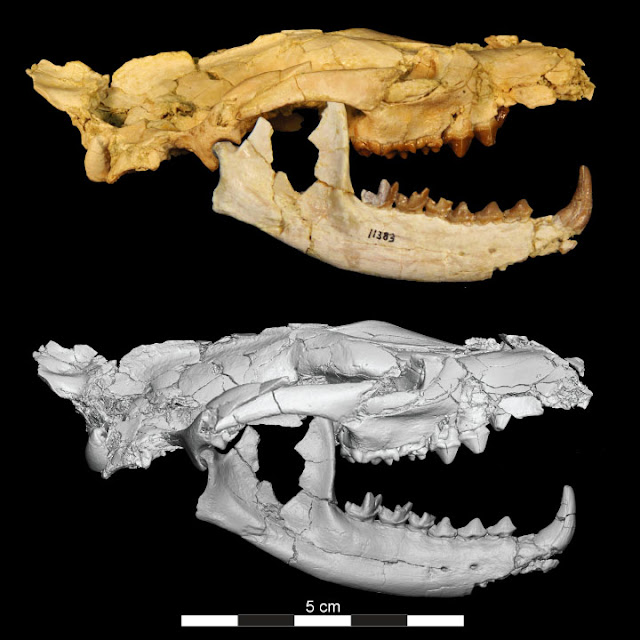
Hyaenodont skull [Credit: Matthew Borths]
Hyaenodonts preceded modern terrestrial carnivores in Africa and also lived in Europe, Asia, and North America. Some were tree-dwelling; others were terrestrial. The Afro-Arabian hyaenodont records are the oldest, making them key to understanding the evolution of these extinct meat-eaters.

The authors of the present study characterized 34 million-year-old Egyptian fossils of a new skunk-sized species of hyaenodont. They named it Masrasector nananubis, the species name referring to Anubis, the canine-headed Egyptian god associated with the afterlife.

This hyaenodont was a teratodontine, a carnivorous clade that has been difficult to align with other lineages due to poorly known cranial anatomy. The fossils of the new hyaenodont are the most complete known remains of a teratodontine from the Paleogene Period, and include largely complete skulls, jaws and limb bones.

Based on the morphology of the new hyaenodont's bones, the researchers concluded that teratodontines are a close sister group of Hyainailourinae, one of two major hyaenodont clades that were hypercarnivorous, eating mostly meat.

Comparison of the limb bones with those of other meat-eating mammals suggests that the new species was terrestrial and moved fast. The researchers state that the fossils of this new species will inform all future explorations of hyaenodont evolution and ecological diversity.

"Hyaenodonts were the the top predators in Africa after the extinction of the dinosaurs," says Borths. "This new species is associated with a dozen specimens, including skulls and arm bones, which means we can explore what it ate, how it moved, and consider why these carnivorous mammals died off as the relatives of dogs, cats, and hyenas moved into Africa."

Source: PLOS [April 19, 2017]

New species of hyaenodon found in Egypt

Analysis of Egyptian fossils has identified a new species of extinct carnivorous mammals called hyaenodonts, according to a study published ...

Tuesday, April 18, 2017


Egyptian archaeologists have unearthed several mummies, colourful wooden sarcophagi and more than 1,000 funerary statues in a 3,500-year-old tomb near the city of Luxor, hailing an "important discovery".

Mummies discovered in ancient tomb near Egypt's Luxor
Members of an Egyptian archaeological team work on a wooden coffin discovered in a 3,500-year-old tomb 
in the Draa Abul Nagaa necropolis, near the southern Egyptian city of Luxor [Credit: AFP/Stringer]
The 18th Dynasty tomb containing at least eight mummies was discovered in the Draa Abul Nagaa necropolis near the famed Valley of the Kings, the antiquities ministry said in a Tuesday statement.

It belonged to a nobleman named Userhat who worked as the city judge. It was opened to add more mummies during the 21st Dynasty, about 3,000 years ago, to protect them during a period when tomb-robbing was common, Mostafa Waziri, the head of the archaeological mission, said at the site.

"It was a surprise how much was being displayed inside," Antiquities Minister Khaled el-Enany told reporters outside the tomb.

"We found a large number of Ushabti (small carved figurines), more than 1,000 of them," Enany said.

"This is an important discovery."

Mummies discovered in ancient tomb near Egypt's Luxor
Members of an Egyptian archaeological team stand near artifacts, known as Ushabtis, discovered in a 3,500-year-old tomb 
in the Draa Abul Nagaa necropolis, near the southern city of Luxor [Credit: AFP/Stringer]
Ushabti figurines were often placed with the deceased in ancient Egyptian tombs to help with responsibilities in the afterlife.

Antiquities officials had initially said six mummies along with partial remains were discovered near the southern city, but said they had later identified two more mummies.

"There are 10 coffins and eight mummies. The excavation is ongoing," Waziri said.

Inside the tomb, archaeologists wearing white masks and latex gloves inspected the sarcophagi, which were covered with intricate drawings in red, blue, black, green, and yellow, and featured the carved faces of the dead.

The coffins were mainly well-preserved, though some had deteriorated and broken over the years.

Archaeologists were also examining a mummy wrapped in linen which was inside one of the coffins.

Mummies discovered in ancient tomb near Egypt's Luxor
A member of an Egyptian archaeological team shows artifacts discovered in a 3,500-year-old tomb
 in the Draa Abul Nagaa necropolis, near the southern city of Luxor [Credit: AFP/Stringer]
White, orange, green, and patterned pots were also found in the tombs.

The necropolis is located across the Nile from Luxor, on the west bank, where many of the famous ancient Egyptian pharaohs were buried, including Tutankhamun.

The age of the tomb was determined "through the drawings on the ceiling," said Waziri.

"It is a T-shaped tomb (which) consists of an open court leading into a rectangular hall, a corridor and an inner chamber," the ministry said in a statement.


A nine-metre shaft inside the tomb held the Ushabti figurines, as well as "wooden masks and a handle of a sarcophagus lid," the ministry said.

"The corridor of the tomb leads into an inner chamber where a cachette of sarcophagi is found," the ministry said.

Waziri said the mummies dated back to an age called "the era of the tomb robbers."

"It's evident that someone with a conscience, the priests or a high-profile government official... made an opening to the chambers, and they put the coffins there," he said.

Another room in the tomb was also discovered, though it has not yet been completely excavated, the ministry said.

Mummies discovered in ancient tomb near Egypt's Luxor
Photos courtesy of the Egyptian Ministry of Antiquities 

Archaeologists were able to enter the tomb "after removing almost 450 metres of debris out of the open court," it added.

The tombs and ancient temples of Thebes, the capital of ancient Egypt during its later periods and now the city of Luxor, have been a major tourist attraction.

Tourism here has dropped in the turmoil that followed the 2011 uprising that toppled longtime ruler Hosni Mubarak.

Enany said he hoped these new discoveries would help attract tourists again.

Nevine el-Aref, the spokeswoman for the antiquities ministry, said "there is evidence and traces that new mummies could be discovered in the future" at the site.

Author: Mohamed Abdel Aziz | Source: AFP [April 18, 2017]

Mummies discovered in ancient tomb near Egypt's Luxor

Egyptian archaeologists have unearthed several mummies, colourful wooden sarcophagi and more than 1,000 funerary statues in a 3,500-year-old...

Thursday, April 13, 2017


Excavators from Egypt’s Ministry of Antiquities have discovered a collection of Graeco-Roman artefacts during excavation work carried out in Alexandria’s Babour El-Maya area.

Graeco-Roman artefacts discovered at future Alexandria residential site
Clay pot discovered in Alexandria [Credit: Egyptian Ministry of Antiquities]
Mahmoud Afifi, head of the Ancient Egyptian Department at the Ministry of Antiquities, told Ahram Online that the excavation work, undertaken upon the request of an Alexandria resident, was carried out on a piece of land called Villa Agion in preparation for the erection of a residential building.

Graeco-Roman artefacts discovered at future Alexandria residential site
Clay jar discovered in Alexandria [Credit: Egyptian Ministry of Antiquities]
Afifi says that according to Egyptian law, the Ministry of Antiquities must inspect any piece of land slated for development to ensure it holds no archaeological items.

Graeco-Roman artefacts discovered at future Alexandria residential site
Clay pot discovered in Alexandria [Credit: Egyptian Ministry of Antiquities]
If the land is found to have artefacts that can be removed, the land is returned to its owner. However, if the land holds monuments that cannot be moved, the land is seized and declared an archaeological site, with the landowner receiving compensation.

Graeco-Roman artefacts discovered at future Alexandria residential site
Clay oil lamp discovered in Alexandria [Credit: Egyptian Ministry of Antiquities]
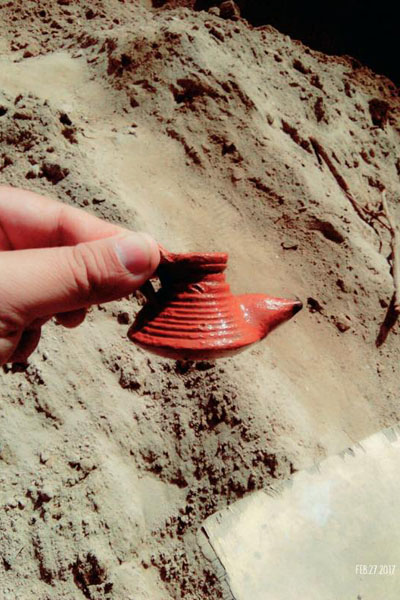
Mostafa Roshdi, director-general of Alexandria Antiquities, said that excavators unearthed a collection of clay pots, coins, ovens, bones, and clay lamps dating from the Hellenistic and Byzantine eras.

Graeco-Roman artefacts discovered at future Alexandria residential site
Clay red pot discovered in Alexandria [Credit: Egyptian Ministry of Antiquities]
Graeco-Roman pavement, black granite floors, and plaster-covered limestone walls were also discovered.

Roshdi said excavation work at the site is still ongoing.

Author: Nevine El-Aref | Source: Ahram Online [April 13, 2017]

Graeco-Roman artefacts discovered at future Alexandria residential site

Excavators from Egypt’s Ministry of Antiquities have discovered a collection of Graeco-Roman artefacts during excavation work carried out in...

Thursday, April 6, 2017


Preliminary studies on hieroglyphs found in newly discovered pyramid ruins in the Dahshur necropolis have revealed a cartouche of the 13th Dynasty pharaoh Ameny Qemau (also spelled Qemaw), Adel Okasha, director-general of the Dahshur necropolis, told Ahram Online.

More on Remains of ancient pyramid found in Egypt
Only part of the pyramid's inner structure survives today [Credit: Egyptian Ministry of Antiquities]
Okasha said that offering texts are engraved on the ruins, as well as a female name of the pharaoh's family.

Okasha said that excavation work is ongoing to reveal more of the pyramid's secrets.

Earlier this week, an Egyptian mission from the Ministry of Antiquities uncovered remains of the pyramid.

More on Remains of ancient pyramid found in Egypt
This block was found within the 13th dynasty pyramid in Egypt and bears the name of pharaoh Ameny Qemau 
[Credit: Egyptian Ministry of Antiquities]
Okasha says that the structure is composed of a corridor leading to the inside of the pyramid, a hall leading to a southern ramp, and a room at the western end.

An alabaster block measuring 15cm by 17cm has been found in the corridor, engraved with 10 vertical hieroglyphic lines that are still being studied.

A granite lintel and a collection of stone blocks showing the interior design of the pyramid have also been uncovered.

Author: Nevine El-Aref | Source: Ahram Online [April 06, 2017]

More on Remains of ancient pyramid found in Egypt

Preliminary studies on hieroglyphs found in newly discovered pyramid ruins in the Dahshur necropolis have revealed a cartouche of the 13th D...

Monday, April 3, 2017


The remains of an Egyptian pyramid built around 3,700 years ago have been discovered near the well-known bent pyramid of King Snefru, the antiquities ministry announced Monday.

Remains of ancient pyramid found in Egypt
An alabaster block engraved with 10 vertical hieroglyphic lines was also among the finds 
[Credit: Ministry of Antiquities, Egypt]
The pyramid from the 13th dynasty was found in Dahshur's royal necropolis, 30 kilometres (20 miles) south of Cairo, it said.

"An alabaster... block engraved with 10 vertical hieroglyphic lines" was among the finds, the ministry said, citing Adel Okasha, director general at the necropolis.

It said "granite lintel and stoney blocks showing the interior design of the pyramid" were also found.

Remains of ancient pyramid found in Egypt
The interior corridor was uncovered during the initial excavations 
[Credit: Ministry of Antiquities, Egypt]
Excavation is still in its early stages and the size of the pyramid has not yet been established. Blocks of stones and the beginning of a corridor which were discovered are shown in photos provided by the ministry.

"All the discovered parts of the pyramid are in very good condition and further excavation is to take place to reveal more parts," the ministry said.

Egypt, home of one of the world's earliest civilisations, boasts 123 ancient pyramids, Zahi Hawas, former head of the Supreme Council of Antiquities, told AFP.

Remains of ancient pyramid found in Egypt
As excavators continue to clear out the ruins, they will be able to assess just how big the pyramid once was 
[Credit: Ministry of Antiquities, Egypt]
They include the world-famous Pyramids of Giza, constructed around 4,500 years ago.

The Khufu pyramid is the largest of the three in Giza, standing at 146 metres (yards), and the only surviving structure of the seven wonders of the ancient world.

Khufu and Khafre in Giza along with the Bent and Red pyramids in Dahshur are part of Operation ScanPyramids, with teams scanning the structures in search of hidden rooms and cavities.

Source: AFP [April 03, 2017]

Remains of ancient pyramid found in Egypt

The remains of an Egyptian pyramid built around 3,700 years ago have been discovered near the well-known bent pyramid of King Snefru, the an...

Sunday, April 2, 2017


Egyptian Minister of Antiquities Khaled El-Enany and members of parliment inaugurated Alexandria's cistern and imperial bath complex area in the Kom El-Dikka archaeological site.

4th century imperial bath complex inaugurated in Egypt's Alexandria
The bath complex in Kom Al-Dikka [Credit: Ministry of Antiquities, Egypt]
The area had been undergoing excavation and restoration since 1960 by an Egyptian-Polish mission from Warsaw University.

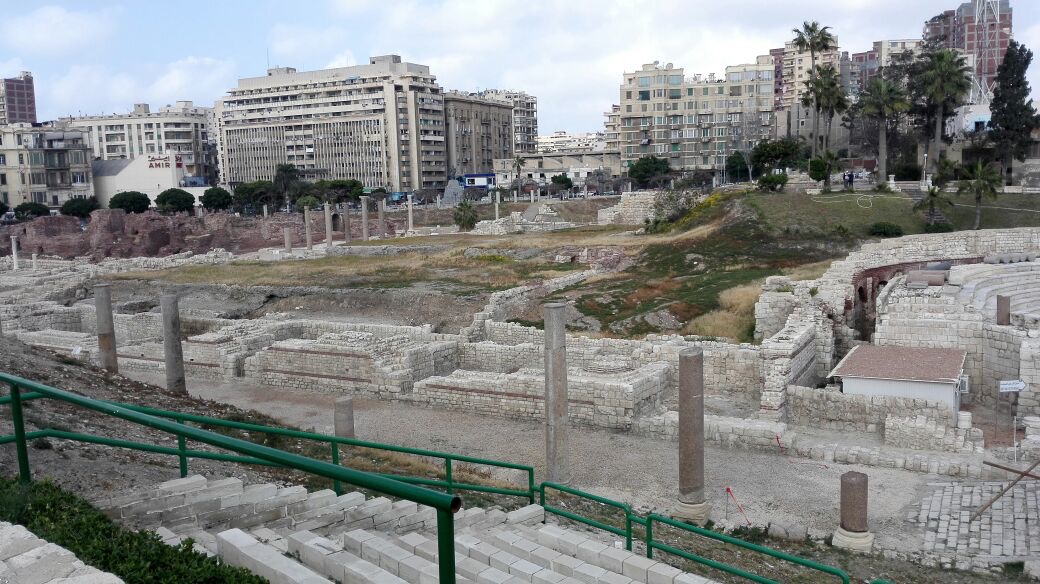
Mahmoud Afifi, head of the ministry's Ancient Egyptian Antiquities Department, said that the newly inaugurated area will be included within the Kom Al-Dikka tourist path, which includes the Roman amphitheater, the bird villa and residential houses from the Hellenistic period until the Islamic era.

El-Enany describes the bathing complex as "one of the finest edifices of its time," and that the bathing halls had welcomed hundreds of bathers at a time.

4th century imperial bath complex inaugurated in Egypt's Alexandria
The bath complex in Kom Al-Dikka [Credit: Ministry of Antiquities, Egypt]
The complex also includes palestrae for physical exercises, colonnade passages and amenities such as public latrines.

Water was supplied to the complex using huge cisterns and heated by a complex system of furnaces and pipes.

The minister and the parlimentary delegates also paid a visit to the planned Mosaic museum in downtown Alexandria to inspect the ongoing work and address any obstacles to its completion.

4th century imperial bath complex inaugurated in Egypt's Alexandria
The bath complex in Kom Al-Dikka [Credit: Ministry of Antiquities, Egypt]
During the tour, Mohamed Abdelmaguid, director-general of the Underwater Archaeological Department, introduced a three-phase plan to develop the Qayet Bey Citadel and its surroundings.

Abdelmaguid also reviewed a plan for the construction of the first underwater museum beneath the city's eastern harbour, which once was the ancient Alexandria royal area.

Abdelmaguid suggests the building of an underwater park to promote diving as well as the establishment of a training centre for underwater archaeology.

Author: Nevine El-Aref | Source: Ahram Online [April 02, 2017]

4th century imperial bath complex inaugurated in Egypt's Alexandria

Egyptian Minister of Antiquities Khaled El-Enany and members of parliment inaugurated Alexandria's cistern and imperial bath complex are...


© 2015 - Distributed By Free Blogger Templates | Lyrics | Songs.pk | Download Ringtones | HD Wallpapers For Mobile