Header

Modul
Showing posts with label China. Show all posts

Tuesday, April 18, 2017


From July to December in 2016, 14 large Zinc mining and metallurgy sites in Guiyang district were surveyed by Hunan Institute of Cultural Relics and Archaeology cooperates with Peking University School of Archaeology and Museology and other organizations. Intentional excavation of Tongmuling site was hence carried out.

Ancient zinc mining and metallurgy site discovered in China's Hunan Province
Aerial photo of Tongmuling site [Credit: Chinese Archaeology]
The survey and excavation revealed a number of intact, large-scaled zinc and multi-metal smelting sites, unearthed a series of important smelting remains, encouraged our understanding of smelting technology during Ming and Qing dynasties, which therefore promoted the archaeological research on crafts production.

Excavation Results

Tongmuling site is situated in Renyi Town, Guiyang County. The total area of the site is around 110,000 square meters. There is a platform formed by slag in the center of the site. The surface of the platform is triangular, with a length of 100 meters from the east to the west and a width of 50 meters from the south to the north. According to the excavation, a burning unit and two smelting unites on the platform presented a “品” shape, show that the mines were burned first and then smelted.

The burning unit is located in front of the platform (south part) and distributed in an oval shape with a length of 55 meters from the east to the west, a width of 20 meters from the south to the north, and a total area of about 1100 square meters. There are 6 burning stations distributed according to the topography in the burning unit. Each burning station consists of 4 or 8 cylindrical burning furnaces. The burning furnaces have similar size, with a diameter of around 0.9 meters at the opening and a preserved height of 0.8 meters. The wall is relatively straight and the bottom is flat. There is a ventilation opening on a side of the furnace.

Ancient zinc mining and metallurgy site discovered in China's Hunan Province
The melting workshop [Credit: Chinese Archaeology]
The first smelting unit is located in the east part of the platform and distributed in a round-cornered rectangular shape with a length of 55 meters, a width of 25 meters, and a total area of about 1300 square meters. In this unit, No. 1 channel furnace smelting workshop is preserved more complete. The channel furnace is the main body of the workshop and surrounded by remains such as the storage pit, mixing pit, stirring pit, and raw material pile.

The second smelting unit is located in the southwest part of the platform. In this unit, there are 3 smelting workshops with the channel furnace as the main body. The workshops are all connected with the road surface; therefore, they are suggested as the remains from same time period. The structure, design, and size of each workshop are similar to No. 1 channel furnace smelting workshop in the first smelting unit. According to the investigation, the collapse of the southwest part of the third channel furnace was probably caused by coal mining in modern times.

Ancient zinc mining and metallurgy site discovered in China's Hunan Province
Illustration showing the smelting process [Credit: Chinese Archaeology]
A series of relatively intact smelting tools such as crucible, condensation pocket, condensation appliance, condensation lid, iron shovel, crooked chisel, and anvil were uncovered from the smelting working area. On the other hand, green graininess scattered slag and lumped corrugated slag were found. Also, furnace remains (K23 and K24) with a high content of copper, lead, and silver, as well as a suspected plank of circular bellow piston, were recovered at the correspondence positions to the slag. It is suggested that this is a multi-metal smelting site mainly used for zinc-smelting and combined with smelting of lead, copper, and silver.

Daily utensils and a small quantity of coins belong to Qianlong and Jiaqing periods of Qing dynasty were recovered from the housing and working areas. It is initially suggested that the site began to use in the late Ming and early Qing dynasties and abandoned in the late Qing dynasty.

Ancient zinc mining and metallurgy site discovered in China's Hunan Province
An ore wash trough on the river bed [Credit: Chinese Archaeology]
The archaeology team has investigated the surrounding areas of the Tongmuling site. Test excavations were also carried out to the sites with important signs and a double-lined furnace with a length of around 20 meters was recovered. This is the first time that this type of furnace found in China. On the other hand, remains related to zinc-smelting such as burning furnace, channel furnace, and housing remains were found.

Value and significance

The discovery and excavation of the entire platform in the center of the site indicates the function and structure of the smelting site. This is very important to the understanding of the function division, technological process, production capacity, and the daily life and productivity of the workers.

The discovery of lined round shaped furnaces has filled in the gap in the research of zinc-smelting technology in China. The channel furnaces recovered from the site are the most completed Qing dynasty zinc-smelting furnaces found in China. The remains of zinc-smelting and metallurgy uncovered with the furnaces dovetailed with the historical literature. It is very significant to the reconstruction of ancient zinc-smelting technology. The investigation and excavation result is a treasure to the research of Chinese metallurgical history, coin history, and political-social history.

Translator: Li Xuelei | Source: Chinese Archaeology [April 18, 2017]

Ancient zinc mining and metallurgy site discovered in China's Hunan Province

From July to December in 2016, 14 large Zinc mining and metallurgy sites in Guiyang district were surveyed by Hunan Institute of Cultural Re...

Friday, April 14, 2017


Gezishan Site is located at the northwest of Qingtongxia city, Ningxia Province, it is an important prehistorical site in the later period of late Pleistocene in China. From 2013, the Ningxia Provincial Institute of Archaeology and Cultural Relics in conjunction with Institute of Vertebrate Paleontology and Paleoanthropology, Chinese Academy of Sciences made a systematical research, and cleared up the selected location No.10. In 2016, another great finding was made during the excavation.

New discoveries at Gezishan Palaeolithic Site, in China's Ningxia Province
Remains of camp fire found in Gezishan Site [Credit: Chinese Archaeology]
Excavation and research plan

Location No.10 was at the east of the Gezishan Basin. From 2014 to 2015, the archaeological team had felt out the distribution of the connate deposit of the site in the current situation, also had ascertained the actuality of the core area of the cultural layer. In 2016, archaeologists decided to expand the excavation scale in the core area, in order to get the overall connotation of the site.

In 2016, the archaeological team decided to clear up 200 excavation units (whose length of side was 1 meter) at the north of the core zone of the site, with an area of about 180 square meters. Expect the upper layer (disruption layer) was excavated as a thickness of about 20 to 30 centimeters layer, the rest was excavated as a thickness of about 5 to 10 centimeters.

Stratum, age, artifacts and remains

The stratum was divided into 5 layers, and archaeologists have recorded the three-dimensional coordinates of about 7,000 stone tools (larger than 2 centimeters) and more than 500 pieces of animal bones; Dozens of ostrich eggshell beads was found, especially those of less than 2 millimeters diameter, which became an important achievement of this excavation, however, the manufacturing techniques and the usage method, indicating the skills and cognitive competence need to be further researched.

New discoveries at Gezishan Palaeolithic Site, in China's Ningxia Province
The section which showed the uncertain post hole [Credit: Chinese Archaeology]
Meanwhile, about 400 pieces of charcoal samples was collected from different layers, in order to establish a high-resolution chronology frame and a solid background for the culture understanding. More than 20 remains of fire-using and carbon dust dense area were revealed, a large amount of burnt stones scattered in the excavation, and some of which were fireplaces with burnt bones around. In the fourth layer of excavation unit T5, dozens of round pits, with about 10-20 centimeters in diameter, 5-20 centimeters in depth were found, in zonal distribution, which was speculated to be temporary dwelling remains.

Academic values and significance

The excavation of Gezishan Site was the first time that chronosequence from the late period of late Pleistocene to the early period of holocene was established at the edge of the northwestern desert in China, providing important materials for understanding the prehistoric human activities and environmental change in this special geographic zone. Given to the excavation, archaeologists firstly found the stone saddle-quern, stone roller, featured bi-facial tools and Helan pointed implements in situ, which defining the date of those artifacts, and providing evidence of the means of livelihood and diet of ancient people at that moment in this area.

New discoveries at Gezishan Palaeolithic Site, in China's Ningxia Province
The ostrich eggshell beads [Credit: Chinese Archaeology]
The ostrich eggshell  and ornaments unearthed in the site refreshed our understandings towards the cognitive competence and skills of processing tiny objects of the ancient people, as well as providing perfect samples of studying their complex techniques and cognitive competence. A large number of fire using traces inside the site and its spatial distribution not only reflected the livelihood pattern, the background of climate and environment of ancient humans, but providing important informatiom for the activities of making fire, using fire and the use of housing space.

New discoveries at Gezishan Palaeolithic Site, in China's Ningxia Province
The pierced calcite ornaments [Credit: Chinese Archaeology]
Location No.10 of Gezishan site provides a complete stratigraphic sequence for this region. The cultural accumulations of at least three different periods have not only enriched our understanding of the period and its culture, but have also made it a special location for studying the cultural evolution and prehistoric human activities of the desert fringe zone from the late Pleistocene to the early Holocene as well as the transitional period from the Palaeolithic to the Neolithic. 

Translator: Wang Jue | Source: Chinese Archaeology [April 14, 2017]

New discoveries at Gezishan Palaeolithic Site in China's Ningxia Province

Gezishan Site is located at the northwest of Qingtongxia city, Ningxia Province, it is an important prehistorical site in the later period o...

Tuesday, April 11, 2017


The Asian arowana (Scleropages formosus), known as the dragon fish, is one of the most prized and expensive aquarium fishes in the world. Scleropages is an extant freshwater fish of Osteoglossidae with a transoceanic distribution in Southeast Asia and Australia. All previously Known fossil records of Scleropages are scales, otoliths and isolated fragments of bones, and the distribution of osteoglossids remains a zoogeographical enigma.

New species of dragon fish discovered from the Eocene of China
Holotype of Scleropages sinensis (IVPP V 13672.2) in left lateral view 
[Credit: ZHANG Jiangyong]
In a paper published in the latest issue of Vertebrata PalAsiatica, Dr. ZHANG Jiangyong, Institute of Vertebrate Paleontology and Paleoanthropology (IVPP), Chinese Academy of Sciences, and Dr. Mark Wilson, Department of Biological Sciences, University of Alberta, reported a new species of osteoglossid fish, Scleropages sinensis sp. nov., from the Early Eocene Xiwanpu Formation in Hunan and the Yangxi Formation in Hubei, China. The discovery of Scleropages sinensis dates the divergence of Scleropages and Osteoglossum as at least old as the Early Eocene, which is a significant step toward solving this zoogeographical puzzle.

The body of the new fish is fusiform in adults, with median fins posteriorly positioned and pelvic fins in abdominal position. Skull bones are thick and squamation is heavy. The standard length of the largest specimen is 175 mm, that of the holotype is 140 mm, and that of the smallest is 78 mm.

New species of dragon fish discovered from the Eocene of China
Scleropages sinensis, a complete fish in left lateral view (A, B), a skull (C) 
and a caudal skeleton (D) [Credit: ZHANG Jiangyong]
Fossil Scleropages are known from the Maastrichtian of India, the Maastrichtian/Late Paleocene of Africa, the Paleocene of Europe, the Eocene of Sumatra, and the Oligocene of Australia. All of these earlier records are scales, otoliths and isolated fragments of bones. Therefore, this finding is the first skeletons of fossil Scleropages ever unearthed in the world with some specimens exceptionally well-preserved.

"This new fish resembles Scleropages in skull bones, caudal skeleton, the shape and position of fins, and reticulate scales. Therefore, it must belong to the genus", said Dr. ZHANG Jiangyong of the IVPP.

New species of dragon fish discovered from the Eocene of China
Comparison between Scleropages sinensis (A) and S. formosus (B), S. leichardti (C) 
[Credit: ZHANG Jiangyong]
The new fish is different from all extant species of Scleropages in features: the nasals do not appear to be ornamented; the sensory pore in the antorbital is large; the posterior infraorbitals are not quite covering the dorsal limb of the preopercle; the posteroventral angle of the preopercle is produced to point; the posteroventral margin of the opercle is concave and the ventral end of the bone is produced to a point; the pectoral fin is very long and extends well behind the beginning of the pelvic fin; the vertebral count is about 46–48; the parapophyses are shorter and the upper and lower caudal rays are nearly as long as the inner rays.

The new fish is closer to its Asian neighbor, S. formosus, than to its southern relative, S. leichardti. Scleropages formosus inhabits natural lakes, swamps, flooded forests, and slowly moving, deep parts of rivers with overhanging vegetative cover. It is a carnivorous fish and its food consists mainly of insects, fishes, worms, small amphibians, small mammals, and even birds. S. sinensis may live in the same natural environment and have a similar diet except for the largest items.

Sexual dimorphism may exist in S. sinensis. The presumed male has a slimmer and shallower body, a relatively larger head, and a deeper mouth cleft. The discovery of Scleropages sinensis sp. nov. dates the divergence of Scleropages and Osteoglossum to no later than the Early Eocene.

Source: Chinese Academy of Sciences [April 11, 2017]

New species of dragon fish discovered from the Eocene of China

The Asian arowana (Scleropages formosus), known as the dragon fish, is one of the most prized and expensive aquarium fishes in the world. Sc...

Monday, April 10, 2017


An ancient bridge has been discovered at the site of the Middle Capital of Ming Dynasty (1368-1644) in Fengyang city of East China's Anhui province.

Ming Dynasty bridge unearthed in eastern China's Anhui
An ancient bridge has been unearthed at the historic site of the Middle Capital of Ming Dynasty (1368-1644) 
in Fengyang city of East China's Anhui province [Credit: VCG]
According to archaeologists, the bridge was constructed with grey bricks during Ming Dynasty and had been in service since completion.

Ming Dynasty bridge unearthed in eastern China's Anhui
Archaeological staff members clean up the mud on the periphery of the ancient bridge at the historic site of the Middle 
Capital of Ming Dynasty (1368-1644) in Fengyang city of East China's Anhui province, April 9, 2017 
[Credit: VCG]
In 1970s, due to road construction, the bridge was buried under the ground. However, it was not until last year that the ancient bridge was excavated again.

Ming Dynasty bridge unearthed in eastern China's Anhui
The ancient bridge was constructed with grey bricks [Credit: VCG]
Chen Huairen, an expert on Ming Dyansty, said the bridge was located at Yunji Street, a second axis that crossed the main axis of the city.

Ming Dynasty bridge unearthed in eastern China's Anhui
Aerial view of the historical site of the Middle Capital of Ming Dynasty (1368-1644) in Fengyang city 
of East China's Anhui province, April 9, 2017 [Credit: VCG]
Other ancient capital cities Xi'an and Beijing only had one city axis in north-south direction, but the Middle Capital of Ming Dynasty in Fengyang had two, which makes it unique in city planning, said Chen.

Ming Dynasty bridge unearthed in eastern China's Anhui
Some parts of the Middle Capital of Ming Dynasty (1368-1644) in Fengyang city have been restored 
[Credit: VCG]
At the site, Donghua Gate, Southeastern Corner Tower, and Merdian Gate of the Middle Capital of Ming Dynasty have been restored.

Source: China Daily [April 10, 2017]

Ming Dynasty bridge unearthed in eastern China's Anhui

An ancient bridge has been discovered at the site of the Middle Capital of Ming Dynasty (1368-1644) in Fengyang city of East China's Anh...

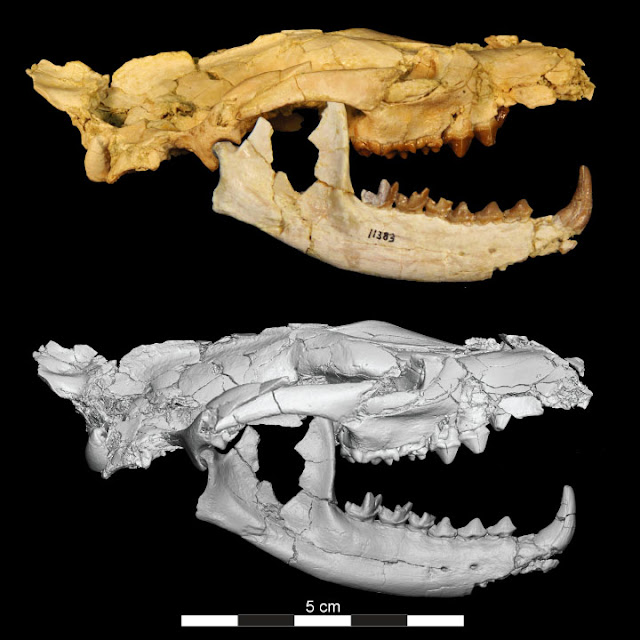
The skeleton of a small, short-snouted reptile found in China was recently identified as the oldest known member of the phytosaurs -- an extinct group of large, semi-aquatic reptiles that superficially resembled the distantly-related crocodylians and lived during the Triassic Period, approximately 250 million years ago to 200 million years ago.

Critical gap in fossil record of Chinese phytosaurs filled
The skull of Diandongosuchus fuyuanensis [Credit: Xiao-chun Wu]
Virginia Tech researchers led the team that re-evaluated and re-classified the animal, Diandongosuchus fuyuanensis, which had previously been labeled as a poposauroid, a group of animals more closely related to crocodiles.

The shape of the animal's head, shoulder, and skeleton bones is what gave away the animal's linkage to the phytosaurs, according to Michelle Stocker, lead author and assistant professor of geosciences in the College of Science. After seeing a photo of the fossil in a paper published in 2012, she and other co-authors met in China in 2015 to re-examine the bones. Their findings were published in Scientific Reports.

The fossil, which is older than other phytosaur fossils by about 5 million years, fills a critical gap in scientists' understanding of how the animal evolved. The short snout and small body size suggest that the features the species is most known for -- a long snout and large body size -- evolved later than previously thought. A long snout is useful for predatory endeavors like reaching, snapping, and biting.

"So much of our study of the fossil record is about filling in the gaps in our knowledge of how animals came to look as they do or live where they are, and Diandongosuchus does that for phytosaurs. We're never done filling in those gaps," said Stocker.

"Early members of these Triassic reptile lineages are appearing where they've been predicted for years. Now we have the fossils," said Nesbitt.

Source: Virginia Tech [April 10, 2017]

Critical gap in fossil record of Chinese phytosaurs filled

The skeleton of a small, short-snouted reptile found in China was recently identified as the oldest known member of the phytosaurs -- an ext...

Friday, April 7, 2017


Recovered minerals that originated in the deep mantle can give scientists a rare glimpse into the dynamic processes occurring deep inside of Earth and into the history of the planet's mantle layer. A team led by Yingwei Fei, a Carnegie experimental petrologist, and Cheng Xu, a field geologist from Peking University, has discovered that a rare sample of the mineral majorite originated at least 235 miles below Earth's surface. Their findings are published by Science Advances.

'Nesting doll' minerals offer clues to Earth's mantle dynamics
The fragment of the metamorphic rock eclogite in which the garnet that encased the ferric-iron-rich majorite 
sample was found in Northern China [Credit: Courtesy of Yingwei Fei]
Majorite is a type of garnet formed only at depths greater than 100 miles. Fascinatingly, the majorite sample Fei's team found in Northern China was encased inside a regular garnet -- like mineralogical nesting dolls. It was brought to surface as an eclogite xenolith in the North China Craton, one of the oldest cratonic blocks in the world. What's more, the majorite was rich in ferric iron, an oxidized form of iron, which is highly unusual for the mineral.

All of these uncommon factors prompted the team to investigate the majorite's origins.

They used several different kinds of analytical techniques to determine the chemistry and structural characteristics of this majorite formed deep inside Earth. In order to determine the exact depth of its origin, Carnegie's postdoc Renbiao Tao conducted high-pressure experiments that mimicked the formation conditions of natural majorite. The team pinpointed its origin to a depth of nearly 250 miles (400 kilometers), at the bottom of the soft part of the upper mantle, called the asthenosphere, which drives plate tectonics.

It is extremely unusual that a high-pressure majorite could survive transportation from such a depth. Adding to the strange circumstances is the fact that it was later encased by a garnet that formed at a much shallower depth of about 125 miles (200 kilometers). The nesting-doll sample's existence required two separate geological events to explain, and these events created a time capsule that the researchers could use to better understand Earth's deep history.

"This two-stage formation process offers us important clues about the mantle's evolutionary stage at the time when the majorite was first formed," Fei explained.

The sample's location and depth of origin indicate that it is a relic from the end of an era of supercontinent assembly that took place about 1.8 billion years ago. Called Columbia, the supercontinent's formation built mountain ranges that persist today.

"More research is needed to understand how the majorite became so oxidized, or rich in ferric iron, and what this information can tell us about mantle chemistry. We are going back to the site this summer to dig deeper trenches and hope to find fresh rocks that contain more clues to the deep mantle," Fei added.

Source: Carnegie Institution for Science [April 07, 2017]

'Nesting doll' minerals offer clues to Earth's mantle dynamics

Recovered minerals that originated in the deep mantle can give scientists a rare glimpse into the dynamic processes occurring deep inside of...

Wednesday, April 5, 2017


Archaeologists have found 13 tombs, which are estimated to be between 1,800 and 2,700 years old, in Bomi County of southwest China's Tibet Autonomous Region.

Archaeologists discover 13 ancient tombs in Tibet

The tombs were discovered by construction workers during a road project in Qundo township, Nyingchi, in the second half of 2016, according to the regional institute of cultural relics.

Two relatively complete human skeletons were found in two tombs, while human bones were also discovered in other graves, said Shaka Wangdu, associate researcher with the institute.

Archaeologists found that the tombs appeared to follow a known burial custom, which is still seen in parts of Qundo. According to the custom, after the body has decayed, the bones are exhumed and reburied.

Objects including eight complete examples of pottery, a millstone, three bronze arrowheads and iron residue were also found.

"The tombs will help research into Tibetan funeral customs and human development in eastern Tibet in a period without written records," said Shaka Wangdu.

Source: XinhuaNet [April 05, 2017]

Archaeologists discover 13 ancient tombs in Tibet

Archaeologists have found 13 tombs, which are estimated to be between 1,800 and 2,700 years old, in Bomi County of southwest China's Tib...

Monday, April 3, 2017


Mountains, like rainforests, are hotbeds of biodiversity. But scientists aren't sure why. For years, they've thought that it might be related to the new environments that arise when mountains form— as plants and animals adapt to the new micro-habitats and their populations become isolated by increasingly rugged terrain, they divide into new species at a faster rate than usual. However, there was little hard proof that this hypothesis was correct.

New species evolve faster as mountains form
Plants in the Hengduan Mountains [Credit: Jian Huang]
In a new paper in the Proceedings of the National Academy of Sciences, a team has put forth compelling quantitative evidence in favor of the hypothesis, analyzing thousands of plant species from China's Hengduan Mountains and adjacent regions. They found that as the Hengduan Mountains were forming, the plants there evolved into new species at a faster rate than in the nearby Himalayas, which are older.

"Essentially, this paper is about why there are so many species in mountains and how they came to be there," says corresponding author Rick Ree, Associate Curator of Botany at Chicago's Field Museum. "There are two main ways species can get to a place—either they emigrated from another place, or they evolved from an earlier species that was already there. Our research provides the strongest evidence yet that when mountains form, new species evolve and diversify at an increased rate."

The mountain range that Ree and his co-author Yaowu Xing studied, the Hengduan Mountains region in western China, is directly to the east of the Himalayas. It formed recently (in Earth-time, at least), eight million years ago, the result of colliding tectonic plates. Among global biodiversity hotspots, it's unusual in not having a tropical or Mediterranean climate.

"The Hengduan Mountains are temperate, with cold winters and short wet summers. They have conifer forests, glaciers, alpine meadows—you could be tricked into thinking you were in the Rockies or the Alps, until you looked around and saw that there was ten times the biodiversity you see in those places," says Ree.

That incredible biodiversity, Ree and Xing suspected, was the result of uplift-driven diversification. According to this hypothesis, when mountains are formed by tectonic forces, the new distinct environments forming along the mountainsides allow the species already there to split and branch into new species that are specially adapted to those new environments. "As mountains form, you get different elevations, different substrates exposed, different soil chemistries, different climates. They create lots of little micro-habitats along which species can adapt to local conditions," explains Ree. "These changes mean more opportunities for species to diversity and fill new niches."

To test this hypothesis, the scientists examined the plants growing in the Hengduan Mountains, which are relatively young in geological time, and compared them to plants that live nearby on the Qinghai-Tibetan Plateau and Himalayas, which are much older. "We were able to use the differences in age as a natural experiment, with controlled comparisons of how species accumulated in the different regions, says Ree. "The fact that these mountains are next to each other but have different ages allows us to compare their histories in terms of how the species got there."

Ree and Xing performed phylogenetic analyses of thousands of plants, using DNA sequences to put together family trees showing how the species are related to one another. Then they used fossil plants to give their findings a time scale. "By looking at fossils, we were able to tell when different groups appeared and when ancestral species branched apart," says Ree. "The combination of modern plant DNA and ancient plant fossils gave us a historical framework that allowed us to reconstruct where and when species moved and diversified."

The team found that new species were formed at an increased rate within the Hengduan Mountains as they were forming, compared to species formation rates in the surrounding regions—evidence that species form faster as mountains are uplifted. But those revelations only became clear when Ree and Xing looked at the data set as a whole. "On their own, many of the plant groups don't show a strong pattern of increased diversity as the mountains uplifted, but when you look at them collectively, the pattern emerges quite clearly," says Ree.

This discovery is especially important in that it provides support for a hypothesis that largely lacked quantitative evidence until now. "The uplift-driven diversification hypothesis is popular, but this study provides the strongest empirical evidence so far," says Ree. "What sets this study apart is the way that we included lots of different plant groups, performed controlled natural comparions of these regions at different ages, and measured the rates of these processes over time. It's the first study that brings evidence from lots of different groups to bear on this question in a quantitative framework."

While Ree's main interest remains the Hengduan Mountains, he notes that the comparative approach employed in this study could be applied to other biodiversity hotspots and other organisms, including animals. "Ever since Darwin, we've wanted to know the what, where, and how of species' origins," says Ree. "How do species come to live where they do? Why are there more species here than there? Our study sheds a little light on those questions."

Source: Field Museum [April 03, 2017]

New species evolve faster as mountains form

Mountains, like rainforests, are hotbeds of biodiversity. But scientists aren't sure why. For years, they've thought that it might b...


© 2015 - Distributed By Free Blogger Templates | Lyrics | Songs.pk | Download Ringtones | HD Wallpapers For Mobile