Header

Modul
Showing posts with label Early Mammals. Show all posts

Wednesday, April 19, 2017


Analysis of Egyptian fossils has identified a new species of extinct carnivorous mammals called hyaenodonts, according to a study published in the open-access journal PLOS ONE

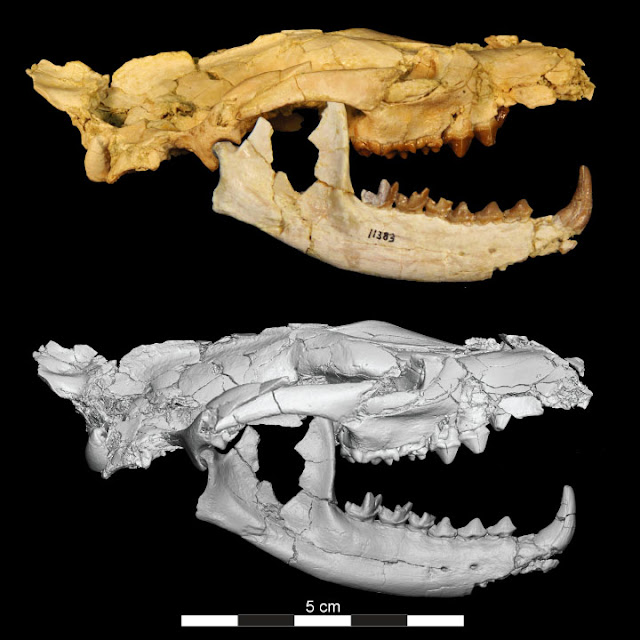
New species of hyaenodon found in Egypt
Hyaenodont skull [Credit: Matthew Borths]
Hyaenodonts preceded modern terrestrial carnivores in Africa and also lived in Europe, Asia, and North America. Some were tree-dwelling; others were terrestrial. The Afro-Arabian hyaenodont records are the oldest, making them key to understanding the evolution of these extinct meat-eaters.

The authors of the present study characterized 34 million-year-old Egyptian fossils of a new skunk-sized species of hyaenodont. They named it Masrasector nananubis, the species name referring to Anubis, the canine-headed Egyptian god associated with the afterlife.

This hyaenodont was a teratodontine, a carnivorous clade that has been difficult to align with other lineages due to poorly known cranial anatomy. The fossils of the new hyaenodont are the most complete known remains of a teratodontine from the Paleogene Period, and include largely complete skulls, jaws and limb bones.

Based on the morphology of the new hyaenodont's bones, the researchers concluded that teratodontines are a close sister group of Hyainailourinae, one of two major hyaenodont clades that were hypercarnivorous, eating mostly meat.

Comparison of the limb bones with those of other meat-eating mammals suggests that the new species was terrestrial and moved fast. The researchers state that the fossils of this new species will inform all future explorations of hyaenodont evolution and ecological diversity.

"Hyaenodonts were the the top predators in Africa after the extinction of the dinosaurs," says Borths. "This new species is associated with a dozen specimens, including skulls and arm bones, which means we can explore what it ate, how it moved, and consider why these carnivorous mammals died off as the relatives of dogs, cats, and hyenas moved into Africa."

Source: PLOS [April 19, 2017]

New species of hyaenodon found in Egypt

Analysis of Egyptian fossils has identified a new species of extinct carnivorous mammals called hyaenodonts, according to a study published ...

Tuesday, April 18, 2017


Studies of bones from Ice Age megafaunal animals across Eurasia and the Americas have revealed that major increases in environmental moisture occurred just before many species suddenly became extinct around 11-15,000 years ago. The persistent moisture resulting from melting permafrost and glaciers caused widespread glacial-age grasslands to be rapidly replaced by peatlands and bogs, fragmenting populations of large herbivore grazers.

Megafaunal extinctions driven by too much moisture
Alan Cooper inspects ice age bones from the Yukon Palaeontology Program’s collection, Canada, 2015 
[Credit: Julien Soubrier]
Research led by the Australian Centre for Ancient DNA (ACAD) at the University of Adelaide, published in Nature Ecology and Evolution, has revealed that the ancient bones preserve direct biochemical evidence of the environmental upheavals, which can be traced through time.

Using 511 radiocarbon dated bones from animals such as bison, horse, and llamas the team was able to investigate the role of environmental change in the mysterious megafaunal extinctions, which claimed the vast majority of existing large land animals such as giant sloths and sabre-toothed cats.

Megafaunal extinctions driven by too much moisture
Lead Author Tim Rabanus-Wallace hunts for megafaunal fossils in the Canadian permafrost in 2015 
[Credit: Julien Soubrier]
"We didn't expect to find such clear signals of moisture increases occurring so widely across all of Europe, Siberia and the Americas," says study leader Professor Alan Cooper, ACAD Director. "The timing varied between regions, but matches the collapse of glaciers and permafrost and occurs just before most species go extinct.

The international team of researchers, including the University of Alaska Fairbanks, University of Oslo, the Yukon Government, and palaeontologists across Russia and Canada, measured nitrogen isotopes preserved in dated ancient animal bones and teeth recovered from permafrost areas and caves across Europe, Siberia, North and South America. They found distinctive biochemical signals reflecting massive increases of moisture on the landscape.

Megafaunal extinctions driven by too much moisture
The study shows that a peak in moisture occurred between the time of the ice sheets melting, and the invasion 
of new vegetation types such as peatlands (data shown from Canada and northern United States)
[Credit: Julien Soubrier]
"Grassland megafauna were critical to the food chains. They acted like giant pumps that shifted nutrients around the landscape," says lead author Dr Tim Rabanus-Wallace, from the University of Adelaide. "When the moisture influx pushed forests and tundras to replace the grasslands, the ecosystem collapsed and took many of the megafauna with it."

"The idea of moisture-driven extinctions is really exciting because it can also explain why Africa is so different, with a much lower rate of megafaunal extinctions and many species surviving to this day,, says Professor Cooper. "Africa's position across the equator means that grassland zones have always surrounded the central monsoon region. The stable grasslands are what has allowed large herbivores to persist -- rather than any special wariness of hunters learned from humans evolving there."

Megafaunal extinctions driven by too much moisture
The head of Blue Babe, a mummified ice age bison, rests recently in a lab at the University of Alaska Museum 
of the North. The bison, uncovered near Fairbanks in 1979, was first described by Dale Guthrie, now
 professor emeritus. Most of Blue Babe's skin was preserved and is now publicly displayed on a
 model at the museum, but the head and horns were kept frozen. Professor Matthew Wooller
 and others are now analyzing them to improve our understanding of Blue Babe's environment.
The work includes extraction of collagen from the bones for nitrogen isotope analysis 
[Credit: Matthew Wooller]
Professor Matthew Wooller, of the University of Alaska Fairbanks, says: "We find that on different continents the climate changes happened at different times, but they all showed that moisture increased massively just prior to extinction. The really elegant feature of this study is that it produces direct evidence from the fossils themselves -- these extinct creatures are informing us about the climate they experienced leading up to their own extinctions."

Source: University of Adelaide [April 18, 2017]

Megafaunal extinctions driven by too much moisture

Studies of bones from Ice Age megafaunal animals across Eurasia and the Americas have revealed that major increases in environmental moistur...

Together with an international team, Senckenberg scientists examined the diet of the extinct Giant Sloth Megatherium. Based on analyses of the collagen in the fossil bones, the researchers concluded in their study, which was recently published in the scientific journal Gondwana Research that Megatherium subsisted on an exclusively vegetarian diet. Until recently, there had been much speculation about the food habits of these elephant-sized, ground-dwelling animals.

The giant sloth megatherium was a vegetarian
It lived 10,000 years ago and subsisted on a strictly vegetarian diet: the Giant Sloth Megatherium 
[Credit: Kamraman/WikiCommons]
Sloths may well rank among the world’s most peculiar animals: With their backs pointing downward, they hang in trees and move in slow motion from branch to branch with the aid of their sickle-shaped claws. “Sloths already occurred 10,000 years ago, for example the species Megatherium,” explains Professor Dr. HervĂ© Bocherens of the Senckenberg Center for Human Evolution and Palaeoenvironment at the University of TĂĽbingen.

The extinct relatives of the sloths could reach the size of an elephant and were much too heavy to spend a significant amount of time in the trees. Instead, they lived on the ground, where they excavated large burrows. For many years, their dietary habits were an enigma; the long claws on their hands and feet, in particular, gave rise to various speculations. Did the sloths use their claws to dig up subterranean insect colonies? Did the long claws serve as hunting tools, and were the giant animals carnivores? Or did the fossil representatives live on a strictly vegetarian diet, like the recent sloths? “These questions were at the center of our new study,” adds Bocherens.

The giant sloth megatherium was a vegetarian
The sloths were too heavy to live in trees [Credit: Drawing by Robert Bruce Horsfall, 
from “A history of land mammals in the western hemisphere”]
Normally it is possible to deduce the feeding habits of fossil animals on the basis of the shape and wear of their teeth – however, the teeth of the Giant Sloth are not comparable to those of modern animals. “We therefore had to use a different method, so we measured the composition of carbon isotopes – the ratio of protein and mineral content – in the fossilized sloth bones,” explains Bocherens, and he continues, “Our measurements show that Megatherium lived on an exclusively vegetarian diet.”

In carnivores, the proportion of proteins is significantly higher than in herbivores, which primarily eat food high in carbohydrates. These differences can be documented in the isotopes. In order to reinforce their results, the scientists compared their data with more than 200 bones from modern mammals, whose diet is known, as well as with fossil specimens from both carnivores and herbivores. “Our results show that by using this method, it is possible to reconstruct the feeding habits of animals even several thousand years after their death,” adds the biogeologist from TĂĽbingen.

Knowledge of the sloths’ feeding habits is important in order to understand their role in past ecosystems. “Moreover, the results can help us understand the interactions between Megatherium and the first human inhabitants of America – their habitats overlapped for several thousand years, before the Giant Sloth became extinct,” offers Bocherens as a preview.

Source: Senckenberg Research Institute and Natural History Museum [April 18, 2017]

The giant sloth megatherium was a vegetarian

Together with an international team, Senckenberg scientists examined the diet of the extinct Giant Sloth Megatherium. Based on analyses of t...

Saturday, April 15, 2017


In the heart of Interior Alaska, at a recently discovered archaeological site, scientists have uncovered a huge mammoth tusk dating back 14,000 years. Objects made of ivory and used for hunting were also identified.

14,000 year old mammoth tusk discovered hidden in Alaska wilderness
The tusk was discovered buried in soil sediments at the Holzman archaeological site 
[Credit: Adelphi University]
The Holzman site was first discovered in 2015, hidden in the Alaska wilderness. Initial excavations revealed a series of late Pleistocene occupations containing remains of large mammal fauna, mammoth ivory fragments and stone tools buried in sediment deposits.

During the 2016 excavation season, a member of the team discovered the large mammoth tusk buried in the soil, about 1.5 metre underground. The tusk is nearly 5ft-long (140cm), and appears to be well preserved.

Radiocarbon dating suggests it is 14,000 years old, but it was sent to a lab at Adelphi University for further analyses.

Hunters or scavengers?

The scientists, are investigating who the first Americans were and when humans first settled in North America.

They hope the study of the tusk will help them settle important questions about the first Americans and about whether they overlapped with mammoths at the Holzman site.

The newly discovered tusk is 14,000 years old but so far evidence of human activity at the site only date back to 13,700 years ago.

14,000 year old mammoth tusk discovered hidden in Alaska wilderness
The site lies at the heart of Alaska Interior [Credit: Adelphi University]
"It's possible that humans found the tusk, which dated back to a few hundred years before their time, and used it to create their ivory tools", Brian Wygal, a co-principal investigator of the excavation and an associate professor of anthropology at Adelphi University, told IBTimes UK.

"One of the most important questions that we want to answer is whether the tusk was scavenged by these prehistoric people or if they hunted the mammoth down – in which cases mammoths and humans would have cohabited at the Holzman site 14,000 years ago".

The analyses of the tusk could provide an answer. The scientists are planning more isotope analyses as well as a study of ancient DNA to see if they can find traces that the mammoth was hunted. Depending on how well preserved the tusk is, they might also be able to establish how old it was when it died, its sex and what its diet was.

New excavations this summer might further help them determine if humans already lived at the site 14,000 years ago. "We may for instance find other parts of the mammoth which will indicate that it was consumed by people 14,000 years ago", Wygal said.

The research could also shed a new light on how mammoths became extinct in the US. If the analyses revealed the large mammals were hunted down, this will provide more evidence that humans might have played a role in their demise. The subject of how mammoths went extinct remains a source of heated debate among scientists.

Author: Lea Surugue | Source: International Business Times [April 13, 2017]

14,000 year old mammoth tusk discovered hidden in Alaska wilderness

In the heart of Interior Alaska, at a recently discovered archaeological site, scientists have uncovered a huge mammoth tusk dating back 14,...

Friday, April 14, 2017


Saber-toothed cats that roamed Los Angeles 12,000 years ago had many injuries to their shoulders and backbones that likely occurred when they killed large herbivore prey such as bison and horses, UCLA biologists report in the journal Nature Ecology and Evolution.

The dangers of being a saber-toothed cat in Los Angeles 12,000 years ago
In this illustration, saber-toothed cats pursue a bison. UCLA biologists say the cats sustained injuries to their backs 
and shoulders, likely as a result of attacks on their prey [Credit: Mauricio Anton]
Their Southern California contemporary, the dire wolf, was more likely to suffer from injuries to the head, neck, ankles and wrists, the researchers report.

"The difference in neck injuries between the two animals is dramatic," said lead author Caitlin Brown, a UCLA doctoral student in ecology and evolutionary biology. "The dire wolves had many neck injuries clustered together that could have resulted from the wolves being dragged by thrashing prey, as we see in modern wolves. In contrast, the saber-toothed cat has almost no neck or head injury, which implies that they were avoiding damage to their precious teeth."

Brown and another UCLA doctoral student in ecology and evolutionary biology, Mairin Balisi, analyzed more than 35,000 bones from saber-toothed cats and dire wolves over six months at the La Brea Tar Pits' George C. Page Museum. The researchers found injuries on 4.3 percent of all saber-toothed cat bones and 2.8 percent of all dire wolf bones.

Like modern gray wolves, dire wolves—which "are not made-up beasts for 'Game of Thrones,'" Brown said—were predators that caught and killed prey with their jaws. By contrast, saber-toothed cats (Smilodon fatalis), a species without close modern descendants, are thought to have ambushed large prey using powerful back and forelimb muscles to pull down and position the animals for killing bites. Saber-toothed cats were heavier than dire wolves, and are believed to have used their large forelimbs to pin down their prey.

"Consequently, we expected injuries in saber-toothed cats would likely be concentrated in the shoulder, anterior ribcage and spine, while those of dire wolves were likely to be more evenly distributed across all four limbs," said senior author Blaire Van Valkenburgh, a UCLA professor of ecology and evolutionary biology. "In addition, head injuries were likely to be more common in the dire wolves because they were at risk of being kicked while biting the hind­quarters during a chase. Caitlin and Mairin's analyses supported these conclusions."

While previous studies of these animals have demonstrated that injuries likely occurred during fierce battles, the UCLA biologists are the first scientists to study enough bones to determine how frequently the injuries occurred.

The finding that saber-toothed cats sustained more frequent injuries than dire wolves suggests that the cats faced a much greater risk of injury over their lifetimes. It is thought that this is because the cats killed relatively larger prey and may have done so alone, rather than as part of a group. Instead of exhaust­ing their prey through a long pursuit, the cats ambushed prey at a short distance and immobilized them using their massive forelimbs before killing the prey with precisely positioned bites, the researchers said.

"Dire wolves hunted in packs, which were essentially a running set of jaws," Van Valkenburgh said. "They had to do everything with their mouths. So we expected to see injuries where they were kicked in the head, and maybe injuries in the limbs, either by being kicked or by tripping during a hunt."

Saber-toothed cats are not tigers, Balisi noted, and are only distantly related to modern cats.

The biologists studied only trauma, inju­ries that likely resulted from hunting. This trauma included fractures that had healed, severe or chronic muscle strain, and osteoarthritis.

Author: Stuart Wolpert | Source: University of California, Los Angeles [April 14, 2017]

The dangers of being a saber-toothed cat in Los Angeles 12,000 years ago

Saber-toothed cats that roamed Los Angeles 12,000 years ago had many injuries to their shoulders and backbones that likely occurred when the...

Wednesday, April 12, 2017


Led by scientists of the Senckenberg Research Institute and the University of Tübingen, the excavation team found the remains of a saber-toothed cat at the archaeological site in Schöningen. An examination of the skull fragments at the Dutch University of Leiden revealed the animal to be a representative of the European saber-toothed cat, Homotherium latidens. The recent discovery constitutes the third example of this large predatory cat from Schöningen.

Almost complete skull of saber-toothed cat discovered in Schöningen
Artistic rendition of Homotherium latidens [Credit: Mauricio AntĂłn]
Long claws, razor-sharp, curved canine teeth and the size of a fully grown lion: the saber-toothed cat (Homotherium latidens) was a competitor as well as a dangerous predator that even posed a risk to the humans of its time.

"In the course of our excavation in May 2015, we came across conspicuous bone fragments," explains Dr. Jordi Serangeli, a scientist at the University of TĂĽbingen and the excavation leader at the approximately 300,000-year-old archaeological site, and he continues, "In total, there are three individuals of Homotherium present in these relatively young sediment layers."

Almost complete skull of saber-toothed cat discovered in Schöningen
In-situ position of a skull fragment from the third Homotherium, which was discovered on 25 May 2015 
at the archaeological dig in Schöningen [Credit: Univ. Tübingen/Senckenberg]
Until the first discovery of a saber-toothed cat in 2012 at the Schöningen excavation site in Lower Saxony it had been assumed that the large cats were already extinct about 200,000 years earlier, i.e., around 500,000 years ago. "Our findings show that 300,000 years ago, the saber-toothed cats were not as rare as previously thought," adds Serangeli.

During a restoration in 2016, André Ramcharan and Ivo Verheijen at the University of Leiden were able to reassemble the eleven bone fragments into an almost complete neurocranium. "We then compared the reconstructed skull with recent and already extinct species of large carnivores and were thus able to demonstrate that the remains represented the head of a European saber-toothed cat," explains Professor Dr. Thijs van Kolfschoten of the University of Leiden.

Almost complete skull of saber-toothed cat discovered in Schöningen
The bones were initially scanned, restored and subsequently reassembled with the aid 
of a computer [Credit: University of Leiden]
The third saber-toothed cat specimen that was discovered offers a great potential: thanks to the excellent level of preservation at the Schöningen dig, the interior of the skull reflects the shape and structure of the Homotherium brain. By examining the detailed brain structures, the team of scientists hopes to gain insights into the visual and hearing abilities as well as the feeding habits of the large cats.

"The third Homotherium from Schöningen is invaluable for our understanding of the European saber-toothed cat," summarizes Professor Nicholas Conard of the Senckenberg Centre for Human Evolution and Palaeoenvironment and head of the Institute for Early Prehistory and Quaternary Ecology at the University of Tübingen.

Almost complete skull of saber-toothed cat discovered in Schöningen
The reconstructed neurocranium of the European saber-toothed cat 
[Credit: Univ. TĂĽbingen/Senckenberg]
In the near future the international team from the Schöningen project intends to publish the results of its interdisciplinary studies regarding the three saber-toothed cats discovered to date. "Moreover, we expect that future digs will produce additional Homotherium finds," offers Serangeli as a preview.

The dig in Schöningen keeps a team of ten members employed full-time -- and during the main excavation season, the team is joined by five to ten students, who support the scientific excavation. Worldwide, about 50 scientists from 30 institutions and a wide variety of disciplines are involved in researching the discoveries from Schöningen. The dig is financed by the State of Lower Saxony.

Almost complete skull of saber-toothed cat discovered in Schöningen
Technician AndrĂ© Ramcharan (University of Leiden, Netherlands) compares a find with 
the cast skull of a Homotherium [Credit: University of Leiden]
The spectacular new discovery is put on display for the public at the palaeon in Schöningen as part of the special exhibition "The Ice Age Huntress." Thanks to the close cooperation between Senckenberg, the international partners and the der palaeon GmbH, it is possible to make spectacular scientific findings available to the public in a timely manner.

Source: Senckenberg Research Institute and Natural History Museum [April 12, 2017]

Almost complete skull of saber toothed cat discovered in Schöningen

Led by scientists of the Senckenberg Research Institute and the University of TĂĽbingen, the excavation team found the remains of a saber-too...

Tuesday, April 11, 2017


The discovery of three extinct species and new insights to a fourth indicates a little-known family of marsupials, the Palaeothentidae, was diverse and existed over a wide range of South America as recent as 13 million years ago. The finding, however, complicates the question: why did these animals go extinct?

Three new species of extinct South American marsupials discovered
Acdestis maddeni's snout is short and its canines are relatively large, followed by large, shearing middle
teeth and molars well developed for grinding [Credit: Skull drawing by Russell Engelman. 
Life restoration of Acdestis by Russell Hawley]
"It was previously assumed this group slowly went extinct over a long time period, but that's probably not the case," said Russell Engelman, a biology MS student at Case Western Reserve and lead author of a new study on the group. "They were doing very well at the time they were supposedly on death's door."

Discovering new fossil sites may be the only way to learn the answer, researchers say.

Engelman; along with Federico Anaya, professor of geological engineering at Universidad Autónoma Tomás Frías, in Potosí, Bolivia; and Darin Croft, anatomy professor at Case Western Reserve School of Medicine, describe the animals, where they fit in the family, and their paleoecology and paleobiology in the Journal of Systematic Palaeontology.

Fossils of the new species were found at Quebrada Honda, a high elevation fossil site in southern Bolivia. They are about 13 million years old (from the middle Miocene epoch), placing them among the youngest known palaeothentid fossils.

Fossil remains of other members of the family, and other relatives within the order Paucituberculata, have been found at sites of similar age in southwestern Colombia and possibly southern Argentina, geographically spanning almost the entire continent.

"The only close relatives of palaeothentids alive today are shrew-opossums, small, poorly-known, ground-living marsupials that live in and near the Andes," Croft said. "Palaeothentid marsupials once included a diversity of species that filled a variety of roles in ancient ecosystems. During their heyday in the Miocene, they were abundant."

The new species, Palaeothentes serratus, Palaeothentes relictus, and Chimeralestes ambiguus, all had long snouts but differed in diet and body size and other features.

The researchers suggest P. serratus -- serratus means saw-like -- was an insectivore, with well-developed slicing premolars. The researchers estimate the mouse-size marsupial weighed about 3.5 ounces.

P. relictus had large, well-developed grinding molars. The animal probably ate fruits, seeds and insects, and weighed about five ounces.

C. ambiguus, as the name indicates, has attributes of a number of family members, making its evolutionary relationships with the group uncertain. The animal was about the same size as P. serratus and its limited dental remains indicate its diet was likely similar to that of P. relictus.

The most common member of the family found at Quebrada Honda is Acdestis maddeni. The species was named 14 years ago, but the researchers are the first to find and analyze its lower jaw.

These lower jaw fossils, combined with reexamination of other specimens, show that the skull of Acdestis was different from other palaeothentids. A. maddeni's snout is short and its canines are relatively large, followed by large, shearing middle teeth and molars well developed for grinding.

"All this indicates it was a generalist," Engelman said. "Although it could eat fruits and insects like its relatives it could also catch small vertebrates and dismember them... It probably ate anything, like a hedgehog or Norway rat does."

The animal was rat-size and weighed about a pound, the researchers estimate.

The fossil record indicates the Palaeothentidae and much of the order Paucituberculata abruptly went extinct about 12 million years ago, leaving only the lineage leading to modern shrew-opossums.

"Most species threatened with extinction are like giant pandas: highly specialized, live only in a certain area and eat only certain things," Engelman said. Due to their diversity and wide range, "the Palaeothentidae didn't fit the pattern of extinction."

Previous hypotheses that palaeothentids were done in by climate change or competition lack support, the researchers say.

For example, fossils found at high latitudes in Argentina and Bolivia after the Middle Miocene Climatic Optimum indicate they withstood the dramatic cooling of the period. The family and opossums, which may have been competitors, appear to have overlapped for nearly 10 million years. Yet opossums didn't become abundant until 3 million to 4 million years after the family went extinct.

But, the hypothesis cannot be completely ruled out, the researchers said. And, there is a possibility the decline of the family was slow.

The reason for the quandary is that fossils have been well collected in the southern end of South America but the middle and northern parts of the continent remain largely unexplored.

"It's as if all the fossils in the U.S. came from Florida -- you don't get the full picture," Engelman said.

If new fossil sites are found in the northern two-thirds of the continent, "it will be interesting to see whether we find younger members of the group," Croft said. "That will help us understand their extinction."

Source: Case Western Reserve University [April 11, 2017]

Three new species of extinct South American marsupials discovered

The discovery of three extinct species and new insights to a fourth indicates a little-known family of marsupials, the Palaeothentidae, was ...

Thursday, April 6, 2017


A team of specialists that included scientists from Siberia, the Urals, and the University of Arizona conducted radiocarbon dating of the teeth and bones of ancient porcupines found in the caves of Gorny Altai and the Urals. They established that these thermophilic animals lived in these territories 30,000 to 40,000 years ago and died out with the onset of the Last Glacial Maximum.

Scientists determine the time of extinction of ancient porcupines in the Altai Mountains
Porcupine bones and teeth [Credit: Yaroslav Kuzmin]
"There have been no similar publications based on Russian material," says Yaroslav Kuzmin of TSU, one of the authors of the article. "The reason is that the finds of porcupines in Siberia are extremely rare. The samples with which we worked were discovered by the famous Siberian paleontologist Nikolai Ovodov in the 1980s in the Altai (Razboynichya Cave). Later, in the 1990s and early 2000s, bones and teeth that were preserved in several caves of Altai and the Urals were added to them."

All this time, the age of ancient porcupines remained unknown, because the method of dating available to scientists required a large quantity of material for analysis.

"This method was not suitable for us," says Yaroslav Kuzmin. "First, in this case, material invaluable from the point of view of history will be completely lost in the course of dating. Second, the maximum size of the remains of animals found was only a few centimeters, so we simply did not have enough materials for analysis. Unique finds were preserved only because they were lying in caves of limestone, often at a temperature of about zero degrees, that is, they were not exposed to such destructive factors as heat, wind, and rain."

Therefore, the researchers were only recently able to reconstruct the past and establish the age of ancient mammals. This happened thanks to the close scientific collaboration of scientists from Russia and the US. The University of Arizona conducted a direct radiocarbon dating of porcupine bones and teeth with an accelerator mass spectrometer. This method requires a minimum amount of material (less than the fingernail of the little finger) but is an accurate way to determine geological age.

The results of the study showed that the fossils of porcupines living in the area of the modern Urals are more than 40,000 years old. Their Siberian relatives were significantly younger, from about 30,000 to 40,000 years ago. In the area that is now Russia, porcupines lived during an interstadial period, between two glacial maxima. According to the authors of the article, about 27,000 years ago, the cooling began, which changed the situation in the Altai Mountains: Forests decreased, the temperature and precipitation decreased, and the area occupied by grasses and bushes and other foliage increased. The conditions became unsuitable for the habitation of thermophilic mammals, and as a result, the porcupines permanently disappeared from the region.

More information about the results of the research can be found in the journal Quaternary Science Reviews.

Source: National Research Tomsk State University [April 06, 2017]

Scientists determine the time of extinction of ancient porcupines in the Altai Mountains

A team of specialists that included scientists from Siberia, the Urals, and the University of Arizona conducted radiocarbon dating of the te...

Monday, April 3, 2017


Two monkeys grooming each other about 20-30 million years ago may have helped produce a remarkable new find -- the first fossilized red blood cells from a mammal, preserved so perfectly in amber that they appear to have been prepared for display in a laboratory.

Monkey business produces rare preserved blood in amber fossils
This tick found as a fossil in amber shows two small holes in its back, as if it were just picked off 
the animal it was feeding on [Credit: George Poinar, Jr., Oregon State University]
The discovery, published in the Journal of Medical Entomology, also describes the only known fossils of a type of parasite that still exists today, Babesia microti, which infects the blood cells of humans and other animals.

Two small holes in the back of a blood-engorged tick, which allowed blood to ooze out just as the tick became stuck in tree sap that later fossilized into amber, provide a brief glimpse of life in a tropical jungle millions of years ago in what is now the Dominican Republic.

"These two tiny holes indicate that something picked a tick off the mammal it was feeding on, puncturing it in the process and dropping it immediately into tree sap," said George Poinar, Jr., professor emeritus in the College of Science at Oregon State University, author of the study and an international expert on plant and animal life forms found preserved in amber.

Monkey business produces rare preserved blood in amber fossils
This piece of amber contains the first fossilized red blood cells from a mammal ever discovered - in this
case, infected by a parasite [Credit: George Poinar, Jr., Oregon State University]
"This would be consistent with the grooming behavior of monkeys that we know lived at that time in this region. The fossilized blood cells, infected with these parasites, are simply amazing in their detail. This discovery provides the only known fossils of Babesia-type pathogens."

The fossil parasites add to the history of the Order Piroplasmida, of which the Babesiidae is one family. In humans, the parasite B. microti can cause babesiosis, a disease with symptoms that resemble malaria and can be fatal. A related parasite in cattle can cause Texas cattle fever, which has been a historic problem in the plains states, and just this spring is causing another outbreak that has led to quarantines on more than 500,000 acres of land in Texas.

"The life forms we find in amber can reveal so much about the history and evolution of diseases we still struggle with today," Poinar said. "This parasite, for instance, was clearly around millions of years before humans, and appears to have evolved alongside primates, among other hosts."

Part of what makes these fossils unique, Poinar said, is the clarity by which the parasites and blood cells are preserved, almost as if they had been stained and otherwise treated in a laboratory for inspection. The parasites were different enough in texture and density to stand out clearly within the red blood cells during the natural embalming process for which amber is famous.

Source: Oregon State University [April 03, 2017]

Monkey business produces rare preserved blood in amber fossils

Two monkeys grooming each other about 20-30 million years ago may have helped produce a remarkable new find -- the first fossilized red bloo...

Sunday, April 2, 2017


Near the end of the Pleistocene epoch, populations of the woolly mammoth (Mammuthus primigenius) were distributed across parts of three continents, from western Europe and northern Asia through Beringia to the Atlantic seaboard of North America. Nonetheless, questions about the connectivity and temporal continuity of mammoth populations and species remain unanswered. Scientists have now used state-of-the-art sequencing techniques to analyze the mitochondrial genomes of the remainings of 143 mammoths.

Genetic study sheds light on the diversity and evolution of mammoths
As with elephants today, female mammoths did not change groups and stayed where they were born. The samples analyzed
 in this study include those of two mammoths that were found where Madrid is now located [Credit: Thinkstock]
This study, published in Scientific Reports, includes the mitochondrial genomes of 54 mammoth fossils that have been sequenced for the first tie. This has allowed to increase the number of specimens coming from Europe, since until now there were none of this zone. Among the new specimens, stand out the two most western mammoths never analyzed. These mammoths come from the Aldehuela site in Getafe, and their DNA has been extracted from fossils preserved in the Museum of Origins in Madrid.

Thanks to the analysis of the 143 mitochondrial genomes, all the mammoths of that period have been divided into three great lineages. "Up until now we have detected three differentiated populations, one of them in continental Europe", explains Lalueza-Fox, a researcher at the Institute for Evolutionary Biology in Barcelona, a joint center of the CSIC and the Pompeu Fabra University. Thus, this study allows to obtain a more complete picture of global genetic diversity and the evolution of mammoths.

The results of the study suggest that male mammoths were the ones who left the group to go and look for partners in the other herds. As is currently the case with elephants, this means that the females remained in the group where they were born. "This fact would explain why mitochondrial DNA, which is exclusively transferred through the maternal route, is very geographically structured in these fossils," concludes Lalueza-Fox.

On the other hand, it has been possible to see that the genetic variation does not correspond with the paleontological interpretation that the fossils would suggest. The researchers suggest this lack of correlation is due to crosses of the woolly mammoths with other types of mammoths, such as steppe mammoths, or other coexisting species.

Source: Instituto de BiologĂ­a Evolutiva [April 02, 2017]

Genetic study sheds light on the diversity and evolution of mammoths

Near the end of the Pleistocene epoch, populations of the woolly mammoth (Mammuthus primigenius) were distributed across parts of three cont...


© 2015 - Distributed By Free Blogger Templates | Lyrics | Songs.pk | Download Ringtones | HD Wallpapers For Mobile