Header

Modul
Showing posts with label Eastern Europe. Show all posts

Monday, April 17, 2017


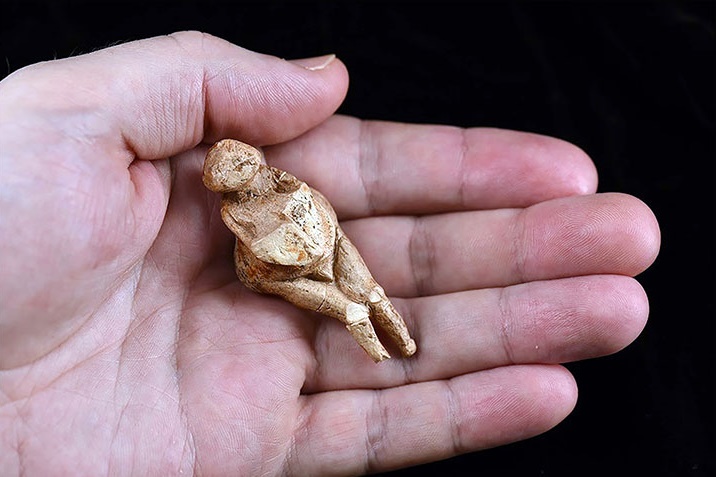
A stunning 23,000-year-old 'Venus' has been discovered in the Bryansk region of Russia, say scientists. The Palaeolithic beauty was carved from woolly mammoth tusk and shows a 'fantastically delicate' prehistoric woman.
'Palaeolithic Venus' discovered in Russia
The 23,000-year-old 'Venus' statue [Credit: Institute of Archaeology and Ethnography]
The rare find was made in the Bryansk region of Russia. Dr Konstantin Gavrilov, who led the expedition that discovered it.

"This statuette pictures a rather portly woman, but it looks fantastically delicate, probably due to the long and thin legs," enthused the scientist, from the Stone Age department of Moscow's Archaeology Institute.

'Palaeolithic Venus' discovered in Russia
The exceptionally rare Venus is made from 'a mammoth tusk [Credit: Institute of Archaeology and Ethnography]
It appeared to depict a "cult of fertility", said Dr Gavrilov, but then indicated this was impossible since it predated the existence of agriculture.

The 'Venus' is made from "mammoth tusk and it portrays a fat, maybe pregnant woman, with a big belly and bust," he said. "Part of the bust and belly has peeled off, along a natural crack in the tusk.
But the rear view remains intact from 23,000 years ago."

'Palaeolithic Venus' discovered in Russia
Front and rear views of the 23,000-year-old 'Venus' statue 
[Credit: Institute of Archaeology and Ethnography]
"The figurine was found near large limestone layers and parts of mammoth bones that were painted with a mineral sienna paint. Most likely, the statuette was put next to the bones on the ground rather than 'buried' like other 'Venuses'' found in Russia."

"Most experts believed such prehistoric statuettes are 'ceremonial' and 'ritual' objects", he said. "Other 'Venuses' have been found in Russia, notably near Lake Baikal in Siberia, but on closer inspection some of these were, in fact, clothed."

'Palaeolithic Venus' discovered in Russia
The site where the figurine was found [Credit: Institute of Archaeology and Ethnography]
The latest find was made among bones of mammoths, bison, and flint stones in a 23,000 year old layer at archaeological site Khotylyovo-2.

Author: Will Stewart | Source: Daily Mail [April 17, 2017]

'Palaeolithic Venus' discovered in Russia

A stunning 23,000-year-old 'Venus' has been discovered in the Bryansk region of Russia, say scientists. The Palaeolithic beauty was ...

Saturday, April 8, 2017


Archaeologists have discovered a dwelling from the time of the Bronze Age in the Lúčna district in Detva. An archaeological company from Banská Bystrica was exploring the land under planned family houses, when the ground plan of a house, five metres wide and 8 and half metres long, was discovered.

Bronze Age farmhouse discovered in central Slovakia
Archaeologist Roman Hrončiak stands by a post hole of the Bronze Age farmhouse 
[Credit: Jozef Poliak, TASR]
Archaeologist Roman Hrončiak supposed to find settlement holes, but the real discovery surprised him. The discovery of the dwelling is significant not only for Detva but for whole region, according to the archaeologist.

Until now, only holes were found in Detva but it was unable to define them as a settlement. This is the first time a settlement where people had been living a thousand years before Christ has been confirmed in the area.

Bronze Age farmhouse discovered in central Slovakia
Reconstruction of the Bronze Age farmhouse discovered in Detva 
[Credit: Jozef Poliak, TASR]
In 2016 Noemi Beljak Pažinová confirmed the existence of a prehistoric settlement in Lúčna during her research when she found a small hearth last year.

In the prehistoric house, the archaeologists and volunteers also uncovered fragments of receptacles for the preparation and serving of food. Some fragments are more luxurious with polished surfaces.

Both archaeologists agree that dwellers of this area probably supplied the fortified settlement of Kalamárka, the oldest known archaeological locality of central Slovakia, 5 kilometres from Detva.

Source: The Slovak Spectator [April 08, 2017]

Bronze Age farmhouse discovered in central Slovakia

Archaeologists have discovered a dwelling from the time of the Bronze Age in the Lúčna district in Detva. An archaeological company from Ban...


© 2015 - Distributed By Free Blogger Templates | Lyrics | Songs.pk | Download Ringtones | HD Wallpapers For Mobile