Header

Modul
Showing posts with label Near East. Show all posts

Wednesday, April 19, 2017


Gunmen attacked security forces near St. Catherine's Monastery in Egypt's south Sinai on Tuesday, killing at least one police officer and injuring four others, the Health Ministry said, just a week after two deadly church bombings killed 45.

ISIS targets St. Catherine's Monastery in Sinai, Egypt
The Monastery of St. Catherine, near Mount Sinai in Egypt, where a policeman was killed and four others 
were wounded on Monday [Credit Pedro Costa Gomes/AFP/Getty Images]
Islamic State claimed responsibility for the attack on a police checkpoint about 800 meters from the entrance to the monastery, one of the world's most important Christian sites.

The attack comes just 10 days before Pope Francis is scheduled to visit Egypt and just over a week after two deadly suicide bombings on Christian churches, also claimed by Islamic State, plunged the country into mourning and marked one of the bloodiest days for the country's Christian minority in decades.

St . Catherine's, founded in the 6th century and located at the foot of Mount Sinai, is one of the oldest Christian monasteries in the world and a UNESCO world heritage site. It is part of the Eastern Orthodox church.

Egypt's Christian minority, which makes up about 10% of the country's 92 million people, has increasingly been targeted by Islamist militants, with three deadly church attacks in the span of four months.

In February, scores of Christian families and students fled North Sinai province after a spate of targeted killings.

A successful assault on St. Catherine's would be the latest challenge to President Abdel Fattah al-Sisi, who has pledged to protect the religious minority as part of his campaign against extremism.

Egypt has for years been battling an Islamist insurgency in the rugged and thinly populated northern Sinai, which gained pace after the military overthrew President Mohamed Mursi of the Muslim Brotherhood in 2013 following mass protests against his rule.

Attacks in Egypt's southern Sinai, a popular destination for tourists dotted with Red Sea resorts, are by contrast rare.

Security sources told Reuters that security had been put on high alert at tourist facilities across southern Sinai after the attack .

The attack in southern Sinai comes as Russia is expected to make a long-awaited decision on whether to restore flights to the Sharm el-Sheikh resort after a Russian airliner was downed in 2015, dealing a serious blow to the area's tourism industry, which relies heavily on Russian visitors.

Egypt's tourism industry, a crucial source of hard currency, has suffered in the years of turmoil that followed the overthrow of President Hosni Mubarak in 2011, as well as from the suspected bombing of the Russian plane, which killed all 224 on board.

Israel took the unusual step earlier this month of barring its citizens from crossing into the Sinai peninsula, saying the threat of attack s in the area inspired by Islamic State and other jihadi groups was high.

Author: Ali Abdelaty | Source: Reuters [April 19, 2017]

ISIS targets St. Catherine's Monastery in Sinai, Egypt

Gunmen attacked security forces near St. Catherine's Monastery in Egypt's south Sinai on Tuesday, killing at least one police office...

Tuesday, April 18, 2017


Archaeologists have discovered a Roman emperor's summer residence in Kibyratis, located in the Turkish mountains, according to Haaretz.

Roman emperor's summer palace discovered in southern Turkey
Lydian tomb in the Kabalis with relief of a lion, Archaic period [Credit: University of Vienna]
The rural estate belonged to the family of Emperor Marcus Aurelius, who ruled from 161-180 AD, according to researchers from the Austrian Archaeological Institute.

The area of Kibyratis has had few archaeological digs, although large rural estates from the Roman period were known to exist there.

Comprehensive surveys only started in 2008, which revealed extensive sites belonging to imperial families.

The remains have been badly damaged but historians have managed to piece together mosaics, clay water pipes and marbled wall decorations.

The Roman Empire had lucrative contracts exporting wine and pottery goods from its Eastern provinces and there is evidence of wine making from the finds of marble press weights used in viticulture.

Roman emperor's summer palace discovered in southern Turkey
Survey on Asar Tepe: At least part of this belonged to the Calpurnii estate. Here the remains 
of pottery production were found [Credit: Oliver Hulden]
A votive altar unearthed is inscribed with a poem about a hunting party, which was one of the most popular pastimes of Roman nobles. The inscription was dedicated by Marcus Calpurnius Longus, of the Calpurnii family.

It describes Longus killing an ibex during a hunting expedition and sacrificing the animal to the gods to gain their protection over his lands and wealth.

Other finds include a relief carved in rock to the mother goddess Cybele, an ancient Phrygian deity, worshipped with orgiastic rites. A second carving shows a shepherd being attacked by a wolf.

Archaeologists believe that the man gave praise to the goddess Cybele for saving him from the attack, and dedicated the stone carving in gratitude.

Another important discovery found in 2011 was a rock-cut tomb in the northern research area. The tomb, decorated with the relief of a lion, can now be dated to the archaic period, hundreds of years before the find of around 180 AD.

For reasons unknown, the Calpurnii family lost the Kibyratis estate and it came into the hands of the royal family towards the end of the 2nd century AD. One of the new owners was Annia Cornifica Faustina, sister of Marcus Aurelius.

Author: Fiona Keating | Source: International Business Times [April 18, 2017]

Roman emperor's summer palace discovered in southern Turkey

Archaeologists have discovered a Roman emperor's summer residence in Kibyratis, located in the Turkish mountains, according to Haaretz ....

Egyptian archaeologists have unearthed several mummies, colourful wooden sarcophagi and more than 1,000 funerary statues in a 3,500-year-old tomb near the city of Luxor, hailing an "important discovery".

Mummies discovered in ancient tomb near Egypt's Luxor
Members of an Egyptian archaeological team work on a wooden coffin discovered in a 3,500-year-old tomb 
in the Draa Abul Nagaa necropolis, near the southern Egyptian city of Luxor [Credit: AFP/Stringer]
The 18th Dynasty tomb containing at least eight mummies was discovered in the Draa Abul Nagaa necropolis near the famed Valley of the Kings, the antiquities ministry said in a Tuesday statement.

It belonged to a nobleman named Userhat who worked as the city judge. It was opened to add more mummies during the 21st Dynasty, about 3,000 years ago, to protect them during a period when tomb-robbing was common, Mostafa Waziri, the head of the archaeological mission, said at the site.

"It was a surprise how much was being displayed inside," Antiquities Minister Khaled el-Enany told reporters outside the tomb.

"We found a large number of Ushabti (small carved figurines), more than 1,000 of them," Enany said.

"This is an important discovery."

Mummies discovered in ancient tomb near Egypt's Luxor
Members of an Egyptian archaeological team stand near artifacts, known as Ushabtis, discovered in a 3,500-year-old tomb 
in the Draa Abul Nagaa necropolis, near the southern city of Luxor [Credit: AFP/Stringer]
Ushabti figurines were often placed with the deceased in ancient Egyptian tombs to help with responsibilities in the afterlife.

Antiquities officials had initially said six mummies along with partial remains were discovered near the southern city, but said they had later identified two more mummies.

"There are 10 coffins and eight mummies. The excavation is ongoing," Waziri said.

Inside the tomb, archaeologists wearing white masks and latex gloves inspected the sarcophagi, which were covered with intricate drawings in red, blue, black, green, and yellow, and featured the carved faces of the dead.

The coffins were mainly well-preserved, though some had deteriorated and broken over the years.

Archaeologists were also examining a mummy wrapped in linen which was inside one of the coffins.

Mummies discovered in ancient tomb near Egypt's Luxor
A member of an Egyptian archaeological team shows artifacts discovered in a 3,500-year-old tomb
 in the Draa Abul Nagaa necropolis, near the southern city of Luxor [Credit: AFP/Stringer]
White, orange, green, and patterned pots were also found in the tombs.

The necropolis is located across the Nile from Luxor, on the west bank, where many of the famous ancient Egyptian pharaohs were buried, including Tutankhamun.

The age of the tomb was determined "through the drawings on the ceiling," said Waziri.

"It is a T-shaped tomb (which) consists of an open court leading into a rectangular hall, a corridor and an inner chamber," the ministry said in a statement.


A nine-metre shaft inside the tomb held the Ushabti figurines, as well as "wooden masks and a handle of a sarcophagus lid," the ministry said.

"The corridor of the tomb leads into an inner chamber where a cachette of sarcophagi is found," the ministry said.

Waziri said the mummies dated back to an age called "the era of the tomb robbers."

"It's evident that someone with a conscience, the priests or a high-profile government official... made an opening to the chambers, and they put the coffins there," he said.

Another room in the tomb was also discovered, though it has not yet been completely excavated, the ministry said.

Mummies discovered in ancient tomb near Egypt's Luxor
Photos courtesy of the Egyptian Ministry of Antiquities 

Archaeologists were able to enter the tomb "after removing almost 450 metres of debris out of the open court," it added.

The tombs and ancient temples of Thebes, the capital of ancient Egypt during its later periods and now the city of Luxor, have been a major tourist attraction.

Tourism here has dropped in the turmoil that followed the 2011 uprising that toppled longtime ruler Hosni Mubarak.

Enany said he hoped these new discoveries would help attract tourists again.

Nevine el-Aref, the spokeswoman for the antiquities ministry, said "there is evidence and traces that new mummies could be discovered in the future" at the site.

Author: Mohamed Abdel Aziz | Source: AFP [April 18, 2017]

Mummies discovered in ancient tomb near Egypt's Luxor

Egyptian archaeologists have unearthed several mummies, colourful wooden sarcophagi and more than 1,000 funerary statues in a 3,500-year-old...

Thursday, April 13, 2017


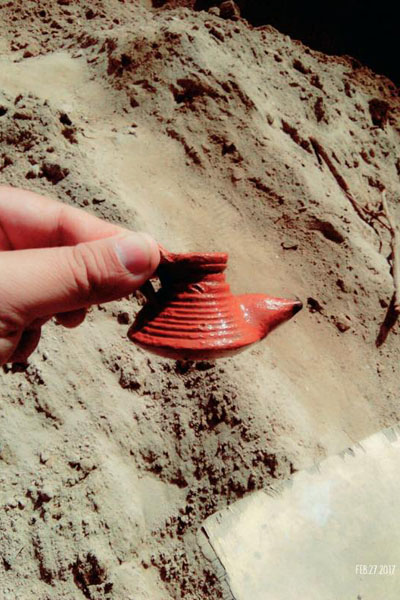
Excavators from Egypt’s Ministry of Antiquities have discovered a collection of Graeco-Roman artefacts during excavation work carried out in Alexandria’s Babour El-Maya area.

Graeco-Roman artefacts discovered at future Alexandria residential site
Clay pot discovered in Alexandria [Credit: Egyptian Ministry of Antiquities]
Mahmoud Afifi, head of the Ancient Egyptian Department at the Ministry of Antiquities, told Ahram Online that the excavation work, undertaken upon the request of an Alexandria resident, was carried out on a piece of land called Villa Agion in preparation for the erection of a residential building.

Graeco-Roman artefacts discovered at future Alexandria residential site
Clay jar discovered in Alexandria [Credit: Egyptian Ministry of Antiquities]
Afifi says that according to Egyptian law, the Ministry of Antiquities must inspect any piece of land slated for development to ensure it holds no archaeological items.

Graeco-Roman artefacts discovered at future Alexandria residential site
Clay pot discovered in Alexandria [Credit: Egyptian Ministry of Antiquities]
If the land is found to have artefacts that can be removed, the land is returned to its owner. However, if the land holds monuments that cannot be moved, the land is seized and declared an archaeological site, with the landowner receiving compensation.

Graeco-Roman artefacts discovered at future Alexandria residential site
Clay oil lamp discovered in Alexandria [Credit: Egyptian Ministry of Antiquities]
Mostafa Roshdi, director-general of Alexandria Antiquities, said that excavators unearthed a collection of clay pots, coins, ovens, bones, and clay lamps dating from the Hellenistic and Byzantine eras.

Graeco-Roman artefacts discovered at future Alexandria residential site
Clay red pot discovered in Alexandria [Credit: Egyptian Ministry of Antiquities]
Graeco-Roman pavement, black granite floors, and plaster-covered limestone walls were also discovered.

Roshdi said excavation work at the site is still ongoing.

Author: Nevine El-Aref | Source: Ahram Online [April 13, 2017]

Graeco-Roman artefacts discovered at future Alexandria residential site

Excavators from Egypt’s Ministry of Antiquities have discovered a collection of Graeco-Roman artefacts during excavation work carried out in...

Friday, April 7, 2017


Like all food crops, the faba, or fava, bean -- a nutritious part of many the diet of many cultures diets -- had a wild ancestor. Wild faba is presumed to be extinct, but Weizmann Institute of Science researchers have now identified 14,000-year-old remains of seeds that offer important clues as to the time and place that this plant grew naturally. Understanding the ecology of the wild plants' environment and the evolution they underwent in the course of domestication is crucial to improving the biodiversity of the modern crop. The findings were reported in Scientific Reports.

In search of the wild fava bean
14,000-year-old faba seeds contain clues to the timing of the plants' domestication 
[Credit: Weizmann Institute of Science]
Dr. Elisabetta Boaretto, head of the "Timing of Cultural Changes" track of the Max Planck-Weizmann Center for Integrative Archaeology and Anthropology, and Dr. Valentina Caracuta, a former postdoctoral fellow in Boaretto's group who is currently a researcher at the University of Salento-Italy, had previously shown that the 10,200-year-old faba beans discovered in three archaeological sites in Lower Galilee were the earliest faba bean ever domesticated.

The new finding -- faba seeds from an archaeological site, el-Wad, on Mount Carmel in Northern Israel -- came from the earliest levels of an excavation that had been carried out by Profs. Mina Evron and Daniel Kaufman, and Dr. Reuven Yeshurun, all of Haifa University. The people living at that time, the Natufians, were hunter-gathers, and thus the plants there were growing wild. Boaretto and Caracuta performed radiocarbon dating and micro X-ray CT analysis on the preserved pieces of bean to pinpoint their age and identify them as the ancestors of the modern fava bean.

"Sometime between 11,000 and 14,000 years ago, people in this region domesticated faba -- around the same time that others farther north were domesticating wheat and barley," says Boaretto. Faba, a nutritious legume, is eaten around the world; in some places it is used for animal feed; and it fixes nitrogen in the soil. "Understanding how this plant was adapted to the habitat of the Carmel 14,000 years ago can help us understand how to create new modern varieties that will better be able to withstand pests and tolerate environmental stress," she says.

This research is supported by by the Max Planck-Weizmann Center for Integrative Archaeology and Anthropology "Timing of Cultural Changes"; and the Exilarch Foundation for the Dangoor Research Accelerator Mass Spectrometer. The faba bean sample was dated at the Dangoor Research Accelerator Mass Spectrometer D-REAMS, Weizmann Institute of Science.

The Weizmann Institute of Science in Rehovot, Israel, is one of the world's top-ranking multidisciplinary research institutions. Noted for its wide-ranging exploration of the natural and exact sciences, the Institute is home to scientists, students, technicians and supporting staff. Institute research efforts include the search for new ways of fighting disease and hunger, examining leading questions in mathematics and computer science, probing the physics of matter and the universe, creating novel materials and developing new strategies for protecting the environment.

Source: Weizmann Institute of Science [April 07, 2017]

In search of the wild fava bean

Like all food crops, the faba, or fava, bean -- a nutritious part of many the diet of many cultures diets -- had a wild ancestor. Wild faba ...

Thursday, April 6, 2017


Preliminary studies on hieroglyphs found in newly discovered pyramid ruins in the Dahshur necropolis have revealed a cartouche of the 13th Dynasty pharaoh Ameny Qemau (also spelled Qemaw), Adel Okasha, director-general of the Dahshur necropolis, told Ahram Online.

More on Remains of ancient pyramid found in Egypt
Only part of the pyramid's inner structure survives today [Credit: Egyptian Ministry of Antiquities]
Okasha said that offering texts are engraved on the ruins, as well as a female name of the pharaoh's family.

Okasha said that excavation work is ongoing to reveal more of the pyramid's secrets.

Earlier this week, an Egyptian mission from the Ministry of Antiquities uncovered remains of the pyramid.

More on Remains of ancient pyramid found in Egypt
This block was found within the 13th dynasty pyramid in Egypt and bears the name of pharaoh Ameny Qemau 
[Credit: Egyptian Ministry of Antiquities]
Okasha says that the structure is composed of a corridor leading to the inside of the pyramid, a hall leading to a southern ramp, and a room at the western end.

An alabaster block measuring 15cm by 17cm has been found in the corridor, engraved with 10 vertical hieroglyphic lines that are still being studied.

A granite lintel and a collection of stone blocks showing the interior design of the pyramid have also been uncovered.

Author: Nevine El-Aref | Source: Ahram Online [April 06, 2017]

More on Remains of ancient pyramid found in Egypt

Preliminary studies on hieroglyphs found in newly discovered pyramid ruins in the Dahshur necropolis have revealed a cartouche of the 13th D...

Construction workers in Turkey's eastern Marmara region have discovered three sarcophagi from the Roman-period, thought to have belonged to a noble family, reports said on Monday.

Construction workers find 3 Roman era tombs in NW Turkey

The sarcophogi were reportedly found at the construction site of the municipal water and sewarage administration building near the coast in Kocaeli's İzmit district, called Nicomedia by the Greeks and served as the eastern capital of the Roman Empire in the Third and Fourth centuries (AD).

After discovering the ancient tombs at the construction site on Sunday, workers immediately notified officials at Kocaeli Culture and Tourism Directorate, who arrived at the site on Monday to examine the tombs.

Police have reportedly cordoned off the area and have taken security measures to prevent any damage to the sarcophogi.

Kocaeli Culture and Tourism Directorate President Adnan Zamburkan was one of the officials who visited the site and noted that two of the sarcophogi are thought belong to children, while the other one belongs to an adult.

"We will bring the sacrophogi to the museum after consultations with the cultural and natural heritage conservation board" Zamburkan said.

Officials from Kocaeli Museum Directorate have also followed the excavation of the tombs, and took pictures, reports said.

Source: Daily Sabah [March 06, 2017]

Construction workers find 3 Roman era tombs in NW Turkey

Construction workers in Turkey's eastern Marmara region have discovered three sarcophagi from the Roman-period, thought to have belonged...

Wednesday, April 5, 2017


Restoration work has been initiated on the 'Gate of Constantinople' (Turkish İstambul Kapisi), the most magnificent part of the city walls in the northwestern city of İznik (Greek Nikaia) located in northeastern Turkey.

'Gate of Constantinople' at Nikaia to be restored
Aerial view of the Gate of Constantinople at Iznik (Nikaia) [Credit: DHA]
Nikaia is one of the important pilgrimage centres for the world of Christianity as the 1st and 7th Ecumenical Councils were held there in 325 and 787 AD. The city was captured from the Byzantines in 1331 by Orhan I and for a short period the town became the capital of the expanding Ottoman emirate.

The restoration project, carried out by the Bursa Metropolitan Municipality, to turn the sunken basilica in the lake into a museum and others works in the ancient theatre, tile furnaces, Abdulvahap Hill, khans and madrasahs have been continuing in the city.

Works have been accelerated for Nikaia, the capital of the Eastern Roman Empire that holds great significance for Christians and Muslims alike, to enter the UNESCO World Heritage List.

The Gate of Constantinople, which is 4,970 metres in length, with 12 secondary gates and 114 towers, which are 10-15 metres away from each other, features the delicacies of war and defense strategies of the era.

'Gate of Constantinople' at Nikaia to be restored
The Gate of Constantinople at Iznik (Nikaia), 2008 [Credit: WikiCommons]
The Gate of Constantinople, which was the central gate of Nikaia, is the most magnificent gate of the city walls as it opens to Constantinople.

The gate has changed after undergoing many sieges, natural disasters and interventions through the centuries, but has survived until now. After the restoration process, the gate will become a unique work showing the traces of both the Greek and Ottoman civilizations.

At a ceremony held to mark the beginning of the restoration, Bursa Mayor Recep Altepe said they accelerated works for the historical heritages in the city, which is a candidate for UNESCO. 

“We are working on all historical artefacts from the Roman Theatre to the Green Mosque. This is a long-time dream to revive the walls in İznik, which is known as a city of walls. We initiated works in the İstambul Kapisi. Following the first stage of works, all gates, walls and towers will have their unique identity,” he added.

İznik Mayor Osman Sargın said the city had Turkey’s longest city walls. “The cleaning of the walls is almost coming to an end. Those who will enter the walls in the south will be able to walk to the north easily in this historic atmosphere,” he added.

Source: Hurriyet Daily News [April 05, 2017]

'Gate of Constantinople' at Nikaia to be restored

Restoration work has been initiated on the 'Gate of Constantinople' (Turkish İstambul Kapisi ), the most magnificent part of the cit...

Monday, April 3, 2017


The remains of an Egyptian pyramid built around 3,700 years ago have been discovered near the well-known bent pyramid of King Snefru, the antiquities ministry announced Monday.

Remains of ancient pyramid found in Egypt
An alabaster block engraved with 10 vertical hieroglyphic lines was also among the finds 
[Credit: Ministry of Antiquities, Egypt]
The pyramid from the 13th dynasty was found in Dahshur's royal necropolis, 30 kilometres (20 miles) south of Cairo, it said.

"An alabaster... block engraved with 10 vertical hieroglyphic lines" was among the finds, the ministry said, citing Adel Okasha, director general at the necropolis.

It said "granite lintel and stoney blocks showing the interior design of the pyramid" were also found.

Remains of ancient pyramid found in Egypt
The interior corridor was uncovered during the initial excavations 
[Credit: Ministry of Antiquities, Egypt]
Excavation is still in its early stages and the size of the pyramid has not yet been established. Blocks of stones and the beginning of a corridor which were discovered are shown in photos provided by the ministry.

"All the discovered parts of the pyramid are in very good condition and further excavation is to take place to reveal more parts," the ministry said.

Egypt, home of one of the world's earliest civilisations, boasts 123 ancient pyramids, Zahi Hawas, former head of the Supreme Council of Antiquities, told AFP.

Remains of ancient pyramid found in Egypt
As excavators continue to clear out the ruins, they will be able to assess just how big the pyramid once was 
[Credit: Ministry of Antiquities, Egypt]
They include the world-famous Pyramids of Giza, constructed around 4,500 years ago.

The Khufu pyramid is the largest of the three in Giza, standing at 146 metres (yards), and the only surviving structure of the seven wonders of the ancient world.

Khufu and Khafre in Giza along with the Bent and Red pyramids in Dahshur are part of Operation ScanPyramids, with teams scanning the structures in search of hidden rooms and cavities.

Source: AFP [April 03, 2017]

Remains of ancient pyramid found in Egypt

The remains of an Egyptian pyramid built around 3,700 years ago have been discovered near the well-known bent pyramid of King Snefru, the an...

Sunday, April 2, 2017


The restoration project of the Edicule in the Church of the Holy Sepulchre in Jerusalem has recently been completed, but scientists warn that the church may still suffer ‘catastrophic’ collapse.

Newly renovated Tomb of Christ at risk of ‘catastrophic’ collapse
The ornate shrine known as the Edicule encloses what is believed to be the tomb of Jesus Christ inside the 
Church of the Holy Sepulchre in Jerusalem. The shrine has just undergone a year-long restoration 
[Credit: Oded Balilty, AP for National Geographic]
According to National Geographic, scientists at the National Technical University of Athens said some portions of the shrine’s foundation actually sit on rubble of earlier buildings, and unexplained tunnels and voids. The foundation mortar of the structure has also crumbled due to long term exposure to moisture. The discovery was made with ground-penetrating radar and robotic cameras.

Newly renovated Tomb of Christ at risk of ‘catastrophic’ collapse
The 19th-century Edicule after restoration [Credit: Oded Balilty, AP for National Geographic]
“When it fails, the failure will not be a slow process, but catastrophic,” Antonia Moropoulou, NTUA’s chief scientific supervisor told the National Geographic.


To address this risk, scientists at the National Technical University of Athens are proposing a 10-month project that would cost $6 million euros which would involve removing the fractured foundation and installing drainage system around the perimeter of the rotunda.

Source: Protothema [April 02, 2017]

Newly renovated Tomb of Christ at risk of ‘catastrophic’ collapse

The restoration project of the Edicule in the Church of the Holy Sepulchre in Jerusalem has recently been completed, but scientists warn tha...

Egyptian Minister of Antiquities Khaled El-Enany and members of parliment inaugurated Alexandria's cistern and imperial bath complex area in the Kom El-Dikka archaeological site.

4th century imperial bath complex inaugurated in Egypt's Alexandria
The bath complex in Kom Al-Dikka [Credit: Ministry of Antiquities, Egypt]
The area had been undergoing excavation and restoration since 1960 by an Egyptian-Polish mission from Warsaw University.

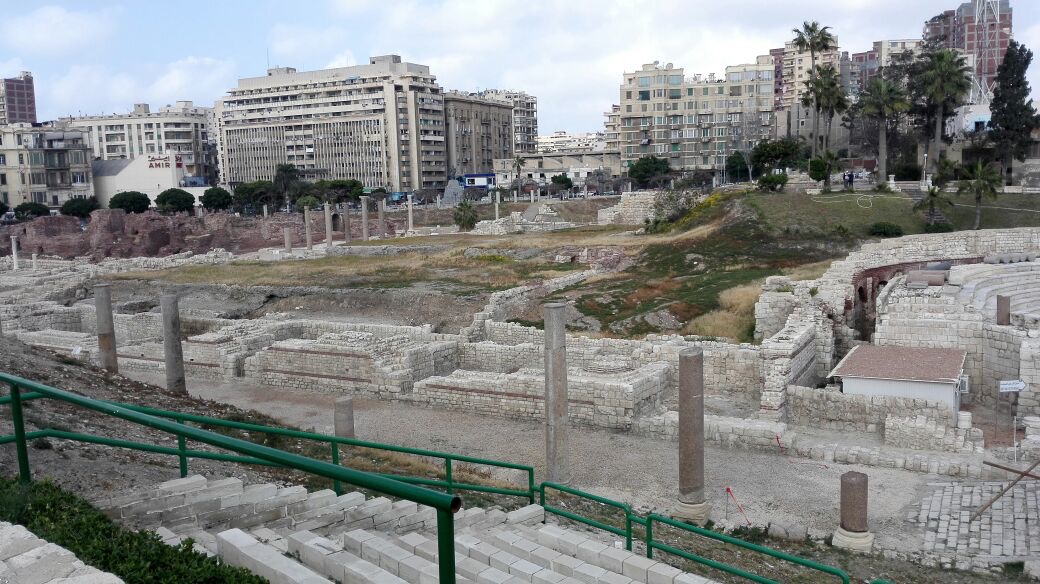
Mahmoud Afifi, head of the ministry's Ancient Egyptian Antiquities Department, said that the newly inaugurated area will be included within the Kom Al-Dikka tourist path, which includes the Roman amphitheater, the bird villa and residential houses from the Hellenistic period until the Islamic era.

El-Enany describes the bathing complex as "one of the finest edifices of its time," and that the bathing halls had welcomed hundreds of bathers at a time.

4th century imperial bath complex inaugurated in Egypt's Alexandria
The bath complex in Kom Al-Dikka [Credit: Ministry of Antiquities, Egypt]
The complex also includes palestrae for physical exercises, colonnade passages and amenities such as public latrines.

Water was supplied to the complex using huge cisterns and heated by a complex system of furnaces and pipes.

The minister and the parlimentary delegates also paid a visit to the planned Mosaic museum in downtown Alexandria to inspect the ongoing work and address any obstacles to its completion.

4th century imperial bath complex inaugurated in Egypt's Alexandria
The bath complex in Kom Al-Dikka [Credit: Ministry of Antiquities, Egypt]
During the tour, Mohamed Abdelmaguid, director-general of the Underwater Archaeological Department, introduced a three-phase plan to develop the Qayet Bey Citadel and its surroundings.

Abdelmaguid also reviewed a plan for the construction of the first underwater museum beneath the city's eastern harbour, which once was the ancient Alexandria royal area.

Abdelmaguid suggests the building of an underwater park to promote diving as well as the establishment of a training centre for underwater archaeology.

Author: Nevine El-Aref | Source: Ahram Online [April 02, 2017]

4th century imperial bath complex inaugurated in Egypt's Alexandria

Egyptian Minister of Antiquities Khaled El-Enany and members of parliment inaugurated Alexandria's cistern and imperial bath complex are...

Christian knights and Mameluke warriors were fighting on the walls. Now the wreck of a 13th century ship reveals the desperate bid to save the Holy Land.

Crusader wreck tells tale of Crusader Holy Land conquest
A Crusader-era book illumination showing a Christian ship at sea. A wreck near the port of Acre dates from
 the fall of that city — and the last hours of the Crusader state [Credit: WikiCommons]
The port of the city of Acre was a vital lifeline for Crusader knights and settlers alike. Through it streamed European pilgrims, horses, fighting men and manufacturing goods, all vital to sustain Christianity’s tenuous hold in what would later become Palestine, Lebanon, Syria and Israel.

In return, ships carried precious cargoes of sugar, spice and exotic textiles. But, in 1291, it all came crashing down.

The Egyptian Mameluke Sultan Al-Ashraf Khalil — leading an army of 100,000 men and horses — rolled back the Christian defences, weakened by almost two centuries of fighting to maintain control over the Holy Land.

European interest was failing — despite efforts by Pope Gregory X to summon reinforcements. And the militant orders — international organisations of warrior-monks — established to defend the Holy Land had become engrossed by their own wealth and the games of thrones back home.

Crusader wreck tells tale of Crusader Holy Land conquest
Gold Crusader florins found in Acre harbour by diving archaeologists 
[Credit: IAA]
What support did arrive for those few on the front line was invariably too little, too late.Eventually, the European knights fell back to their final fortress — the city of Acre. Here, besieged, they were totally reliant on support from the sea.

According to the news service Haaretz, a Crusader-era shipwreck recently found in the bay of Acre has been dated to the time of the desperate last stand by a handful of knights and mercenaries on the walls of the city.

Acre is now part of northern Israel.

The wreck had been severely damaged by dredging. But parts of the timber hull, including its keel, survived. Excavation work began last year. The wood has been carbon-dated between 1062-1250, which neatly brackets the Crusader era.

Crusader wreck tells tale of Crusader Holy Land conquest
Glazed crusader bowl with the mark of St.Peter's key, found in crusader Acre 
[Credit: Michal Artzy]
But archaeologists led by Doctor Ehud Galili and Professor Michal Artzy of Haifa University have uncovered traces of its cargo — and a stash of 30 gold florins. These narrow its date down to that of the final siege of the nearby city.

Fragments of ceramics, including jugs and bowls, reveal the ship was carrying imports from Cyprus and Italy. There are also rusted remains of a few metallic objects, including anchors.

It is possible the wreck may have belonged to King Henry II of Cyprus who had reportedly sent a force of 40 ships filled with reinforcements. Just one month later, King Henry’s forces would retreat by sea as the city fell.

Historic records of the disaster tell the tale of fleeing nobles attempting to bribe boat and ship owners for safe passage out of the Middle East. But few managed to make their way on-board.

Crusader wreck tells tale of Crusader Holy Land conquest
A glazed crusader bowl with bird decoration, found in the marine excavation at Acre. Imported from Paphos, Cyprus 
[Credit: Michal Artzy]
A handful of Templar, Teutonic and Hospitaller warrior-monks fought stoically to buy time for the civilian population, but were eventually forced back to their strongholds after the city’s walls collapsed.

But, by May 18, the Grand Masters of the Hospitallers and Teutonic Knights had fled. The Grand Master of the Templars had been killed. Only a few equipped and trained knights remained alive.

Defeat, they knew, was inevitable. The last stand was fought in a Templar tower at the very edge of the sea. Accounts tell of the city’s inhabitants throwing themselves into the harbour in a desperate bid to reach the departing ships.

The Templar knights were only overcome when Mameluke engineers undermined their fortress’ walls. Among the rubble were 100 of the Sultan’s best men who had been inside, fighting the Crusaders hand-to-hand.

Crusader wreck tells tale of Crusader Holy Land conquest
A painting showing the desperate stand by The Hospitalier Maréchal Matthieu de 
Clermont while defending the walls at the Siege of Acre, 1291. Painting by 
Dominique Papety (1815–49) [Credit: WikiCommons]
Western Christianity would never again establish a firm foothold in the Middle East. After repeated attempts to mobilise yet another crusade, the Templars were accused of witchcraft and homosexuality in an effort by French King Philip IV to seize their wealth. The order was eventually disbanded, and its key officers burnt at the stake.

The Hospitallers retreated to Rhodes, where they established a navy in anticipation of a fresh crusade. The Teutonic Knights shifted the focus of their holy war to the Baltics.

The entire city of Acre was levelled, and left abandoned until rebuilt nearly three hundred years later.

Author: Jamie Seidel | Source: News Corp Australia Network [April 02, 2017]

Crusader wreck tells tale of Crusader Holy Land conquest

Christian knights and Mameluke warriors were fighting on the walls. Now the wreck of a 13th century ship reveals the desperate bid to save t...


© 2015 - Distributed By Free Blogger Templates | Lyrics | Songs.pk | Download Ringtones | HD Wallpapers For Mobile